

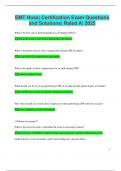
EMT Hosa| Certification Exam Questions
and Solutions| Rated A| 2025
What is the first step in performing Basic Life Support (BLS)?
Ensure the scene is safe before approaching the patient.
What is the proper rate for chest compressions during CPR for adults?
At least 100-120 compressions per minute.
What is the depth of chest compressions for an adult during CPR?
At least 2 inches (5 cm).
What should you do if you are performing CPR on an adult and the patient begins to breathe?
Stop CPR and monitor the patient’s breathing and pulse.
How often should you switch chest compressors when performing CPR with two rescuers?
Every 2 minutes or sooner if fatigued.
**Patient Assessment**
What is the acronym used to remember the steps in assessing a patient?
The acronym "SAMPLE" stands for Signs and symptoms, Allergies, Medications, Past
medical history, Last oral intake, and Events leading up to present illness.
1
,What is the primary focus of a primary assessment?
To identify life-threatening conditions and initiate immediate treatment.
What is the purpose of the secondary assessment?
To perform a more detailed assessment after stabilizing life-threatening conditions.
What are the steps in the primary assessment?
Scene safety, BSI (body substance isolation), general impression, level of consciousness
(AVPU), airway, breathing, circulation, disability, and exposure.
What is the AVPU scale used for?
To assess the patient's level of responsiveness: Alert, Verbal, Pain, Unresponsive.
**Medical and Trauma Management**
What should you do first when you arrive at the scene of a traumatic injury?
Ensure scene safety and begin the primary assessment.
When should you use a cervical collar in trauma patients?
When there is a suspected spinal injury or mechanism of injury.
What are the signs of a tension pneumothorax?
Severe respiratory distress, absent lung sounds on one side, and tracheal deviation.
2
, What is the difference between a closed and an open fracture?
A closed fracture does not break through the skin, while an open fracture involves a break in
the skin.
What is the treatment for a flail chest?
Provide oxygen, support the chest, and monitor for signs of shock.
**Knowledge of Anatomy and Physiology**
What part of the brain is responsible for regulating heart rate and respiratory rate?
The medulla oblongata.
What is the function of the diaphragm in the respiratory system?
The diaphragm contracts to create negative pressure, allowing air to enter the lungs.
What are the two main types of circulation in the body?
Systemic circulation (throughout the body) and pulmonary circulation (through the lungs).
What are the components of the circulatory system?
The heart, blood vessels (arteries, veins, capillaries), and blood.
What is the function of red blood cells in the body?
3
and Solutions| Rated A| 2025
What is the first step in performing Basic Life Support (BLS)?
Ensure the scene is safe before approaching the patient.
What is the proper rate for chest compressions during CPR for adults?
At least 100-120 compressions per minute.
What is the depth of chest compressions for an adult during CPR?
At least 2 inches (5 cm).
What should you do if you are performing CPR on an adult and the patient begins to breathe?
Stop CPR and monitor the patient’s breathing and pulse.
How often should you switch chest compressors when performing CPR with two rescuers?
Every 2 minutes or sooner if fatigued.
**Patient Assessment**
What is the acronym used to remember the steps in assessing a patient?
The acronym "SAMPLE" stands for Signs and symptoms, Allergies, Medications, Past
medical history, Last oral intake, and Events leading up to present illness.
1
,What is the primary focus of a primary assessment?
To identify life-threatening conditions and initiate immediate treatment.
What is the purpose of the secondary assessment?
To perform a more detailed assessment after stabilizing life-threatening conditions.
What are the steps in the primary assessment?
Scene safety, BSI (body substance isolation), general impression, level of consciousness
(AVPU), airway, breathing, circulation, disability, and exposure.
What is the AVPU scale used for?
To assess the patient's level of responsiveness: Alert, Verbal, Pain, Unresponsive.
**Medical and Trauma Management**
What should you do first when you arrive at the scene of a traumatic injury?
Ensure scene safety and begin the primary assessment.
When should you use a cervical collar in trauma patients?
When there is a suspected spinal injury or mechanism of injury.
What are the signs of a tension pneumothorax?
Severe respiratory distress, absent lung sounds on one side, and tracheal deviation.
2
, What is the difference between a closed and an open fracture?
A closed fracture does not break through the skin, while an open fracture involves a break in
the skin.
What is the treatment for a flail chest?
Provide oxygen, support the chest, and monitor for signs of shock.
**Knowledge of Anatomy and Physiology**
What part of the brain is responsible for regulating heart rate and respiratory rate?
The medulla oblongata.
What is the function of the diaphragm in the respiratory system?
The diaphragm contracts to create negative pressure, allowing air to enter the lungs.
What are the two main types of circulation in the body?
Systemic circulation (throughout the body) and pulmonary circulation (through the lungs).
What are the components of the circulatory system?
The heart, blood vessels (arteries, veins, capillaries), and blood.
What is the function of red blood cells in the body?
3


