
Concepts of DATABASE MANAGEMENT
1. Define 1st, 2nd, 3rd, and 4th normal forms:
1st normal form: Data is in a table with unique rows, and all columns contain atomic
values.
2nd normal form: Meets 1st normal form and removes partial dependencies
(dependencies on part of a composite key).
3rd normal form: Meets 2nd normal form and removes transitive dependencies (non-
key attributes depend only on the primary key).
4th normal form: Meets 3rd normal form and ensures no multi-valued dependencies
exist.
2. Atomic value –
An indivisible value, such as a single number, word, or date, used in a database field.
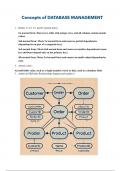
3. Attach an ER(Entity Relationship) diagram and explain it.
, Represents entities, attributes, and their relationships in a database.
5.what is github - A web-based platform for version control and collaboration using Git,
allowing developers to manage and share their code.
Git – A distributed version control system for tracking changes in source code during
software development.
Github – A platform that hosts Git repositories and provides tools for collaboration, such as
issue tracking and pull requests.
6. If you use AND criteria, each criterion must be true for a record to be selected.
7. In an entity relationship model, what does the diamond represent?
Represents relationships between entities.
8. What do Data Scientists typically look for as they analyze data?
They analyze patterns, correlations, trends, and anomalies in data to derive actionable
insights.
9. What career opportunities do databases offer?
Offer career opportunities like database administrator, data analyst, and database
architect, focusing on data management, analysis, and infrastructure design.
10. what is a left join?
Retrieves all records from the left table and matching records from the right table;
unmatched records in the right table are null.
11. what is a right join?
Retrieves all records from the right table and matching records from the left table;
unmatched records in the left table are null.
12.what is an inner join?
Retrieves only the records that have matching values in both tables.
13.what is an outer join?
Combines all records from both tables, showing nulls for non-matching rows.
14. what is oracle?
A database management system that provides robust features for data storage, retrieval,
and management.
15. Using the bureau of labor statistics website.
Cover the competencies required of a database administrator. How much do they get payed?
What languages do they know? Use The bureau of labor statistics.
1. Define 1st, 2nd, 3rd, and 4th normal forms:
1st normal form: Data is in a table with unique rows, and all columns contain atomic
values.
2nd normal form: Meets 1st normal form and removes partial dependencies
(dependencies on part of a composite key).
3rd normal form: Meets 2nd normal form and removes transitive dependencies (non-
key attributes depend only on the primary key).
4th normal form: Meets 3rd normal form and ensures no multi-valued dependencies
exist.
2. Atomic value –
An indivisible value, such as a single number, word, or date, used in a database field.
3. Attach an ER(Entity Relationship) diagram and explain it.
, Represents entities, attributes, and their relationships in a database.
5.what is github - A web-based platform for version control and collaboration using Git,
allowing developers to manage and share their code.
Git – A distributed version control system for tracking changes in source code during
software development.
Github – A platform that hosts Git repositories and provides tools for collaboration, such as
issue tracking and pull requests.
6. If you use AND criteria, each criterion must be true for a record to be selected.
7. In an entity relationship model, what does the diamond represent?
Represents relationships between entities.
8. What do Data Scientists typically look for as they analyze data?
They analyze patterns, correlations, trends, and anomalies in data to derive actionable
insights.
9. What career opportunities do databases offer?
Offer career opportunities like database administrator, data analyst, and database
architect, focusing on data management, analysis, and infrastructure design.
10. what is a left join?
Retrieves all records from the left table and matching records from the right table;
unmatched records in the right table are null.
11. what is a right join?
Retrieves all records from the right table and matching records from the left table;
unmatched records in the left table are null.
12.what is an inner join?
Retrieves only the records that have matching values in both tables.
13.what is an outer join?
Combines all records from both tables, showing nulls for non-matching rows.
14. what is oracle?
A database management system that provides robust features for data storage, retrieval,
and management.
15. Using the bureau of labor statistics website.
Cover the competencies required of a database administrator. How much do they get payed?
What languages do they know? Use The bureau of labor statistics.


