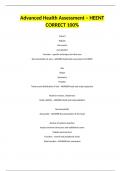
Advanced Health Assessment – HEENT
CORRECT 100%
Inspect
Palpate
Percussion
Auscultation
Function - specific techniques for that area
Documentation of area - ANSWER Systematic assessment of HEENT
Size
Shape
Symmetry
Position
Texture and distribution of hair - ANSWER Head and scalp inspection
Head for masses, tenderness
Scalp mobility - ANSWER Head and scalp palpation
Normocephalic
Atraumatic - ANSWER Documentation of the head
Review of systems question
Inspect external structures and ophthalmic exam
Palpate lacrimal duct
Function - central and peripheral vision
Pupil reaction - ANSWER Eyes assssment
, Vision loss
Diplopia due to CN, cerebellum, extraocular muscles
Eye tearing: due to irritants, allergies
Eye drainage: infection or allergies
Eye appearance changes:trauma, infection
Eye pain: trauma, retinal detachment
Blurred vision: near/far
Dry eyes
Ptosis - ANSWER History of present health concern
Diplopia - ANSWER Double vision
Drooping of the eye
Can be due to swelling
Can have this due to a neurological condition, stoke etc. - ANSWER Ptosis
Lids and lashes - color lesions, edema, symmetry, position and distribution of lashes
Lacrimal glands and ducts - color, edema, excessive, testing or drainage
Conjunctiva - color, moisture, lesions, and foreign bodies
Sclera (should be white) - color, moisture, lesions, or tears
Cornea - clarity and abrasions, corneal reflex
Anterior chamber - clarity, bulging iris, and blood
, Iris - color, size, shape, symmetry
Pupils - size, shape, reaction to light - direct and consensual, test accommodation
Lacrimal glands and ducts - tenderness and excessive tearing - ANSWER Inspection of external structures
Injections - ANSWER Bloodshot eyes are called
Pupils will dilate as you move finger closer to eye (at the nose)
*cross eyed - ANSWER Accommodation testing
Pupillary response - ANSWER Physiological response that varies the size of the pupil, via the optic and
oculomotor cranial nerve
Pinpoint pupils - ANSWER Miosis is AKA
Miosis - ANSWER Characterized by constricted and fixed pupils, possibly a result of narcotic drugs or
brain damage
Anisocoria - ANSWER Pupils of unequal size
If greater in bright light - the cause may be trauma, tonic pupil (caused by impaired parasympathetic
nerve supply to iris) and oculomotor nerve paralysis
Greater in dim light - cause may be Horner' syndrome (caused by paralysis of the cervical sympathetic
nerves and characterized by ptosis, sunken eyeball, flushing of the affected side of the face, and
narrowing of the palpebral fissure) - ANSWER Anisocoria circumstances
Mydriasis - ANSWER Dilated and fixed pupils, typically resulting from central nervous system injury,
circulatory collapse, or deep anesthesia
CORRECT 100%
Inspect
Palpate
Percussion
Auscultation
Function - specific techniques for that area
Documentation of area - ANSWER Systematic assessment of HEENT
Size
Shape
Symmetry
Position
Texture and distribution of hair - ANSWER Head and scalp inspection
Head for masses, tenderness
Scalp mobility - ANSWER Head and scalp palpation
Normocephalic
Atraumatic - ANSWER Documentation of the head
Review of systems question
Inspect external structures and ophthalmic exam
Palpate lacrimal duct
Function - central and peripheral vision
Pupil reaction - ANSWER Eyes assssment
, Vision loss
Diplopia due to CN, cerebellum, extraocular muscles
Eye tearing: due to irritants, allergies
Eye drainage: infection or allergies
Eye appearance changes:trauma, infection
Eye pain: trauma, retinal detachment
Blurred vision: near/far
Dry eyes
Ptosis - ANSWER History of present health concern
Diplopia - ANSWER Double vision
Drooping of the eye
Can be due to swelling
Can have this due to a neurological condition, stoke etc. - ANSWER Ptosis
Lids and lashes - color lesions, edema, symmetry, position and distribution of lashes
Lacrimal glands and ducts - color, edema, excessive, testing or drainage
Conjunctiva - color, moisture, lesions, and foreign bodies
Sclera (should be white) - color, moisture, lesions, or tears
Cornea - clarity and abrasions, corneal reflex
Anterior chamber - clarity, bulging iris, and blood
, Iris - color, size, shape, symmetry
Pupils - size, shape, reaction to light - direct and consensual, test accommodation
Lacrimal glands and ducts - tenderness and excessive tearing - ANSWER Inspection of external structures
Injections - ANSWER Bloodshot eyes are called
Pupils will dilate as you move finger closer to eye (at the nose)
*cross eyed - ANSWER Accommodation testing
Pupillary response - ANSWER Physiological response that varies the size of the pupil, via the optic and
oculomotor cranial nerve
Pinpoint pupils - ANSWER Miosis is AKA
Miosis - ANSWER Characterized by constricted and fixed pupils, possibly a result of narcotic drugs or
brain damage
Anisocoria - ANSWER Pupils of unequal size
If greater in bright light - the cause may be trauma, tonic pupil (caused by impaired parasympathetic
nerve supply to iris) and oculomotor nerve paralysis
Greater in dim light - cause may be Horner' syndrome (caused by paralysis of the cervical sympathetic
nerves and characterized by ptosis, sunken eyeball, flushing of the affected side of the face, and
narrowing of the palpebral fissure) - ANSWER Anisocoria circumstances
Mydriasis - ANSWER Dilated and fixed pupils, typically resulting from central nervous system injury,
circulatory collapse, or deep anesthesia