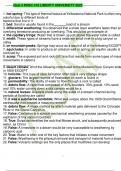
Quiz 5 PHSC 210 LIBERTY UNIVERSITY 2022
1. hot spring: This type of thermal feature at Yellowstone National Park is often very
colorful due to different kinds of
bacteria that live in it
2. bed: Sand is usually found in the load of a stream
3. differential weathering: It is observed that a shale layer weathers faster than an
overlying limestone producing an overhang. This would be an example of
4. the capillary fringe: Water that is drawn up just above the water table is called
5. misfit: These types of streams have a relatively small river in a big canyon or
valley
6. on mountain peaks: Springs may occur as a result of all of the following EXCEPT
7. aquicludes: In order to produce an artesian well or spring, an aquifer usually is
confined by
8. scarp: The exposed soil and rock cliff face that results from some types of mass
movements is called a
9. desert climate: All of the following contributed to the Madison River Canyon slide
in 1959 EXCEPT
10. helictite: This type of cave formation often has a very strange shape
11. glaciers: The largest reserve of freshwater on earth is found in
12. permeability: The ability of water to flow through a rock is called
13. debris flow: A rapid flow composed of 40% boulders, 30% gravel, 10% sand
and 10% water coming down a slot canyon would be a
14. natural levees: Deposits made along the sides of a stream channel during
periods of flooding are called
15. it was a submarine landslide: What was unique about the 1929 Grand Banks
earthquake that created a mass movement?
16. debris flow: A major method by which material gets delivered to the Colorado
River in the Grand Canyon is
17. False: Cavitation is a special mechanical weathering process caused by the
explosion of tiny vacuum bubbles
18. True: Scripture identifies the rock that Moses struck, and subsequently produced
water, as Christ
19. False: A limestone in a desert would be very susceptible to weathering by
carbonic acid
20. True: Water is often one of the key factors that initiates a mass movement
21. False: Weathering is the physical removal and transport of material from a slope
22. False: Volcanic settings are the only places that mudflows can develop
1/3
1. hot spring: This type of thermal feature at Yellowstone National Park is often very
colorful due to different kinds of
bacteria that live in it
2. bed: Sand is usually found in the load of a stream
3. differential weathering: It is observed that a shale layer weathers faster than an
overlying limestone producing an overhang. This would be an example of
4. the capillary fringe: Water that is drawn up just above the water table is called
5. misfit: These types of streams have a relatively small river in a big canyon or
valley
6. on mountain peaks: Springs may occur as a result of all of the following EXCEPT
7. aquicludes: In order to produce an artesian well or spring, an aquifer usually is
confined by
8. scarp: The exposed soil and rock cliff face that results from some types of mass
movements is called a
9. desert climate: All of the following contributed to the Madison River Canyon slide
in 1959 EXCEPT
10. helictite: This type of cave formation often has a very strange shape
11. glaciers: The largest reserve of freshwater on earth is found in
12. permeability: The ability of water to flow through a rock is called
13. debris flow: A rapid flow composed of 40% boulders, 30% gravel, 10% sand
and 10% water coming down a slot canyon would be a
14. natural levees: Deposits made along the sides of a stream channel during
periods of flooding are called
15. it was a submarine landslide: What was unique about the 1929 Grand Banks
earthquake that created a mass movement?
16. debris flow: A major method by which material gets delivered to the Colorado
River in the Grand Canyon is
17. False: Cavitation is a special mechanical weathering process caused by the
explosion of tiny vacuum bubbles
18. True: Scripture identifies the rock that Moses struck, and subsequently produced
water, as Christ
19. False: A limestone in a desert would be very susceptible to weathering by
carbonic acid
20. True: Water is often one of the key factors that initiates a mass movement
21. False: Weathering is the physical removal and transport of material from a slope
22. False: Volcanic settings are the only places that mudflows can develop
1/3