
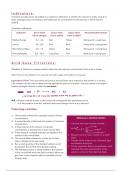
Indicators:
Indicators are dyes which are added to a solution to determine e whether the solution is acidic, neutral or
basic. (changes colour according to the hydronium ion concentration in the solution in which they are
added)
Common indicators:
Indicators pH in which Colour when Colour when Recommended titration
colour changes acid is added base is added
Methyl Orange 3,1 - 4,4 Red Yellow Strong acid + weak base
Litmus 5,0 - 8,0 Red Blue Strong acid + strong base
Bromothymol Blue 6,0 - 7,6 Yellow Blue Strong acid + strong base
Phenolphthalein 8,3 - 10,0 Colourless Pink Weak acid + strong base
Acid-base Titrations:
Titration: A titration is a process used to determine the unknown concentration of an acid or a base
Why? The aim of a titration is to react an acid with a base until neither is in excess.
Equivalence Point: The point where amounts of acid and base have reacted so that neither is in excess.
( An indicator can be used to determine the equivalence point of a titration - the point where one stops a
titration [changes colours] is called the end point )
NaOH + HC1 > Nall +
12
example
:
mol of base and I mol of acd react completely so that only the product is left )
11
.
N.B. indicator must be chosen so that end point corresponds with equivalence point
‣ i.e if salt produce is neutral, indicator used must change colour at a pr around 7
Preforming a titration:
1. One burette is filled with a standard solution (known
concentration). Making up a standard solution
2. A second burette is filled with the solution of unknown
concentration. 1. Calculate the mass of solute needed:
3. A fixed volume of the solution of unknown am'3
> 9
-
mv
mol .
concentration is emptied into a clean conical flask. -
C =
- am3
4. A few drops of a suitable indicator are added to the
1
>9
- . mol
solution in the conical flask. 2. Measure out the mass of solute on a watch
5. The conical flask is placed on a white tile to allow glass
colour changes to be seen easily 3. Transfer all the solute to the volumetric flask
6. Run a small quantity of the standard solution out of and dissolve the solute.
the burette. Record the initial burette reading. 4. Fill the volumetric flask to its graduation mark.
7. The standard solution is slowly added to the solution Calculate the exact concentration of the
in the conical flask while the flask is swirled. When you solution, correct to three decimal digits.
get close to the endpoint add the standard solution
drop by drop.
Indicators are dyes which are added to a solution to determine e whether the solution is acidic, neutral or
basic. (changes colour according to the hydronium ion concentration in the solution in which they are
added)
Common indicators:
Indicators pH in which Colour when Colour when Recommended titration
colour changes acid is added base is added
Methyl Orange 3,1 - 4,4 Red Yellow Strong acid + weak base
Litmus 5,0 - 8,0 Red Blue Strong acid + strong base
Bromothymol Blue 6,0 - 7,6 Yellow Blue Strong acid + strong base
Phenolphthalein 8,3 - 10,0 Colourless Pink Weak acid + strong base
Acid-base Titrations:
Titration: A titration is a process used to determine the unknown concentration of an acid or a base
Why? The aim of a titration is to react an acid with a base until neither is in excess.
Equivalence Point: The point where amounts of acid and base have reacted so that neither is in excess.
( An indicator can be used to determine the equivalence point of a titration - the point where one stops a
titration [changes colours] is called the end point )
NaOH + HC1 > Nall +
12
example
:
mol of base and I mol of acd react completely so that only the product is left )
11
.
N.B. indicator must be chosen so that end point corresponds with equivalence point
‣ i.e if salt produce is neutral, indicator used must change colour at a pr around 7
Preforming a titration:
1. One burette is filled with a standard solution (known
concentration). Making up a standard solution
2. A second burette is filled with the solution of unknown
concentration. 1. Calculate the mass of solute needed:
3. A fixed volume of the solution of unknown am'3
> 9
-
mv
mol .
concentration is emptied into a clean conical flask. -
C =
- am3
4. A few drops of a suitable indicator are added to the
1
>9
- . mol
solution in the conical flask. 2. Measure out the mass of solute on a watch
5. The conical flask is placed on a white tile to allow glass
colour changes to be seen easily 3. Transfer all the solute to the volumetric flask
6. Run a small quantity of the standard solution out of and dissolve the solute.
the burette. Record the initial burette reading. 4. Fill the volumetric flask to its graduation mark.
7. The standard solution is slowly added to the solution Calculate the exact concentration of the
in the conical flask while the flask is swirled. When you solution, correct to three decimal digits.
get close to the endpoint add the standard solution
drop by drop.


