

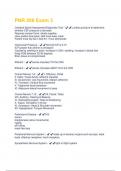
PNR 206 Exam 3
Cerebral Spinal Assessment/Diagnostic Test - ✔️✔️Lumbar puncture to determine
whether CSF pressure is elevated
Requires consent form, sterile supplies
Have patient bow back, staff must wear mask
Patient must lay flat in bed for 1 hour afterwards
Intracranial Pressure - ✔️✔️Normal ICP is 0-15
ICP greater than 20mm is emergent
Caused by swelling in brain, increase in CSH, swelling, increase in blood flow
Keep HOB between 20-30 degrees
Brain tissue is compromised
Afferent - ✔️✔️carries impulses TO the CNS
Efferent - ✔️✔️carries impulses AWAY from the CNS
Cranial Nerves 1-6 - ✔️✔️I. Olfactory- Smell
II. Optic- Visual Acuity (afferent impulse)
III. Oculomotor- eye movement, dilation (efferent)
IV. Trochlear- Vertical Eye movement
V. Trigeminal-facial sensation
VI. Abducens-lateral movement of eyes
Cranial Nerves 7-12 - ✔️✔️VII. Facial- Taste
VIII. Auditory- Hearing & Balance
IX. Glossopharyngeal- Taste & Swallowing
X. Vagus- Sensation in throat
XI. Accessory- Head & Shoulder movement
XII. Hypoglossal- Tongue Movement
Parkinsons Disease - ✔️✔️S/S:
tremor
bradykinesia (slow movements)
rigidity
pill rolling
mask like face
Peripheral Nervous System - ✔️✔️made up of sensory organs such as eyes, taste
buds, olfactory receptors, touch receptors
Sympathetic Nervous System - ✔️✔️fight or flight system
, increase heartrate
increase blood pressure
increase sweating
pupils dilate
parasympathetic nervous system - ✔️✔️Pupils constrict
Relaxed state
everything remains normal or relaxed
function of hypothalamus - ✔️✔️controls body temp, appetite, water balance, links
nervous & endocrine systems
Vital Signs for patient with ICP - ✔️✔️Increased BP
Increase heartrate
elevated temp
How long can brain be without Oxygen? - ✔️✔️4-6 mins
Genetic/Development Disorders - ✔️✔️Cerebral Palsy, Huntington Disease, Muscular
Dystrophy
Glascow Coma Scale - ✔️✔️15 =Optimal
3 =Comatose
if patient opens eyes, responds to pain =5
Older Persons with ICP - ✔️✔️Personality Changes
Decrease LOC
Irritability
Snellen Chart - ✔️✔️Used to test visual acuity
tests cranial nerve ii- optic
Concussion - ✔️✔️teach patient to contact doctor is not feeling normal after 1 week
Basal Skull Fracture Signs - ✔️✔️fluid leaking from ears & nose
Racoon Eyes
Battle Sign
Craniotomy Post-Op care - ✔️✔️Keep HOB at 30 degrees
Don't move lower HOB or put patient flat (supine)
Cheyne-Stokes respiration - ✔️✔️cycles of alternating apnea and hyperventilation
associated with critical conditions
Cerebral Spinal Assessment/Diagnostic Test - ✔️✔️Lumbar puncture to determine
whether CSF pressure is elevated
Requires consent form, sterile supplies
Have patient bow back, staff must wear mask
Patient must lay flat in bed for 1 hour afterwards
Intracranial Pressure - ✔️✔️Normal ICP is 0-15
ICP greater than 20mm is emergent
Caused by swelling in brain, increase in CSH, swelling, increase in blood flow
Keep HOB between 20-30 degrees
Brain tissue is compromised
Afferent - ✔️✔️carries impulses TO the CNS
Efferent - ✔️✔️carries impulses AWAY from the CNS
Cranial Nerves 1-6 - ✔️✔️I. Olfactory- Smell
II. Optic- Visual Acuity (afferent impulse)
III. Oculomotor- eye movement, dilation (efferent)
IV. Trochlear- Vertical Eye movement
V. Trigeminal-facial sensation
VI. Abducens-lateral movement of eyes
Cranial Nerves 7-12 - ✔️✔️VII. Facial- Taste
VIII. Auditory- Hearing & Balance
IX. Glossopharyngeal- Taste & Swallowing
X. Vagus- Sensation in throat
XI. Accessory- Head & Shoulder movement
XII. Hypoglossal- Tongue Movement
Parkinsons Disease - ✔️✔️S/S:
tremor
bradykinesia (slow movements)
rigidity
pill rolling
mask like face
Peripheral Nervous System - ✔️✔️made up of sensory organs such as eyes, taste
buds, olfactory receptors, touch receptors
Sympathetic Nervous System - ✔️✔️fight or flight system
, increase heartrate
increase blood pressure
increase sweating
pupils dilate
parasympathetic nervous system - ✔️✔️Pupils constrict
Relaxed state
everything remains normal or relaxed
function of hypothalamus - ✔️✔️controls body temp, appetite, water balance, links
nervous & endocrine systems
Vital Signs for patient with ICP - ✔️✔️Increased BP
Increase heartrate
elevated temp
How long can brain be without Oxygen? - ✔️✔️4-6 mins
Genetic/Development Disorders - ✔️✔️Cerebral Palsy, Huntington Disease, Muscular
Dystrophy
Glascow Coma Scale - ✔️✔️15 =Optimal
3 =Comatose
if patient opens eyes, responds to pain =5
Older Persons with ICP - ✔️✔️Personality Changes
Decrease LOC
Irritability
Snellen Chart - ✔️✔️Used to test visual acuity
tests cranial nerve ii- optic
Concussion - ✔️✔️teach patient to contact doctor is not feeling normal after 1 week
Basal Skull Fracture Signs - ✔️✔️fluid leaking from ears & nose
Racoon Eyes
Battle Sign
Craniotomy Post-Op care - ✔️✔️Keep HOB at 30 degrees
Don't move lower HOB or put patient flat (supine)
Cheyne-Stokes respiration - ✔️✔️cycles of alternating apnea and hyperventilation
associated with critical conditions


