MDC 4 NUR2755 FINAL EXAM
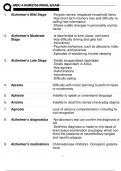
1. Alzheimer's Mild Stage -Forgets names; misplaces household items
-Has short-term memory loss and difficulty re-
calling new information
-Shows subtle changes in personality and be-
havior
2. Alzheimer's Moderate -Is disoriented to time, place, and event
Stage -Has difficulty driving and gets lost
-Incontinent
-Psychotic behaviors, such as delusions, hallu-
cinations, and paranoia
-Episodes of wandering, trouble sleeping
3. Alzheimer's Late Stage -Totally incapacitated; bedridden
-Totally dependent in ADLs
-Has agnosia
-Hallucinations
-Incontinence
-Difficulty eating
4. Apraxia Difficulty with motor planning to perform tasks
or movements
5. Aphasia Inability to speak or understand language
6. Anomia Inability to recall the names of everyday objects
7. Agnosia Loss of sensory comprehension, including fa-
cial recognition
8. Alzheimer's diagnostics -No laboratory test can confirm the diagnosis of
AD
-Definitive diagnosis is made on the basis of
brain tissue examination at autopsy, which con-
firms the presence of neurofibrillary tangles
and neuritic plaques
9. Alzheimer's medications Cholinesterase inhibitors- Donepezil, galanta-
mine
, MDC 4 NUR2755 FINAL EXAM
NMDA receptor antagonists- Memantine
10. Parkinson's symptoms -Slow, shuffling, and propulsive gait
-RESTING tremors
-Muscle rigidity
-Bradykinesia/akinesia (loss of ability to move
muscles voluntarily)
-Mask Like face
-Drooling
-Postural instability
11. Parkinson's diagnostics -Diagnosis typically made based on manifesta-
tions, their progression, and by ruling out other
disease
-Analysis of CSF may show a decrease in
dopamine levels
12. Parkinson's medications Carbidopa/Levodopa (Sinemet)
13. Parkinson's surgical inter- Stereotactic pallidotomy or thalamotomy
ventions
14. Migraine triggers -Caffeine
-Red wine
-MSG
-Foods high in tyramine (aged cheeses, cul-
tured food like yogurt)
15. Migraine abortive therapy Acetaminophen, ibuprofen, naproxen, triptans,
ergotamine derivatives
16. Migraine preventative Beta blockers, calcium channel blockers,
therapy antiepileptics, Botox
17. Migraine surgical treat- Trigeminal nerve resection
ment
18. Aura symptoms -Visual disturbances
-Flashing lights/lines/spots
, MDC 4 NUR2755 FINAL EXAM
-Numbness of lips or tongue
-Acute confused state
-Aphasia
-Vertigo
-Unilateral weakness*
-Offensive smell
-"Deja vu" feeling
19. Multiple sclerosis clinical -Muscle weakness and spasticity
manifestations -Intention tremors (tremor when performing an
activity)
-Diplopia (double vision)
-Nystagmus (an involuntary condition in which
the eyes make repetitive uncontrolled move-
ments)
-Depression/labile
20. Multiple sclerosis diagno- MRI of the brain and spinal cord demonstrates
sis the presence of plaques in at least 2 areas
21. Multiple sclerosis medica- -Baclofen
tions -Disease-modifying therapies
-Interferon beta-1a and beta-1b
-Corticosteroids
22. Meningitis clinical mani- -Nuchal rigidity
festations -Kernig Sign
-Brudzinski Sign
-Decreased level of consciousness
-Photosensitivity
23. Kernig Sign Resistance and pain with extension of the
client's leg from a flexed position
1. Alzheimer's Mild Stage -Forgets names; misplaces household items
-Has short-term memory loss and difficulty re-
calling new information
-Shows subtle changes in personality and be-
havior
2. Alzheimer's Moderate -Is disoriented to time, place, and event
Stage -Has difficulty driving and gets lost
-Incontinent
-Psychotic behaviors, such as delusions, hallu-
cinations, and paranoia
-Episodes of wandering, trouble sleeping
3. Alzheimer's Late Stage -Totally incapacitated; bedridden
-Totally dependent in ADLs
-Has agnosia
-Hallucinations
-Incontinence
-Difficulty eating
4. Apraxia Difficulty with motor planning to perform tasks
or movements
5. Aphasia Inability to speak or understand language
6. Anomia Inability to recall the names of everyday objects
7. Agnosia Loss of sensory comprehension, including fa-
cial recognition
8. Alzheimer's diagnostics -No laboratory test can confirm the diagnosis of
AD
-Definitive diagnosis is made on the basis of
brain tissue examination at autopsy, which con-
firms the presence of neurofibrillary tangles
and neuritic plaques
9. Alzheimer's medications Cholinesterase inhibitors- Donepezil, galanta-
mine
, MDC 4 NUR2755 FINAL EXAM
NMDA receptor antagonists- Memantine
10. Parkinson's symptoms -Slow, shuffling, and propulsive gait
-RESTING tremors
-Muscle rigidity
-Bradykinesia/akinesia (loss of ability to move
muscles voluntarily)
-Mask Like face
-Drooling
-Postural instability
11. Parkinson's diagnostics -Diagnosis typically made based on manifesta-
tions, their progression, and by ruling out other
disease
-Analysis of CSF may show a decrease in
dopamine levels
12. Parkinson's medications Carbidopa/Levodopa (Sinemet)
13. Parkinson's surgical inter- Stereotactic pallidotomy or thalamotomy
ventions
14. Migraine triggers -Caffeine
-Red wine
-MSG
-Foods high in tyramine (aged cheeses, cul-
tured food like yogurt)
15. Migraine abortive therapy Acetaminophen, ibuprofen, naproxen, triptans,
ergotamine derivatives
16. Migraine preventative Beta blockers, calcium channel blockers,
therapy antiepileptics, Botox
17. Migraine surgical treat- Trigeminal nerve resection
ment
18. Aura symptoms -Visual disturbances
-Flashing lights/lines/spots
, MDC 4 NUR2755 FINAL EXAM
-Numbness of lips or tongue
-Acute confused state
-Aphasia
-Vertigo
-Unilateral weakness*
-Offensive smell
-"Deja vu" feeling
19. Multiple sclerosis clinical -Muscle weakness and spasticity
manifestations -Intention tremors (tremor when performing an
activity)
-Diplopia (double vision)
-Nystagmus (an involuntary condition in which
the eyes make repetitive uncontrolled move-
ments)
-Depression/labile
20. Multiple sclerosis diagno- MRI of the brain and spinal cord demonstrates
sis the presence of plaques in at least 2 areas
21. Multiple sclerosis medica- -Baclofen
tions -Disease-modifying therapies
-Interferon beta-1a and beta-1b
-Corticosteroids
22. Meningitis clinical mani- -Nuchal rigidity
festations -Kernig Sign
-Brudzinski Sign
-Decreased level of consciousness
-Photosensitivity
23. Kernig Sign Resistance and pain with extension of the
client's leg from a flexed position