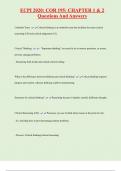
ECPI 2020: COR 195: CHAPTER 1 & 2
Questions And Answers
Umbrella Term: Critical thinking is an umbrella term that includes the terms critical
reasoning (CR) and critical judgement (CJ).
Critical Thinking: - "Important thinking" you need to do to answer questions, or assess ,
prevent, manage problems.
- Reasoning both inside and outside clinical setting
What is the difference between thinking and critical thinking? Critical thinking requires
purpose and control, whereas thinking could be daydreaming.
Synonym for critical thinking? Reasoning because it implies careful, deliberate thought.
Clinical Reasoning (CR): Processes you use to think about issues at the point of care.
- Ex: deciding how to prevent/manage patient problems
- Process: Critical thinking/clinical reasoning
, ECPI 2020: COR 195: CHAPTER 1 & 2
Questions And Answers
Clinical Judgement (CJ): Refers to the result (outcome) of critical thinking or clinical
reasoning - the conclusion, decision, or opinion you make after thinking about the issues.
- Result - Clinical judgement
Critical Thinking In Nursing: - Includes clinical reasoning and clinical judgement - is
purposeful, informed, outcome - focused thinking that:
- Guided by standards, policies, ethic codes, laws
- Driven by patient, family, community needs as well as nurses needs to give efficient/competent
care
- Based on principles of nursing process, problem-solving, and scientific method
- Focuses on safety and quality, constantly re-evaluating, self-correcting, striving to improve
- Carefully identifies key problems, issues, risks, involved, including patients, families, key
stakeholders in decision-making early in the process. Stakeholders will be most affected
(patients/families) or from whom requirements will be drawn
- Uses logic, intuition, creativity and is grounded in specific knowledge, skills, experience.
- Calls for strategies that make most of human potential and compensate for problems created by
human nature
, ECPI 2020: COR 195: CHAPTER 1 & 2
Questions And Answers
Common Sense: - Usually learned from experiences
- Everyone's common sense is different
Ideal Critical Thinker: - Is habitually inquisitive
- Self-informed
- Trustful of reason
- Open-minded
- Flexible
- Fair-minded in evaluation
- Honest in facing personal biases
- Prudent in making judgements
- Willing to reconsider
- Clear about issues
- Orderly in complex matters
- Diligent in seeking relevant information
- Reasonable in selecting criteria
- Focused in inquiry and present in seeking results that are as precise as the subject and the
circumstances of inquiry permit
, ECPI 2020: COR 195: CHAPTER 1 & 2
Questions And Answers
Personal Critical Thinking Indicators: - Self aware
- Genuine/authentic
- Effective communication
- Curious and inquisitive
- Alert to context
- Reflective and self-corrective
- Analytical and insightful
- Logical and intuitive
- Confident and resilient
- Honest and upright
- Autonomous/responsible
- Careful/prudent
- Open/fair-minded
- Sensitive to diversity
- Creative
- Realistic/practical
- Proactive
Questions And Answers
Umbrella Term: Critical thinking is an umbrella term that includes the terms critical
reasoning (CR) and critical judgement (CJ).
Critical Thinking: - "Important thinking" you need to do to answer questions, or assess ,
prevent, manage problems.
- Reasoning both inside and outside clinical setting
What is the difference between thinking and critical thinking? Critical thinking requires
purpose and control, whereas thinking could be daydreaming.
Synonym for critical thinking? Reasoning because it implies careful, deliberate thought.
Clinical Reasoning (CR): Processes you use to think about issues at the point of care.
- Ex: deciding how to prevent/manage patient problems
- Process: Critical thinking/clinical reasoning
, ECPI 2020: COR 195: CHAPTER 1 & 2
Questions And Answers
Clinical Judgement (CJ): Refers to the result (outcome) of critical thinking or clinical
reasoning - the conclusion, decision, or opinion you make after thinking about the issues.
- Result - Clinical judgement
Critical Thinking In Nursing: - Includes clinical reasoning and clinical judgement - is
purposeful, informed, outcome - focused thinking that:
- Guided by standards, policies, ethic codes, laws
- Driven by patient, family, community needs as well as nurses needs to give efficient/competent
care
- Based on principles of nursing process, problem-solving, and scientific method
- Focuses on safety and quality, constantly re-evaluating, self-correcting, striving to improve
- Carefully identifies key problems, issues, risks, involved, including patients, families, key
stakeholders in decision-making early in the process. Stakeholders will be most affected
(patients/families) or from whom requirements will be drawn
- Uses logic, intuition, creativity and is grounded in specific knowledge, skills, experience.
- Calls for strategies that make most of human potential and compensate for problems created by
human nature
, ECPI 2020: COR 195: CHAPTER 1 & 2
Questions And Answers
Common Sense: - Usually learned from experiences
- Everyone's common sense is different
Ideal Critical Thinker: - Is habitually inquisitive
- Self-informed
- Trustful of reason
- Open-minded
- Flexible
- Fair-minded in evaluation
- Honest in facing personal biases
- Prudent in making judgements
- Willing to reconsider
- Clear about issues
- Orderly in complex matters
- Diligent in seeking relevant information
- Reasonable in selecting criteria
- Focused in inquiry and present in seeking results that are as precise as the subject and the
circumstances of inquiry permit
, ECPI 2020: COR 195: CHAPTER 1 & 2
Questions And Answers
Personal Critical Thinking Indicators: - Self aware
- Genuine/authentic
- Effective communication
- Curious and inquisitive
- Alert to context
- Reflective and self-corrective
- Analytical and insightful
- Logical and intuitive
- Confident and resilient
- Honest and upright
- Autonomous/responsible
- Careful/prudent
- Open/fair-minded
- Sensitive to diversity
- Creative
- Realistic/practical
- Proactive