

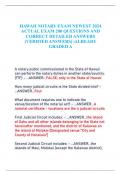
HAWAII NOTARY EXAM NEWEST 2024
ACTUAL EXAM 200 QUESTIONS AND
CORRECT DETAILED ANSWERS
(VERIFIED ANSWERS) |ALREADY
GRADED A
A notary public commissioned in the State of Hawaii
can perform the notary duties in another state/country.
(T?F) - ...ANSWER...FALSE; only in the State of Hawaii
How many judicial circuits is the State divided into? -
...ANSWER...Four
What document requires one to indicate the
venue/location of the notarial act? - ...ANSWER...A
notarial certificate - locations are the 4 judicial circuits
First Judicial Circuit includes: - ...ANSWER...the island
of Oahu and all other islands belonging to the State not
hereinafter mentioned, and the district of Kalawao on
the island of Molokai [Designated venue "City and
County of Honolulu"]
Second Judicial Circuit includes: - ...ANSWER...the
islands of Maui, Molokai (except the Kalawao district),
,Lanai, Kahoolawe, and Molokini [Designated venue
"County of Maui"];
Third Judicial Circuit includes: - ...ANSWER...the island
of Hawaii [Designated venue "County of Hawaii"]
Fifth Judicial Circuit includes: - ...ANSWER...the islands
of Kauai and Niihau [Designated venue "County of
Kauai"]
The notary must indicate in the _____________ the
___________ of the notary's notarial act. -
...ANSWER...notarial journal; date
In Hawaii, it is permissible to perform notarial services
on a Sunday or a holiday. (T/F) - ...ANSWER...True!
If there are interlineations, erasures or other changes
to a document, the notary
should___________________________. - ...ANSWER...call
them to the attention of the person who is signing the
document.
If changes to a document are approved, the notary
should _______ - ...ANSWER...place notary public's
initials in the margin of the document opposite each
interlineation, erasure, or change, along with having the
person signing the document initial each change as
well.
An oath is: - ...ANSWER...a solemn pledge made by a
person (often referred to as the "affiant") with an
,appeal to God or a Supreme Being to attest to the truth
of the person's statement.
An oath is:
a. An affirmation
b. Never used
c. A solemn spoken pledge
d. a and c - ...ANSWER...D?
what is the affiant? - ...ANSWER...the person making an
oath
When the affiant's conscience will not permit the affiant
to use the term "swear" ___________ is permissible. -
...ANSWER...an affirmation
The notary can substitute the term "affirm" for the term
"swear". (T/F) - ...ANSWER...True
Oath/Affirmation taken by public officers: -
...ANSWER..."You do solemnly swear or affirm that you
will support and defend the Constitution of the United
States and the Constitution of the State of Hawaii, and
that you will faithfully discharge your duties to the best
of your ability."
The person to whom the oath has been administered
answers: - ...ANSWER..." I do."
An affidavit: - ...ANSWER...is a written or printed
statement of facts, made voluntarily, and under oath or
affirmation of the party making it, taken before an
, officer who has authority to administer an oath. In other
words, it is an oath that has been put in writing and
signed by the affiant.
An oath that can be administered with an affidavit: -
...ANSWER..."You do solemnly swear or affirm that the
statements made in this affidavit are the truth, the
whole truth, and nothing but the truth." The affiant
answers "I do." The notary then adds the notary's "jurat"
which states that the person appeared before the
notary and signed the affidavit. The notary then signs
the jurat, prints, or stamps the notary's commission
expiration date, and impresses the notary's official seal.
The letters "SS." mean: - ...ANSWER...an abbreviation
for the Latin word "scilicet", which means "namely", or
"more particularly described as".
An acknowledgment is: - ...ANSWER...s a formal
declaration before an authorized official by a person
who has executed a formal or legal written document
that the execution of the document was the person's
free act and deed.
The purpose of an acknowledgment is to...
A. Prevent recordable documents from being signed
voluntarily
B. Assure the grantee of a valid document
C. Prevent forgery of recordable documents
D. To keep the grantee from using a fictitious name -
...ANSWER...C. prevent forgery of recordable
ACTUAL EXAM 200 QUESTIONS AND
CORRECT DETAILED ANSWERS
(VERIFIED ANSWERS) |ALREADY
GRADED A
A notary public commissioned in the State of Hawaii
can perform the notary duties in another state/country.
(T?F) - ...ANSWER...FALSE; only in the State of Hawaii
How many judicial circuits is the State divided into? -
...ANSWER...Four
What document requires one to indicate the
venue/location of the notarial act? - ...ANSWER...A
notarial certificate - locations are the 4 judicial circuits
First Judicial Circuit includes: - ...ANSWER...the island
of Oahu and all other islands belonging to the State not
hereinafter mentioned, and the district of Kalawao on
the island of Molokai [Designated venue "City and
County of Honolulu"]
Second Judicial Circuit includes: - ...ANSWER...the
islands of Maui, Molokai (except the Kalawao district),
,Lanai, Kahoolawe, and Molokini [Designated venue
"County of Maui"];
Third Judicial Circuit includes: - ...ANSWER...the island
of Hawaii [Designated venue "County of Hawaii"]
Fifth Judicial Circuit includes: - ...ANSWER...the islands
of Kauai and Niihau [Designated venue "County of
Kauai"]
The notary must indicate in the _____________ the
___________ of the notary's notarial act. -
...ANSWER...notarial journal; date
In Hawaii, it is permissible to perform notarial services
on a Sunday or a holiday. (T/F) - ...ANSWER...True!
If there are interlineations, erasures or other changes
to a document, the notary
should___________________________. - ...ANSWER...call
them to the attention of the person who is signing the
document.
If changes to a document are approved, the notary
should _______ - ...ANSWER...place notary public's
initials in the margin of the document opposite each
interlineation, erasure, or change, along with having the
person signing the document initial each change as
well.
An oath is: - ...ANSWER...a solemn pledge made by a
person (often referred to as the "affiant") with an
,appeal to God or a Supreme Being to attest to the truth
of the person's statement.
An oath is:
a. An affirmation
b. Never used
c. A solemn spoken pledge
d. a and c - ...ANSWER...D?
what is the affiant? - ...ANSWER...the person making an
oath
When the affiant's conscience will not permit the affiant
to use the term "swear" ___________ is permissible. -
...ANSWER...an affirmation
The notary can substitute the term "affirm" for the term
"swear". (T/F) - ...ANSWER...True
Oath/Affirmation taken by public officers: -
...ANSWER..."You do solemnly swear or affirm that you
will support and defend the Constitution of the United
States and the Constitution of the State of Hawaii, and
that you will faithfully discharge your duties to the best
of your ability."
The person to whom the oath has been administered
answers: - ...ANSWER..." I do."
An affidavit: - ...ANSWER...is a written or printed
statement of facts, made voluntarily, and under oath or
affirmation of the party making it, taken before an
, officer who has authority to administer an oath. In other
words, it is an oath that has been put in writing and
signed by the affiant.
An oath that can be administered with an affidavit: -
...ANSWER..."You do solemnly swear or affirm that the
statements made in this affidavit are the truth, the
whole truth, and nothing but the truth." The affiant
answers "I do." The notary then adds the notary's "jurat"
which states that the person appeared before the
notary and signed the affidavit. The notary then signs
the jurat, prints, or stamps the notary's commission
expiration date, and impresses the notary's official seal.
The letters "SS." mean: - ...ANSWER...an abbreviation
for the Latin word "scilicet", which means "namely", or
"more particularly described as".
An acknowledgment is: - ...ANSWER...s a formal
declaration before an authorized official by a person
who has executed a formal or legal written document
that the execution of the document was the person's
free act and deed.
The purpose of an acknowledgment is to...
A. Prevent recordable documents from being signed
voluntarily
B. Assure the grantee of a valid document
C. Prevent forgery of recordable documents
D. To keep the grantee from using a fictitious name -
...ANSWER...C. prevent forgery of recordable


