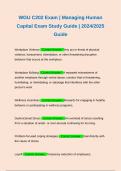
WGU C202 Exam | Managing Human
Capital Exam Study Guide | 2024/2025
Guide
Workplace Violence - Correct Answer - Any act or threat of physical
violence, harassment, intimidation, or other threatening disruptive
behavior that occurs at the workplace.
Workplace Bullying - Correct Answer - A repeated mistreatment of
another employee through verbal abuse; conduct that is threatening,
humiliating, or intimidating; or sabotage that interferes with the other
person's work.
Wellness Incentives - Correct Answer - Rewards for engaging in healthy
behavior or participating in wellness programs.
Dysfunctional Stress - Correct Answer - An overload of stress resulting
from a situation of under- or over-arousal continuing for too long.
Problem-focused coping strategies - Correct Answer - Deal directly with
the cause of stress.
Layoff - Correct Answer - Temporary reduction of employees.
,Downsizing - Correct Answer - A permanent reduction of multiple
employees intended to improve the efficiency or effectiveness of the
firm.
Mobility Policies - Correct Answer - Specify the rules by which people
move between jobs within an organization.
Involuntary Turnover - Correct Answer - The separation is due to the
organization asking the employee to leave.
Employee Engagement - Correct Answer - When employees are
committed to, involved with, enthusiastic, and passionate about their
work.
Succession Management Plans - Correct Answer - Written policies that
guide the succession management process.
Continuance Commitment - Correct Answer - Staying with an
organization because of the perceived high economic and/or social cost
involved with leaving.
Normative Commitment - Correct Answer - Feeling obliged to stay with
an organization for moral or ethical reasons.
,Affective Commitment - Correct Answer - A positive emotional
attachment to the organization and strong identification with its values
and goals.
Survivor Syndrome - Correct Answer - The emotional effects of a
downsizing on surviving employees both during and after a downsizing.
Workforce Redeployment - Correct Answer - The movement of
employees to other parts of the company or to other jobs the company
needs to be filled to match its workforce with its talent needs.
Organizational Citizenship Behaviors - Correct Answer - Discretionary
behaviors that benefit the organization but that are not formally rewarded
or required.
Optimal Turnover - Correct Answer - The turnover level producing the
highest long-term levels of productivity and business improvement.
Organizational Commitment - Correct Answer - The extent to which an
employee identifies with the organization and its goals and wants to stay
with the organization.
, Avoidable Turnover - Correct Answer - Turnover that the employer could
have prevented.
Mobility Barriers - Correct Answer - Factors that make it harder to leave
an organization.
Skills Inventories - Correct Answer - Tracks employees' competencies
and work experiences in a searchable database.
Unavoidable Turnover - Correct Answer - Turnover that the employer
could not have prevented.
Dysfunctional Turnover - Correct Answer - The departure of effective
performers.
Burnout - Correct Answer - Exhaustion of physical or emotional strength
or motivation usually as a result of prolonged stress or frustration.
Termination - Correct Answer - The permanent separation of a single
employee.
Functional Turnorver - Correct Answer - The departure of poor
performers.
Capital Exam Study Guide | 2024/2025
Guide
Workplace Violence - Correct Answer - Any act or threat of physical
violence, harassment, intimidation, or other threatening disruptive
behavior that occurs at the workplace.
Workplace Bullying - Correct Answer - A repeated mistreatment of
another employee through verbal abuse; conduct that is threatening,
humiliating, or intimidating; or sabotage that interferes with the other
person's work.
Wellness Incentives - Correct Answer - Rewards for engaging in healthy
behavior or participating in wellness programs.
Dysfunctional Stress - Correct Answer - An overload of stress resulting
from a situation of under- or over-arousal continuing for too long.
Problem-focused coping strategies - Correct Answer - Deal directly with
the cause of stress.
Layoff - Correct Answer - Temporary reduction of employees.
,Downsizing - Correct Answer - A permanent reduction of multiple
employees intended to improve the efficiency or effectiveness of the
firm.
Mobility Policies - Correct Answer - Specify the rules by which people
move between jobs within an organization.
Involuntary Turnover - Correct Answer - The separation is due to the
organization asking the employee to leave.
Employee Engagement - Correct Answer - When employees are
committed to, involved with, enthusiastic, and passionate about their
work.
Succession Management Plans - Correct Answer - Written policies that
guide the succession management process.
Continuance Commitment - Correct Answer - Staying with an
organization because of the perceived high economic and/or social cost
involved with leaving.
Normative Commitment - Correct Answer - Feeling obliged to stay with
an organization for moral or ethical reasons.
,Affective Commitment - Correct Answer - A positive emotional
attachment to the organization and strong identification with its values
and goals.
Survivor Syndrome - Correct Answer - The emotional effects of a
downsizing on surviving employees both during and after a downsizing.
Workforce Redeployment - Correct Answer - The movement of
employees to other parts of the company or to other jobs the company
needs to be filled to match its workforce with its talent needs.
Organizational Citizenship Behaviors - Correct Answer - Discretionary
behaviors that benefit the organization but that are not formally rewarded
or required.
Optimal Turnover - Correct Answer - The turnover level producing the
highest long-term levels of productivity and business improvement.
Organizational Commitment - Correct Answer - The extent to which an
employee identifies with the organization and its goals and wants to stay
with the organization.
, Avoidable Turnover - Correct Answer - Turnover that the employer could
have prevented.
Mobility Barriers - Correct Answer - Factors that make it harder to leave
an organization.
Skills Inventories - Correct Answer - Tracks employees' competencies
and work experiences in a searchable database.
Unavoidable Turnover - Correct Answer - Turnover that the employer
could not have prevented.
Dysfunctional Turnover - Correct Answer - The departure of effective
performers.
Burnout - Correct Answer - Exhaustion of physical or emotional strength
or motivation usually as a result of prolonged stress or frustration.
Termination - Correct Answer - The permanent separation of a single
employee.
Functional Turnorver - Correct Answer - The departure of poor
performers.