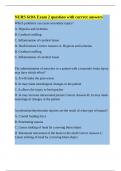
NURS 610A Exam 2 question with correct answers
Which problems can cause secondary injury?
A. Hypoxia and ischemia
B. Cerebral swelling
C. Inflammation of cerebral tissue
D. Skull fracture Correct Answer-A. Hypoxia and ischemia
B. Cerebral swelling
C. Inflammation of cerebral tissue
The administration of narcotics to a patient with a traumatic brain injury
may have which effect?
A. It will make the pain worse
B. In may mask neurological changes in the patient
C. It allows the injury to heal quicker
D. In may increase intracranial pressre Correct Answer-B. In may mask
neurological changes in the patient
Acceleration/deceleration injuries are the result of what type of impact?
A. Cranial loading force
B. Penetrating trauma
C. Linear striking of head by a moving blunt object
D. Rotational movement of the brain in the skull Correct Answer-C.
Linear striking of head by a moving blunt object
,Which condition is NOT associated with increased intracranial volume?
A. Subdural hematoma
B. Hypotension
C. Subarachnoid hemorrhage
D. Meningioma Correct Answer-B. Hypotension
Accumulation of CSF results in what condition?
A. Herniation
B. Cerebral dilation
C. Hydrocephalus
D. Seizures Correct Answer-C. Hydrocephalus
A brief loss of consciousness followed by a period of being alert and
oriented and then a loss of consciousness again is typical presentation
for which condition?
A. Subdural hematoma
B. Epidural hematoma
C. Intracranial hematoma
D. Subarachnoid hemorrhage Correct Answer-B. Epidural hematoma
Management of intracerebral hematoma may include which
intervention?
A. Anticoagulation
B. Maintaining mean arterial pressure of 70 mm/Hg or less
,C. Emergent surgical evacuation
D. Maximizing cerebral perfusion presure (CPP) Correct Answer-D.
Maximizing cerebral perfusion presure (CPP)
Presence of dizziness, headache, and confusion for long periods of time
after concussion is
A. Always expected
B. Known as postconcussive syndrome
C. Caused by taking too much pain medication
D. The result of something other than the concussion Correct Answer-B.
Known as postconcussive syndrome
A 42 year old patient with a severe acute traumatic brain injury has
developed a fever. The nurse is aware that the fever should be reversed
quickly for which reason?
A. It decreases venous return from the brain
B. It often causes seizure activity
C. It increases the brain's metabolic needs
D. It may be caused by an infection Correct Answer-C. It increases the
brain's metabolic needs
Level four interventions have been initiated to decrease the ICP in a
patient with severe traumatic brain injury. The nurse would anticipate
which possible level four actions?
A. Increasing the head of the bed to 30 degrees
, B. Administering high-dose barbituates
C. Initiating saline therapy
D. Administering intravenous mannitol Correct Answer-B.
Administering high-dose barbituates
Which complications is a patient with an ICP monitoring device at risk
for developing? (select all that apply)
A. New onset seizures
B. Overdrainage of CSF
C. Collapsed ventricles
D. Bleeding
E. Infection Correct Answer-B. Overdrainage of CSF
D. Bleeding
E. Infection
Which intervention should the nurse perform to reduce the ICP in a
patient with an acute TBI?
A Flatten the head of the bed
B. Maintain the head and neck in neutral alignment
C. Suction patient every hour
D. Slightly hypoventilate the patient Correct Answer-B. Maintain the
head and neck in neutral alignment
What nursing intervention reduces secondary injury?
Which problems can cause secondary injury?
A. Hypoxia and ischemia
B. Cerebral swelling
C. Inflammation of cerebral tissue
D. Skull fracture Correct Answer-A. Hypoxia and ischemia
B. Cerebral swelling
C. Inflammation of cerebral tissue
The administration of narcotics to a patient with a traumatic brain injury
may have which effect?
A. It will make the pain worse
B. In may mask neurological changes in the patient
C. It allows the injury to heal quicker
D. In may increase intracranial pressre Correct Answer-B. In may mask
neurological changes in the patient
Acceleration/deceleration injuries are the result of what type of impact?
A. Cranial loading force
B. Penetrating trauma
C. Linear striking of head by a moving blunt object
D. Rotational movement of the brain in the skull Correct Answer-C.
Linear striking of head by a moving blunt object
,Which condition is NOT associated with increased intracranial volume?
A. Subdural hematoma
B. Hypotension
C. Subarachnoid hemorrhage
D. Meningioma Correct Answer-B. Hypotension
Accumulation of CSF results in what condition?
A. Herniation
B. Cerebral dilation
C. Hydrocephalus
D. Seizures Correct Answer-C. Hydrocephalus
A brief loss of consciousness followed by a period of being alert and
oriented and then a loss of consciousness again is typical presentation
for which condition?
A. Subdural hematoma
B. Epidural hematoma
C. Intracranial hematoma
D. Subarachnoid hemorrhage Correct Answer-B. Epidural hematoma
Management of intracerebral hematoma may include which
intervention?
A. Anticoagulation
B. Maintaining mean arterial pressure of 70 mm/Hg or less
,C. Emergent surgical evacuation
D. Maximizing cerebral perfusion presure (CPP) Correct Answer-D.
Maximizing cerebral perfusion presure (CPP)
Presence of dizziness, headache, and confusion for long periods of time
after concussion is
A. Always expected
B. Known as postconcussive syndrome
C. Caused by taking too much pain medication
D. The result of something other than the concussion Correct Answer-B.
Known as postconcussive syndrome
A 42 year old patient with a severe acute traumatic brain injury has
developed a fever. The nurse is aware that the fever should be reversed
quickly for which reason?
A. It decreases venous return from the brain
B. It often causes seizure activity
C. It increases the brain's metabolic needs
D. It may be caused by an infection Correct Answer-C. It increases the
brain's metabolic needs
Level four interventions have been initiated to decrease the ICP in a
patient with severe traumatic brain injury. The nurse would anticipate
which possible level four actions?
A. Increasing the head of the bed to 30 degrees
, B. Administering high-dose barbituates
C. Initiating saline therapy
D. Administering intravenous mannitol Correct Answer-B.
Administering high-dose barbituates
Which complications is a patient with an ICP monitoring device at risk
for developing? (select all that apply)
A. New onset seizures
B. Overdrainage of CSF
C. Collapsed ventricles
D. Bleeding
E. Infection Correct Answer-B. Overdrainage of CSF
D. Bleeding
E. Infection
Which intervention should the nurse perform to reduce the ICP in a
patient with an acute TBI?
A Flatten the head of the bed
B. Maintain the head and neck in neutral alignment
C. Suction patient every hour
D. Slightly hypoventilate the patient Correct Answer-B. Maintain the
head and neck in neutral alignment
What nursing intervention reduces secondary injury?