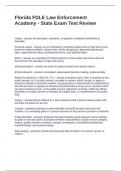
Florida FDLE Law Enforcement
Academy - State Exam Test Review
Values - answer are principles, standards, or qualities considered worthwhile or
desirable.
Personal values - answer are an individual's convictions about what is right and wrong,
based on religious beliefs, cultural roots, family background, personal experiences,
laws, organizational values, professional norms, and political habits.
Ethics - answer is a standard of conduct based on moral duties and virtues that are
derived from the principles of right and wrong.
Ethical principles - answer are rules of conduct derived from ethical values.
Ethical behavior - answer is principled, value-based decision making, practiced daily.
Bribery is defined in s. 838.015, F.S., - answer corruptly to give, offer, or promise to any
public servant, or, if a public servant, corruptly to request, solicit, accept, or agree to
accept for himself or herself or another, any pecuniary or other benefit not authorized by
law with an intent or purpose to influence the performance of any act or omission which
the person believes to be, or the public servant represents as being, within the official
discretion of a public servant, in violation of a public duty, or in performance of a public
duty.
Perjury - answermay be defined as a false statement that a person makes under oath
but does not believe to be true.
Gratuity - answeris anything of value intended to benefit the giver more than the
receiver; it is something given to a person because of that person's position or authority.
Professionalism - answeris behavior that demonstrates good character and is marked
by pride in self and career. Examples of these characteristics include service, integrity,
respect, quality, fairness, honesty, courage, compassion, moral/ethical leadership,
trustworthiness, and common sense.
Stereotyping - answeris a fixed and unvarying idea or opinion of a person, group, or
subject.
,Bias or prejudice - answeris a strong belief or feeling about a person, group, or subject,
whether positive or negative, that is formed without reviewing all available facts or
information.
Discrimination - answeris the negative behavior toward a person or group that is based
on color, race, sex, age, religion, ethnic and national origin, handicap, and/or marital
status.
Perception - answeris the impression in a person's mind of an individual, a group of
people, or events based on experiences, biases, beliefs, assumptions, and
observations.
Sexual harassment - answeris defined as unwelcome sexual advances, requests for
sexual favors, and other verbal or physical conduct of a sexual nature.
Quid pro quo - answer"something for something in return."
Hostile work environment - answeran office culture where lewd jokes or other offensive
habits are acceptable.
Criminal justice - answerrefers to the structure, functions, and decision-making
processes of those agencies that deal with the management and control of crime and
criminal offenders.
3 main components of the Criminal Justice system - answerThe three main components
of the criminal justice system are law enforcement, the court system, and corrections.
Law enforcement - answeris responsible for the enforcement of and maintaining civil
order.
The court system - answeris responsible for the interpretation of laws.
Corrections - answeris responsible for enforcing punishment as defined by the court
system.
Four levels of law enforcement agencies within the United States: - answerlocal or
municipal, county, state, and federal
Jurisdiction - answermeans the types of cases in which the court can make decisions.
Courts of Appeal: - answerthese courts make decisions on appeals from lower federal
courts, which are subject to review in the U.S. Supreme Court.
Supreme Court of the United States: - answerhears appeals from the decisions of lower
federal courts and state supreme courts, and it resolves issues of constitutional and
,federal law. It stands as the ultimate authority in constitutional interpretation, and its
decisions can be changed only by a constitutional amendment.
Judge - answeris authorized to preside over the courtroom and to decide questions of
law brought before the court.
Prosecutor - answeris responsible for presenting the government's case.
Defense Attorney - answeris responsible for representing the defendant's case.
Probation - answeris a sentence placing a person under the supervision of a probation
officer for a specified length of time instead of confinement.
Parole - answeris the release of an inmate from a correctional institution prior to the
conclusion of the inmate's court-imposed sentence.
Community control (house arrest) - answeris a form of closely monitored community
supervision and is more restrictive than probation or parole.
Chain of command - answeris the order of authority within an organization. It provides
the links of authority and responsibility that join one level of an organization to another.
Insubordination - answerThe failure to follow orders from superiors in the chain of
command
Vertical communication - answeris a term for information from the chief executive officer
that flows down through the supervision levels to the lowest levels of the organization.
The information that flows from the lowest levels to the highest is equally important.
Lateral communication - answeris that which travels across a level of the organization to
employees on the same level within the chain of command. Sometimes, information
must be processed at all levels and then channeled to the individual or individuals
responsible for accomplishing a specific objective.
Delegation of Authority - answergranting of power by the person with authority to
another person
Administrative Law - answerThe body of law that allows for the creation of public
regulatory agencies
Case Law - answerThe body of law that is formed by the decisions of the court system
Civil Law - answerThe area of the law that pertains to the legal action that a person
takes to resolve a private dispute with another person
, Constitutional Law - answerThe standards set forth in the Constitution and court
decisions or interpretations of the Constitution handed down by the U.S. District and
Supreme Courts; identifies the powers and limitations of each branch of the U.S.
government (Checks & Balances)
Criminal Law - answerThe part of statutory law that defines unacceptable behaviors in
government prosecution of those who commit them
Ordinance - answerA statute enacted by a municipal (city) or county government and
which applies only within the jurisdiction of the government entity which created it,
maybe criminal or civil
Statutory Law - answerThe written laws enacted by Congress, State Legislators, or local
governing authorities in response to a perceived need.
Bill of Rights - answerThe first ten amendments to the U.S. Constitution
Due Process Clause - answerThe part of the 14th Amendment that expands the
restrictions the Bill of Rights places on the Federal Government to state and local
governments and states, "No state shall make or enforce any law which shall abridge
the privileges and immunities of citizens of the United States; Nor shall any state
deprive any person of life, liberty, or property without due process of law; nor deny any
person within its jurisdictions of the equal protection of the laws."
Felony - answerA criminal offense committed within the state in which the maximum
penalty is death or incarceration in a state correctional facility for MORE THAN ONE
YEAR
Misdemeanor - answerAny criminal offense that is punishable by a term of
imprisonment in a county correctional facility NOT IN EXCESS OF ONE YEAR
Noncriminal Violation - answerAn offense, also known as a civil infraction, for which the
only penalty may be a fine, forfeiture, or other civil penalty.
Offense - answera criminal or noncriminal act punishable by law
Capital Felony - answerDeath or life imprisonment in a state correctional facility without
possible parole
Life Felony - answerLife imprisonment, $15,000.00 fine, or both
Felony 1st Degree - answer30 years and, in some cases, life imprisonment, $10,000
fine, or both
Felony 2nd Degree - answer15 years imprisonment, $10,000 fine, or both
Academy - State Exam Test Review
Values - answer are principles, standards, or qualities considered worthwhile or
desirable.
Personal values - answer are an individual's convictions about what is right and wrong,
based on religious beliefs, cultural roots, family background, personal experiences,
laws, organizational values, professional norms, and political habits.
Ethics - answer is a standard of conduct based on moral duties and virtues that are
derived from the principles of right and wrong.
Ethical principles - answer are rules of conduct derived from ethical values.
Ethical behavior - answer is principled, value-based decision making, practiced daily.
Bribery is defined in s. 838.015, F.S., - answer corruptly to give, offer, or promise to any
public servant, or, if a public servant, corruptly to request, solicit, accept, or agree to
accept for himself or herself or another, any pecuniary or other benefit not authorized by
law with an intent or purpose to influence the performance of any act or omission which
the person believes to be, or the public servant represents as being, within the official
discretion of a public servant, in violation of a public duty, or in performance of a public
duty.
Perjury - answermay be defined as a false statement that a person makes under oath
but does not believe to be true.
Gratuity - answeris anything of value intended to benefit the giver more than the
receiver; it is something given to a person because of that person's position or authority.
Professionalism - answeris behavior that demonstrates good character and is marked
by pride in self and career. Examples of these characteristics include service, integrity,
respect, quality, fairness, honesty, courage, compassion, moral/ethical leadership,
trustworthiness, and common sense.
Stereotyping - answeris a fixed and unvarying idea or opinion of a person, group, or
subject.
,Bias or prejudice - answeris a strong belief or feeling about a person, group, or subject,
whether positive or negative, that is formed without reviewing all available facts or
information.
Discrimination - answeris the negative behavior toward a person or group that is based
on color, race, sex, age, religion, ethnic and national origin, handicap, and/or marital
status.
Perception - answeris the impression in a person's mind of an individual, a group of
people, or events based on experiences, biases, beliefs, assumptions, and
observations.
Sexual harassment - answeris defined as unwelcome sexual advances, requests for
sexual favors, and other verbal or physical conduct of a sexual nature.
Quid pro quo - answer"something for something in return."
Hostile work environment - answeran office culture where lewd jokes or other offensive
habits are acceptable.
Criminal justice - answerrefers to the structure, functions, and decision-making
processes of those agencies that deal with the management and control of crime and
criminal offenders.
3 main components of the Criminal Justice system - answerThe three main components
of the criminal justice system are law enforcement, the court system, and corrections.
Law enforcement - answeris responsible for the enforcement of and maintaining civil
order.
The court system - answeris responsible for the interpretation of laws.
Corrections - answeris responsible for enforcing punishment as defined by the court
system.
Four levels of law enforcement agencies within the United States: - answerlocal or
municipal, county, state, and federal
Jurisdiction - answermeans the types of cases in which the court can make decisions.
Courts of Appeal: - answerthese courts make decisions on appeals from lower federal
courts, which are subject to review in the U.S. Supreme Court.
Supreme Court of the United States: - answerhears appeals from the decisions of lower
federal courts and state supreme courts, and it resolves issues of constitutional and
,federal law. It stands as the ultimate authority in constitutional interpretation, and its
decisions can be changed only by a constitutional amendment.
Judge - answeris authorized to preside over the courtroom and to decide questions of
law brought before the court.
Prosecutor - answeris responsible for presenting the government's case.
Defense Attorney - answeris responsible for representing the defendant's case.
Probation - answeris a sentence placing a person under the supervision of a probation
officer for a specified length of time instead of confinement.
Parole - answeris the release of an inmate from a correctional institution prior to the
conclusion of the inmate's court-imposed sentence.
Community control (house arrest) - answeris a form of closely monitored community
supervision and is more restrictive than probation or parole.
Chain of command - answeris the order of authority within an organization. It provides
the links of authority and responsibility that join one level of an organization to another.
Insubordination - answerThe failure to follow orders from superiors in the chain of
command
Vertical communication - answeris a term for information from the chief executive officer
that flows down through the supervision levels to the lowest levels of the organization.
The information that flows from the lowest levels to the highest is equally important.
Lateral communication - answeris that which travels across a level of the organization to
employees on the same level within the chain of command. Sometimes, information
must be processed at all levels and then channeled to the individual or individuals
responsible for accomplishing a specific objective.
Delegation of Authority - answergranting of power by the person with authority to
another person
Administrative Law - answerThe body of law that allows for the creation of public
regulatory agencies
Case Law - answerThe body of law that is formed by the decisions of the court system
Civil Law - answerThe area of the law that pertains to the legal action that a person
takes to resolve a private dispute with another person
, Constitutional Law - answerThe standards set forth in the Constitution and court
decisions or interpretations of the Constitution handed down by the U.S. District and
Supreme Courts; identifies the powers and limitations of each branch of the U.S.
government (Checks & Balances)
Criminal Law - answerThe part of statutory law that defines unacceptable behaviors in
government prosecution of those who commit them
Ordinance - answerA statute enacted by a municipal (city) or county government and
which applies only within the jurisdiction of the government entity which created it,
maybe criminal or civil
Statutory Law - answerThe written laws enacted by Congress, State Legislators, or local
governing authorities in response to a perceived need.
Bill of Rights - answerThe first ten amendments to the U.S. Constitution
Due Process Clause - answerThe part of the 14th Amendment that expands the
restrictions the Bill of Rights places on the Federal Government to state and local
governments and states, "No state shall make or enforce any law which shall abridge
the privileges and immunities of citizens of the United States; Nor shall any state
deprive any person of life, liberty, or property without due process of law; nor deny any
person within its jurisdictions of the equal protection of the laws."
Felony - answerA criminal offense committed within the state in which the maximum
penalty is death or incarceration in a state correctional facility for MORE THAN ONE
YEAR
Misdemeanor - answerAny criminal offense that is punishable by a term of
imprisonment in a county correctional facility NOT IN EXCESS OF ONE YEAR
Noncriminal Violation - answerAn offense, also known as a civil infraction, for which the
only penalty may be a fine, forfeiture, or other civil penalty.
Offense - answera criminal or noncriminal act punishable by law
Capital Felony - answerDeath or life imprisonment in a state correctional facility without
possible parole
Life Felony - answerLife imprisonment, $15,000.00 fine, or both
Felony 1st Degree - answer30 years and, in some cases, life imprisonment, $10,000
fine, or both
Felony 2nd Degree - answer15 years imprisonment, $10,000 fine, or both