

100% satisfaction guarantee Immediately available after payment Both online and in PDF No strings attached 4.2 TrustPilot
logo-home
Class notes

blood_-_composition_anf_function

Rating
-
Sold
-
Pages
4
Uploaded on
21-10-2024
Written in
2024/2025

Blood: Its Composition and Function The blood in our circulatory system is a watery based fluid and consists of two basic components: 1) Plasma (55%) and, 2) Formed elements (45%) Part A: Plasma The Plasma is the light yellow liquid portion of the blood and is about 90% water. Dissolved in the plasma are: 1) Gases (e.g. nitrogen carbon dioxide, and oxygen) 2) Ions (e.g. sodium, chloride and calcium) 3) Nutrients (e.g. glucose, amino acids) 4) Hormones 5) Proteins (most abundant) 6) Lipid molecules 7) Various wastes Proteins are the most abundant of all dissolved substances in the plasma. Some plasma proteins serve as carrier proteins. There are three types: Table 1: Summary of plasma proteins Protein Albumins Function 1. Maintain osmotic pressure by drawing water back into capillaries to help maintain body fluid levels. 2. Transport smaller molecules such as hormones and ions Globulins 1. Help protect again invading microbes by binding to foreign substances 2. Transport hormones and fat soluble vitamins Fibrinogens 1. Converted into fibrin networks that form blood clots. Part B: Formed elements There are three types of formed elements that are suspended in the plasma: 1) Red blood cells 2) White blood cells 3) Platelets Red Blood Cells (Erythrocytes) The red blood cells are the most abundant cells in the human blood. They are highly flexible (as they must bend and twist as they pass through the capillaries), biconcave disks that transport oxygen, and to a lesser degree, carbon dioxide in the blood. The unique shape of the red blood cells simply increase its surface area. Hemoglobines, the oxygen-transporting protein found in the RBC’s contains a ring of iron. Inside the RBC’s, oxygen binds to the ring of iron in hemoglobine molecules for transport through the circulatory system. In facet, 98% of oxygen is transported bound to iron in hemoglobine while the other 2% dissolves in the blood plasma. Anemia is a condition resulting in a decrease in the ability to transport oxygen in the blood. A deficiency in either hemoglobine or in red blood cells decreases the oxygen transported to the tissue. This condition is characterised by weakness and fatigues. People suffering from anemia often: i. Are pale and end to faint easily ii. iii. Become short of breath easily Have an increased heart rate i. This is to offset the reduction in the oxygen in the oxygen carrying

Show more Read less


Whoops! We can’t load your doc right now. Try again or contact support.

Document information

Uploaded on
October 21, 2024
Number of pages
4
Written in
2024/2025
Type
Class notes
Professor(s)
Unknown
Contains
All classes

Subjects

Content preview

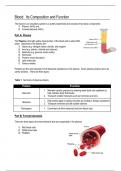
Blood: Its Composition and Function
The blood in our circulatory system is a watery based fluid and consists of two basic components:
1) Plasma (55%) and,
2) Formed elements (45%)

Part A: Plasma
The Plasma is the light yellow liquid portion of the blood and is about 90%
water. Dissolved in the plasma are:
1) Gases (e.g. nitrogen carbon dioxide, and oxygen)
2) Ions (e.g. sodium, chloride and calcium)
3) Nutrients (e.g. glucose, amino acids)
4) Hormones
5) Proteins (most abundant)
6) Lipid molecules
7) Various wastes

Proteins are the most abundant of all dissolved substances in the plasma. Some plasma proteins serve as
carrier proteins. There are three types:


Table 1: Summary of plasma proteins

Protein Function
1. Maintain osmotic pressure by drawing water back into capillaries to
Albumins help maintain body fluid levels.
2. Transport smaller molecules such as hormones and ions
1. Help protect again invading microbes by binding to foreign substances
Globulins
2. Transport hormones and fat soluble vitamins

Fibrinogens 1. Converted into fibrin networks that form blood clots.


Part B: Formed elements
There are three types of formed elements that are suspended in the plasma:

1) Red blood cells
2) White blood cells
3) Platelets

$9.49
Get access to the full document:

100% satisfaction guarantee
Immediately available after payment
Both online and in PDF
No strings attached

Get to know the seller
Seller avatar
angelamakinyaa

Get to know the seller

Seller avatar
angelamakinyaa Chamberlain College Of Nursing
View profile
Follow You need to be logged in order to follow users or courses
Sold
0
Member since
1 year
Number of followers
0
Documents
211
Last sold
-
exam questions with answer ,class notes

EXCELLENT HOMEWORK HELP AND TUTORING ,ALL KIND OF QUIZ AND EXAMS WITH GUARANTEE OF A Am an expert on major courses especially; psychology,Nursing, Human resource Management and Mathemtics Assisting students with quality work is my first priority. I ensure scholarly standards in my documents and that's why i'm one of the BEST GOLD RATED TUTORS in STUVIA. I assure a GOOD GRADE if you will use my work.

0.0

0 reviews

5
0
4
0
3
0
2
0
1
0

Recently viewed by you

Why students choose Stuvia

Created by fellow students, verified by reviews

Quality you can trust: written by students who passed their tests and reviewed by others who've used these notes.

Didn't get what you expected? Choose another document

No worries! You can instantly pick a different document that better fits what you're looking for.

Pay as you like, start learning right away

No subscription, no commitments. Pay the way you're used to via credit card and download your PDF document instantly.

Student with book image

“Bought, downloaded, and aced it. It really can be that simple.”

Alisha Student

Frequently asked questions
