GPSTC EXAM 2 – CRIMINAL PROCEDURE
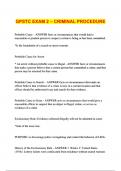
Probable Cause – ANSWER facts or circumstances that would lead a
reasonable or prudent person to suspect a crime is being or has been committed.
*Is the foundation of a search or arrest warrant.
Probable Cause for Arrest
* An arrest without probable cause is illegal - ANSWER facts or circumstances
that make a person believe that a certain person has committed a crime, and that
person may be arrested for that crime.
Probable Cause to Search – ANSWER facts or circumstances that make an
officer believe that evidence of a crime is now in a certain location and that
officer should be authorized to go and search for that evidence.
Probable Cause to Seize - ANSWER acts or circumstances that would give a
reasonable officer to suspect that an object is illegal, stolen, or serves as
evidence of a crime
Exclusionary Rule: Evidence collected illegally will not be admitted in court.
*fruit of the toxic tree.
PURPOSE: to discourage police wrongdoing and control the behavior of LEOs.
History of the Exclusionary Rule - ANSWER 1. Weeks V. United States
(1914): Lottery tickets were confiscated from residence without search warrant.
, *At the time, the provision applied only to the federal government.
*If this evidence was permitted, it would reduce the Fourth Amendment.
2. Wolfe v. Colorado (1949): The Silver Platter doctrine was struck down.
*At this time, the exclusionary rule did not apply to local officers.
*Silver Platter Doctrine: Federal agents went to local officers and asked them to
inspect people's property without a warrant and pass over any evidence to the
federal government.
3. Mapp v. Ohio (1961): When evidence was gathered in violation of the Fourth
Amendment (unreasonable search) it could not be admitted in a STATE court
criminal trial.
* Because of this, the exclusionary rule has now been applied to state, county,
and local governments.
*Everyone must now acquire a warrant in order to legally obtain evidence.
Exceptions to the Exclusionary Rule - ANSWER 1. Good Faith Exception
2. Independent Source
3. The Inevitable Discovery
4. Eliminated Taint
1. Good Faith Exception.
*DOES NOT APPLY IN GEORGIA - ANSWER US V. LEON (1984):
Probable Cause – ANSWER facts or circumstances that would lead a
reasonable or prudent person to suspect a crime is being or has been committed.
*Is the foundation of a search or arrest warrant.
Probable Cause for Arrest
* An arrest without probable cause is illegal - ANSWER facts or circumstances
that make a person believe that a certain person has committed a crime, and that
person may be arrested for that crime.
Probable Cause to Search – ANSWER facts or circumstances that make an
officer believe that evidence of a crime is now in a certain location and that
officer should be authorized to go and search for that evidence.
Probable Cause to Seize - ANSWER acts or circumstances that would give a
reasonable officer to suspect that an object is illegal, stolen, or serves as
evidence of a crime
Exclusionary Rule: Evidence collected illegally will not be admitted in court.
*fruit of the toxic tree.
PURPOSE: to discourage police wrongdoing and control the behavior of LEOs.
History of the Exclusionary Rule - ANSWER 1. Weeks V. United States
(1914): Lottery tickets were confiscated from residence without search warrant.
, *At the time, the provision applied only to the federal government.
*If this evidence was permitted, it would reduce the Fourth Amendment.
2. Wolfe v. Colorado (1949): The Silver Platter doctrine was struck down.
*At this time, the exclusionary rule did not apply to local officers.
*Silver Platter Doctrine: Federal agents went to local officers and asked them to
inspect people's property without a warrant and pass over any evidence to the
federal government.
3. Mapp v. Ohio (1961): When evidence was gathered in violation of the Fourth
Amendment (unreasonable search) it could not be admitted in a STATE court
criminal trial.
* Because of this, the exclusionary rule has now been applied to state, county,
and local governments.
*Everyone must now acquire a warrant in order to legally obtain evidence.
Exceptions to the Exclusionary Rule - ANSWER 1. Good Faith Exception
2. Independent Source
3. The Inevitable Discovery
4. Eliminated Taint
1. Good Faith Exception.
*DOES NOT APPLY IN GEORGIA - ANSWER US V. LEON (1984):