2 0 2 4 /2025 | © copyright | This work may not be copied for profit gain Excel!
PN 131 Quiz 4 NCLEX Questions and
Answers 2024/2025
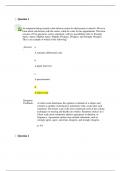
A nurse is teaching a parent how to administer antibiotics at home to a toddler with acute otitis
media. Which statement by the parent indicates that teaching has been successful?
1. "I'll give the antibiotics for the full 10-day course of treatment."
2. "I'll give the antibiotics until my child's ear pain is gone."
3. "Whenever my child is cranky or pulls on an ear, I'll give a dose of antibiotics."
4. "If the ear pain is gone, there's no need to see the physician for another examination of the
ears."
1. "I'll give the antibiotics for the full 10-day course of treatment."
RATIONALE: The mother demonstrates understanding of antibiotic therapy by stating she'll
give the full 10-day course of treatment. Antibiotics must be given for the full course of
therapy, even if the child feels well. Otherwise, the infection won't be eradicated. Antibiotics
should be taken at ordered intervals to maintain blood levels and not as needed for pain. A
reexamination at the end of the course of antibiotics is necessary to confirm that the infection
is resolved.
A toddler develops acute otitis media and is ordered cefpodoxime proxetil (Vantin) 5 mg/kg
P.O. every 12 hours. If the child weighs 22 lb (10 kg), how many milligrams will the nurse
administer with each dose?
1. 50 mg
1|Page| GradeA+ | 2 0 0 2 5
,2 0 2 4 /2025 | © copyright | This work may not be copied for profit gain Excel!
2. 100 mg
3. 110 mg
4. 220 mg
1. 50 mg
RATIONALE: The dose is 5 mg/kg and the child weighs 10 kg. To determine the dose, the
nurse would calculate: 5 mg/1 kg × 10 kg = 50 mg per dose.
A nurse is teaching parents about accident prevention for a toddler. Which guidelines is most
appropriate? Select all that apply
1. Always make the toddler wear a seat belt when riding in a car.
2. Make sure all medications are kept in containers with childproof safety caps.
3. Never leave a toddler unattended on a bed.
4. Teach rules of the road for bicycle safety.
1, 2
RATIONALE: Making sure all medications are kept in containers with childproof safety caps is
the most appropriate guideline because poisoning accidents are common in toddlers owing to
the toddler's curiosity and his increasing mobility and ability to climb. When riding in a car, a
toddler should be strapped into a car seat, not a seat belt. A seat belt is an appropriate
guideline for a school-age child. Never leaving a child alone on a bed is an appropriate
guideline for parents of infants. Toddlers already have the ability to climb on and off of beds
and other furniture by themselves. Note, however, that toddlers should never be left
1|Page| GradeA+ | 2 0 0 2 5
, 2 0 2 4 /2025 | © copyright | This work may not be copied for profit gain Excel!
unattended on high surfaces, such as an examining table in a physician's office. Teaching the
rules of the road for bicycle safety is an appropriate safety measure for a school-age child.
Toddlers shouldn't be allowed in the road unsupervised.
Before performing an otoscopic examination on a child, where should the nurse palpate for
tenderness?
1. Tragus, mastoid process, and helix
2. Helix, umbo, and tragus
3. Tragus, cochlea, and lobule
4. Mastoid process, incus, and malleus
1. Tragus, mastoid process, and helix
RATIONALE: Before inserting the otoscope, the nurse should palpate the child's external ear,
especially the tragus and mastoid process, and should pull the helix backward to determine
the presence of pain or tenderness. The umbo, incus, and malleus (parts of the middle ear) and
the cochlea (part of the inner ear) aren't palpable.
An adolescent is diagnosed with lead poisoning. After emphasizing the importance of
consuming dietary iron, the nurse asks him to select iron-rich breakfast items from a sample
menu. Which selection demonstrates knowledge of dietary iron sources?
1. Grapefruit and white toast
1|Page| GradeA+ | 2 0 0 2 5
PN 131 Quiz 4 NCLEX Questions and
Answers 2024/2025
A nurse is teaching a parent how to administer antibiotics at home to a toddler with acute otitis
media. Which statement by the parent indicates that teaching has been successful?
1. "I'll give the antibiotics for the full 10-day course of treatment."
2. "I'll give the antibiotics until my child's ear pain is gone."
3. "Whenever my child is cranky or pulls on an ear, I'll give a dose of antibiotics."
4. "If the ear pain is gone, there's no need to see the physician for another examination of the
ears."
1. "I'll give the antibiotics for the full 10-day course of treatment."
RATIONALE: The mother demonstrates understanding of antibiotic therapy by stating she'll
give the full 10-day course of treatment. Antibiotics must be given for the full course of
therapy, even if the child feels well. Otherwise, the infection won't be eradicated. Antibiotics
should be taken at ordered intervals to maintain blood levels and not as needed for pain. A
reexamination at the end of the course of antibiotics is necessary to confirm that the infection
is resolved.
A toddler develops acute otitis media and is ordered cefpodoxime proxetil (Vantin) 5 mg/kg
P.O. every 12 hours. If the child weighs 22 lb (10 kg), how many milligrams will the nurse
administer with each dose?
1. 50 mg
1|Page| GradeA+ | 2 0 0 2 5
,2 0 2 4 /2025 | © copyright | This work may not be copied for profit gain Excel!
2. 100 mg
3. 110 mg
4. 220 mg
1. 50 mg
RATIONALE: The dose is 5 mg/kg and the child weighs 10 kg. To determine the dose, the
nurse would calculate: 5 mg/1 kg × 10 kg = 50 mg per dose.
A nurse is teaching parents about accident prevention for a toddler. Which guidelines is most
appropriate? Select all that apply
1. Always make the toddler wear a seat belt when riding in a car.
2. Make sure all medications are kept in containers with childproof safety caps.
3. Never leave a toddler unattended on a bed.
4. Teach rules of the road for bicycle safety.
1, 2
RATIONALE: Making sure all medications are kept in containers with childproof safety caps is
the most appropriate guideline because poisoning accidents are common in toddlers owing to
the toddler's curiosity and his increasing mobility and ability to climb. When riding in a car, a
toddler should be strapped into a car seat, not a seat belt. A seat belt is an appropriate
guideline for a school-age child. Never leaving a child alone on a bed is an appropriate
guideline for parents of infants. Toddlers already have the ability to climb on and off of beds
and other furniture by themselves. Note, however, that toddlers should never be left
1|Page| GradeA+ | 2 0 0 2 5
, 2 0 2 4 /2025 | © copyright | This work may not be copied for profit gain Excel!
unattended on high surfaces, such as an examining table in a physician's office. Teaching the
rules of the road for bicycle safety is an appropriate safety measure for a school-age child.
Toddlers shouldn't be allowed in the road unsupervised.
Before performing an otoscopic examination on a child, where should the nurse palpate for
tenderness?
1. Tragus, mastoid process, and helix
2. Helix, umbo, and tragus
3. Tragus, cochlea, and lobule
4. Mastoid process, incus, and malleus
1. Tragus, mastoid process, and helix
RATIONALE: Before inserting the otoscope, the nurse should palpate the child's external ear,
especially the tragus and mastoid process, and should pull the helix backward to determine
the presence of pain or tenderness. The umbo, incus, and malleus (parts of the middle ear) and
the cochlea (part of the inner ear) aren't palpable.
An adolescent is diagnosed with lead poisoning. After emphasizing the importance of
consuming dietary iron, the nurse asks him to select iron-rich breakfast items from a sample
menu. Which selection demonstrates knowledge of dietary iron sources?
1. Grapefruit and white toast
1|Page| GradeA+ | 2 0 0 2 5