GEG 111 Harper Exam Two
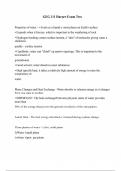
Properties of water - • Exists as a liquid at most places on Earth's surface • Expands when it freezes; which is important in the weathering of rock • Hydrogen bonding creates surface tension, a "skin" of molecules giving water a stickiness quality - surface tension • Capillarity; water can "climb" up narrow openings. This is important to the movement of groundwater. • Good solvent; water dissolves most substances • High specific heat; it takes a relatively high amount of energy to raise the temperature of water. Phase Changes and Heat Exchange - Water absorbs or releases energy as it changes from one state to another. • IMPORTANT: The heat exchanged between physical states of water provides more than 30% of the energy that powers the general circulation of the atmosphere. Latent Heat - The heat energy absorbed or released during a phase change. Three phases of water - 1) Ice: solid phase 2)Water: liquid phase 3)Water Vapor: gas phase Ice, the solid phase - • Upon freezing water expands in volume and density (Note: maximum density occurs while water is still in a liquid phase, at 4°C (39°F) • The decrease in density manifests itself in the buoyancy of ice in water • The increase in volume can damage infrastructure e.g. roads, pipes and plays an important role in the weathering (breakdown) of rocks Water, the liquid phase - Non-compressible fluid that assumes the shape of its container • The phase change from ice absorbs heat energy • A good solvent Water vapor, the gas phase - • Invisible and compressible gas • We see water vapor in the atmosphere after condensation has occurred in the form of clouds, fog, and steam • Water vapor is a greenhouse gas Humidity - Humidity is the amount of water vapor in the air • The water holding capacity of air is influenced by temperature of the air and water vapor • Humidity and air temperature determine our sense of comfort Relative humidity - A measure of how close the air is to saturation (% saturation) at a given temperature or the ratio of the amount of water vapor is in the air compared to the maximum amount of water vapor that the air can hold at a given temperature • Because there is a maximum amount of water vapor that can exist in a volume of air at a given temperature, the rates of evaporation and condensation can reach equilibrium at some point. Saturation and Dew point - • Saturation = 100% humidity • Dew-point temperature: temperature at which a given sample of air becomes saturated with water vapor and net condensation begins. Dry Adiabatic Rate (DAR) - rate at which "dry" air (i.e. unsaturated air) cools by expansion as it rises or warms by compression as it falls. The average DAR is 10 C°/1000 m (5.5 F°/1000 ft.) Moist Adiabatic Rate (MAR) - rate at which saturated air cools by expansion as it rises or warms by compression as it falls. The average DAR is 6 C°/1000 m (3.3 F°/1000 ft.) • MAR is lower than DAR because of the latent heat of condensation (cooling) and the latent heat of evaporation (heating) Environmental Lapse Rate (ELR) - The decrease in temperature with increasing altitude at a particular location and time. Stable Atmospheric conditions - The stability of air can be determined by comparing the DAR, MAR, and ELR rates at a location. • Stable Air: The DAR and MAR are greater than the ELR with altitude. i.e. the air parcel is cooler than the surrounding air with increasing altitude. The tendency will be to resist upward movement. Unstable Atmospheric conditions - Unstable Air: The DAR and MAR are lower than the ELR with altitude. i.e. the air parcel is warmer than the surrounding air with increasing altitude. The tendency will be to rise until temperature and density are equal. • Conditionally Unstable Air: the ELR is between the DAR and MAR. If the air parcel is less than saturated it resists upward movement. If it is saturated it becomes unstable and rises. Adiabatic Processes - Refers to atmospheric heating or cooling of a parcel of air that results from a change in pressure, without the exchange of heat with the surroundings Adiabatic Cooling and Warming - Adiabatic Cooling: cooling of a parcel of air with rising altitude Adiabatic Warming: warming of a parcel of air with decreasing altitude Windward side of mountain - • Air is forced up the windward side of the mountain, where adiabatic cooling takes place -Potential formation of clouds Mar Warm, moist side of mountain. Leeward side of mountain - Air flows down the leeward side of the mountain, where adiabatic warming takes place. • The leeward side of a mountain is sometimes referred to as the rain shadow Dar Chinook winds Hot, Dry Rain Shadow Lifting Condensation Level (LCL) - Altitude at which a parcel of air cools to the dew point temperature, allowing condensation to begin. Atmospheric lifting mechanisms - The processes through which masses of air are lifted leading to adiabatic cooling to the dew-point temperature potentially leading to cloud formation and precipitation. Convergent lifting - Occurs when air flows from opposite directions into one lowpressure zone leading to the upward displacement of air. The ITCZ is a convergent zone where the southeast and northeast trade winds meet. Convectional lifting - Occurs when surface heating causes lifting and convection in an air mass/parcel. If conditions are unstable the body of air continues to rise and clouds can develop. • Sources of heat include: warm land surfaces, urban heat islands. Orographic Lifting - Occurs when air is forced up the side of a mountain leading to adiabatic cooling and the potential formation of clouds. • Topographic barriers (mountains, islands in the ocean, other highlands) enhance convergent or frontal lifting. Frontal Lifting - Occurs along the boundary of unlike air masses (fronts) resulting in the uplifting of the warmer (less dense) air mass. • This type of lifting is common in the Midlatitudes along the Subpolar Low (Polar Front) • Cold and warm fronts are components of Midlatitude Cyclones Cold front - Formed when an advancing cold air mass, which is denser, advances and uplifts a warmer air mass leading to adiabatic cooling and potential instability • An approaching cold front is marked by shifting winds, dropping temperatures, and a drop in barometric pressure as the warm air is uplifted along the front's leading edge • Cumulonimbus clouds, heavy precipitation are associated with cold fronts • A squall line (zone of fast moving high winds and bands of storms along or slightly ahead of a front) may form along a cold front. Squall lines may be hundreds of miles long but are usually 10-20 miles wide. Warm front - • Formed when a warm air mass moves over a colder air mass. The warmer less dense air "rides" over the colder air leading to generally stable conditions Types of fog - Radiation, Advection, Evaporation, Orographic Effects Radiation fog - forms when the radiative cooling of a surface chills the air directly above the surface to dew-point temperature, leading to saturated conditions. Advection fog - Forms when air from one place migrates to another place where the conditions are right for saturation. Evaporation fog - Forms when cold air lies over a warm body of water, causing water molecules to evaporate from the H2O surface into the cold overlying air. Orographic or Upslope Fog - forms as moist air blows up a mountain slope and becomes saturated. Occluded front - when a cold front overtakes a warm front and forces the warm front up. Stationary front - A front that is not moving. Life Cycle of a Midlatitude cyclong - cyclogenesis--> open stage--> occluded stager--> dissolving stage. Cyclogenesis - A disturbance develops, usually along the polar front. Warm air converges near the surface and begins to rise, creating instability. Open stage - Cyclonic, counterclockwise flow pulls warm, moist air from the south into the low-pressure center while cold air advances southward west of the center Occluded Stage - The faster-moving cold front overtakes the slower warm front and wedges beneath it. This forms an occluded front, along which cold air pushes warm air upward, causing precipitation.
Written for
- Institution
-
Harper College
- Course
-
GEG 111 (GEG111)
Document information
- Uploaded on
- October 11, 2024
- Number of pages
- 13
- Written in
- 2024/2025
- Type
- Exam (elaborations)
- Contains
- Questions & answers
Subjects

Also available in package deal