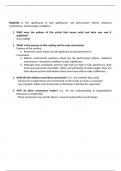
READING 1: The significance of task significance: Job performance effects, relational
mechanisms, and boundary conditions
1. WHO were the authors of this article (last names only) and what year was it
published?
- Grant (2008)
2. WHAT is the purpose of this reading and its main conclusions?
- Purpose of the reading:
o Assess the causal impact of task significant on job performance
- Conclusions
o Address unanswered questions about the job performance effects, relational
mechanisms + boundary conditions of task significance
o Although many employees perform jobs that are high in task significance, they
protect and promote the health, safety, and well-being of other people. They are
often distanced from information about how these efforts make a difference.
3. HOW did the authors reach these conclusions? (i.e., the methods they used)
- Carried out 3 experiments and commented on the results to reach a conclusion
- Use of graphs, tables and normal texts to illustrate or develop the arguments
4. WHY do these conclusions matter? (i.e., for our understanding of organisational
behaviour or leadership)
- These conclusions may aid the theory, research and practice on job design
mechanisms, and boundary conditions
1. WHO were the authors of this article (last names only) and what year was it
published?
- Grant (2008)
2. WHAT is the purpose of this reading and its main conclusions?
- Purpose of the reading:
o Assess the causal impact of task significant on job performance
- Conclusions
o Address unanswered questions about the job performance effects, relational
mechanisms + boundary conditions of task significance
o Although many employees perform jobs that are high in task significance, they
protect and promote the health, safety, and well-being of other people. They are
often distanced from information about how these efforts make a difference.
3. HOW did the authors reach these conclusions? (i.e., the methods they used)
- Carried out 3 experiments and commented on the results to reach a conclusion
- Use of graphs, tables and normal texts to illustrate or develop the arguments
4. WHY do these conclusions matter? (i.e., for our understanding of organisational
behaviour or leadership)
- These conclusions may aid the theory, research and practice on job design