

Production of aspirin
Aspirin is a drug used to treat pain, inflammation, and fever by reducing the bodily
substances that cause these symptoms. It is also used to treat/prevent
cardiovascular conditions under doctor supervision. Although pharmacologically
known as Aspirin, it consists of the active ingredient acetyl salicylic acid – active
ingredients are components that cause biologically active effects. Other than the
pharmacological use of Aspirin, Salicylic acid is used as an antibacterial agent for
products such as toothpaste or as a keratolytic agent (attracts moisture to the skin
by softening keratin – the proteins that support the outer barrier of our skin) for
cosmetics. Salicylic acid can be naturally extracted from sources such as willow tree
bark or synthesized by a chemical reaction to increase both yield and purity. The
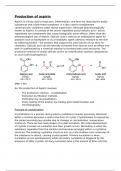
production reaction of acetyl salicylic acid is an esterification reaction catalyzed by
an acid (sulfuric/phosphoric):
(MW = Mr)
So, the production of Aspirin involves:
The production reaction – crystallization
Extraction by filtration methods
Purification by recrystallization
Purity testing of the product by melting point determination and
chromatography
Principle of crystallization
Crystallization is a process during which a substance (solute) previously dissolved
within a solution becomes a solid in the form of crystal. Crystallization is induced by
the solute becoming less soluble due to changes in concentration, temperature
or/and ph. There are two main stages of crystal formation: the initial development
of crystals is known as nucleation and then growth occurs. Nucleation is when the
substance separates from the solution and becomes arranged within a crystalline
structure. The existing crystalline structure acts as a site to allow more molecules of
the substance to attach, causing crystal growth. Primary nucleation is when
nucleation occurs spontaneously while secondary nucleation is triggered by the
presence of other crystals. Primary nucleation time is the amount of time until the
,first nucleus forms, distinguishing it from secondary nucleation times when other
nuclei form.
The saturation of the solution influences the amount to size ratio of the crystals. If a
solution is supersaturated, the crystal nucleation dominates the crystal growth
meaning more crystals will develop but they will be smaller. If a solution has low
saturation, crystals grow faster than they nucleate resulting in larger but fewer
crystals. For a solution to be supersaturated it must contain more of a dissolved
solute than considered normal for average conditions – higher temperatures and
polarity increase solubility, allowing higher saturations.
Principle of filtration
Simple filtration removes any solid impurities within a mixture by pouring the
mixture through porous filter paper which only allows liquids of low viscosity to
surpass its pores. The set up is as follows: The filter paper is folded into a cone to
line the surface of a funnel opening. The funnel is positioned above a conical flask
so that the impure mixture can be gradually poured into the funnel and through the
filter paper, collecting filtrate within the conical flask.
https://keystagewiki.com/images/thumb/9/91/FiltrationDiagram.png/500px-
FiltrationDiagram.png
The removed solid impurities result in a residue which can be disposed of.
The process of hot filtration follows the same principle as simple filtration but is
specifically for mixtures that crystalize at cool temperatures. The mixture is heated
before being filtered so that no crystals form, as these will also be removed from
the mixture, decreasing the product yield.
Vacuum pump filtration
Vacuum pump filtration increases the efficiency and speed of the filtration process,
utilizing the Buchner setup to do so: The impure mixture is poured into a Buchner
funnel which holds both a filter paper and filter plate (a porous plate which also only
allows liquid of low viscosity to surpass its pores), increasing the efficiency. The
Buchner funnel is positioned above a Buchner Flask which has an opening to
connect the flask to a vacuum pump. This creates a pressure difference across the
, filters so that there is a partial vacuum within the flask to suction the filtrate,
increasing the speed.
https://www.bing.com/images/blob?bcid=RHeLz1T7PAoHqxcxoNWLuD9SqbotqVTdPxM
(the preferred method is for the suction to be from a vacuum pump, not an
aspirator)
Principle of recrystallization
Recrystallization is a purification process - removes impurities - for crystal product.
It utilizes the principle that different substances are more soluble within certain
temperatures. So, the method of recrystallization allows the desired product to
recrystallize within a solvent of a temperature that the impurities are more soluble
within than the desired product is so that the impurities are more likely to remain
dissolved within the solution while only the desired product crystallizes. You should
add a minimum amount of the solvent to minimize the loss of product yield. These
crystals are then extracted with simple filtration, allowing the impurities that have
solubilized within the solvent (soluble impurities) to pass through the filter.
It is preferred that the desired product is more soluble within a hot solvent so that it
can crystallize as the solvent cools. Utilizing a combination of hot filtration and
vacuum pump filtration, the solvent should be filtered while still hot to remove
impurities that are less soluble/insoluble. The filtrate should then be allowed to cool
slowly as this encourages a larger, more regular crystal structure making it less
likely for impurities to fit within them. Again, simple filtration is used to extract the
developed crystals.
Principle of purity testing methods
The products need to be tested to ensure they are pure enough:
Aspirin is a drug used to treat pain, inflammation, and fever by reducing the bodily
substances that cause these symptoms. It is also used to treat/prevent
cardiovascular conditions under doctor supervision. Although pharmacologically
known as Aspirin, it consists of the active ingredient acetyl salicylic acid – active
ingredients are components that cause biologically active effects. Other than the
pharmacological use of Aspirin, Salicylic acid is used as an antibacterial agent for
products such as toothpaste or as a keratolytic agent (attracts moisture to the skin
by softening keratin – the proteins that support the outer barrier of our skin) for
cosmetics. Salicylic acid can be naturally extracted from sources such as willow tree
bark or synthesized by a chemical reaction to increase both yield and purity. The
production reaction of acetyl salicylic acid is an esterification reaction catalyzed by
an acid (sulfuric/phosphoric):
(MW = Mr)
So, the production of Aspirin involves:
The production reaction – crystallization
Extraction by filtration methods
Purification by recrystallization
Purity testing of the product by melting point determination and
chromatography
Principle of crystallization
Crystallization is a process during which a substance (solute) previously dissolved
within a solution becomes a solid in the form of crystal. Crystallization is induced by
the solute becoming less soluble due to changes in concentration, temperature
or/and ph. There are two main stages of crystal formation: the initial development
of crystals is known as nucleation and then growth occurs. Nucleation is when the
substance separates from the solution and becomes arranged within a crystalline
structure. The existing crystalline structure acts as a site to allow more molecules of
the substance to attach, causing crystal growth. Primary nucleation is when
nucleation occurs spontaneously while secondary nucleation is triggered by the
presence of other crystals. Primary nucleation time is the amount of time until the
,first nucleus forms, distinguishing it from secondary nucleation times when other
nuclei form.
The saturation of the solution influences the amount to size ratio of the crystals. If a
solution is supersaturated, the crystal nucleation dominates the crystal growth
meaning more crystals will develop but they will be smaller. If a solution has low
saturation, crystals grow faster than they nucleate resulting in larger but fewer
crystals. For a solution to be supersaturated it must contain more of a dissolved
solute than considered normal for average conditions – higher temperatures and
polarity increase solubility, allowing higher saturations.
Principle of filtration
Simple filtration removes any solid impurities within a mixture by pouring the
mixture through porous filter paper which only allows liquids of low viscosity to
surpass its pores. The set up is as follows: The filter paper is folded into a cone to
line the surface of a funnel opening. The funnel is positioned above a conical flask
so that the impure mixture can be gradually poured into the funnel and through the
filter paper, collecting filtrate within the conical flask.
https://keystagewiki.com/images/thumb/9/91/FiltrationDiagram.png/500px-
FiltrationDiagram.png
The removed solid impurities result in a residue which can be disposed of.
The process of hot filtration follows the same principle as simple filtration but is
specifically for mixtures that crystalize at cool temperatures. The mixture is heated
before being filtered so that no crystals form, as these will also be removed from
the mixture, decreasing the product yield.
Vacuum pump filtration
Vacuum pump filtration increases the efficiency and speed of the filtration process,
utilizing the Buchner setup to do so: The impure mixture is poured into a Buchner
funnel which holds both a filter paper and filter plate (a porous plate which also only
allows liquid of low viscosity to surpass its pores), increasing the efficiency. The
Buchner funnel is positioned above a Buchner Flask which has an opening to
connect the flask to a vacuum pump. This creates a pressure difference across the
, filters so that there is a partial vacuum within the flask to suction the filtrate,
increasing the speed.
https://www.bing.com/images/blob?bcid=RHeLz1T7PAoHqxcxoNWLuD9SqbotqVTdPxM
(the preferred method is for the suction to be from a vacuum pump, not an
aspirator)
Principle of recrystallization
Recrystallization is a purification process - removes impurities - for crystal product.
It utilizes the principle that different substances are more soluble within certain
temperatures. So, the method of recrystallization allows the desired product to
recrystallize within a solvent of a temperature that the impurities are more soluble
within than the desired product is so that the impurities are more likely to remain
dissolved within the solution while only the desired product crystallizes. You should
add a minimum amount of the solvent to minimize the loss of product yield. These
crystals are then extracted with simple filtration, allowing the impurities that have
solubilized within the solvent (soluble impurities) to pass through the filter.
It is preferred that the desired product is more soluble within a hot solvent so that it
can crystallize as the solvent cools. Utilizing a combination of hot filtration and
vacuum pump filtration, the solvent should be filtered while still hot to remove
impurities that are less soluble/insoluble. The filtrate should then be allowed to cool
slowly as this encourages a larger, more regular crystal structure making it less
likely for impurities to fit within them. Again, simple filtration is used to extract the
developed crystals.
Principle of purity testing methods
The products need to be tested to ensure they are pure enough:


