

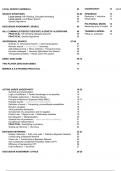
LOCAL SEARCH (GENERAL) 03 UNCERTAINTY 12 (quote
SEARCH STRATEGIES 04-05 INFERENCE 13
Local search: Hill-Climbing, Simulated Annealing 04 Deductive / Inductive 13
Local search: Local Beam Search 05 Observation 13
Genetic Algorithms 05
POLYNOMIAL MODEL 14
DISCUSSION ASSIGNMENT: SEARLE 05 Measuring error of model 14
HILL CLIMBING (STEEPEST DESCENT) & GENETIC ALGORITHMS 06 TRAINING A MODEL 15
PRACTICAL: Hill Climbing (steepest descent) 06 Fitting vs. prediction 15
PRACTICAL: Genetic Algorithms 06
ADVERSARIAL SEARCH 07-08
Ordinary vs. Adversarial Search / Adversarial games 07
Minimax search (+ complexity) / Summary 07
Alpha-Beta pruning / Move ordering / Forward pruning 08
Heuristic strategies / Heuristic Alpha-Beta Tree Search 08
Transpositional tables / Monte Carlo Tree search 08
DEMO: GRID GAME 09-10
TWO-PLAYER ZERO-SUM GAMES 10
MINIMAX & A-B PRUNING PRACTICAL 11
ACTING UNDER UNCERTAINTY 16-22
Symbols and interpretation 16
Logic is insufficient / Perfect knowledge is not possible 16
Probability statements / Decision theory 16
Principle of Maximum Expected Utility (MEU) 16-17
Possible worlds (+ symbols and interpretation) 17
Definition of event / Computing (un)conditional probabilities 18
Random variables 18
Joint probability distribution 19
Complement of a proposition and its negation 19
Product rule / Bayes’s rule / Multivalued variables 19
Normalisation / Marginalisation 20
General form of procedure (+ space and time complexity) 21
(Conditional) independence 21
PRACTICAL: Quantifying uncertainty 22
Scaling up inference / Summary 22
BAYESIAN NETWORKS 23-27
Graphs, Networks / Path, trail, walk / Definition Bayesian Network 23
Constructing a Bayesian Network 24
Chain rule / Constructing a Bayesian Network 25
Size complexity Conditional Probability Tables (CPT) 26
Efficiency of representing CPT 26
Exact inference / Summary 27
DISCUSSION ASSIGNMENT: ETHICS 28-29
, LOCAL SEARCH (GENERAL
3
SEARCH STRATEGIES
STRATEGY COMMENTS PROBLEMS IMPROVEMENTS
Hill-Climbing ● Keeps track of only one current ● Local Maxima ● Allow for a limited number of sideways moves (if on plateau that
state (no backtracking) ● Plateaus (flat local is really a shoulder) (Higher success rate + Higher number of
If elevation = ● Does not look beyond the maximum or moves)
objective → immediate neighbours of the shoulder) ● Stochastic hill climbing: random selection between the uphill
Hill-Climbing current state (greedy) ● Ridges: Sequence of moves, with probability related to steepness.
If elevation = ● On each iteration moves to the local maxima that are ● First-choice hill climbing: random testing of successors until
cost → find neighboring state with highest not directly one is found that is better than the current state. Good strategy
the global value (steepest ascent) connected, Each local when testing all successors is costly
minimum or ● Terminates when a peak is maxima only has ● Random-restart hill climbing: do a number of hill-climbing
lowest valley reached (no neighbor has a worse connecting searches from randomly selected states. If each hill-climbing
→ Steepest higher value) states, Common in search has probability of success p then solution will be found on
Descent low-dimensional state average after 1/p restarts. Will eventually find the correct solution
(Category: Local search) spaces because goal state will be initial state.
Simulated ● Move to randomly chosen ● Problem with hill climbing: efficient, but will get stuck in a local maximum.
Annealing neighbor state ● Problem with random walk: most inefficient, but will eventually find the local maximum.
● If utility is higher, always move to ● Combination of both → simulated annealing (more complete and efficient)
(Category: that state.
Local ● If utility is lower, move to that
search) state with probability p < 1.
● Probability of a move to a worse
state
● Becomes less likely the worse
the move makes the situation
● Becomes less likely as
temperature decreases
4
SEARCH STRATEGIES 04-05 INFERENCE 13
Local search: Hill-Climbing, Simulated Annealing 04 Deductive / Inductive 13
Local search: Local Beam Search 05 Observation 13
Genetic Algorithms 05
POLYNOMIAL MODEL 14
DISCUSSION ASSIGNMENT: SEARLE 05 Measuring error of model 14
HILL CLIMBING (STEEPEST DESCENT) & GENETIC ALGORITHMS 06 TRAINING A MODEL 15
PRACTICAL: Hill Climbing (steepest descent) 06 Fitting vs. prediction 15
PRACTICAL: Genetic Algorithms 06
ADVERSARIAL SEARCH 07-08
Ordinary vs. Adversarial Search / Adversarial games 07
Minimax search (+ complexity) / Summary 07
Alpha-Beta pruning / Move ordering / Forward pruning 08
Heuristic strategies / Heuristic Alpha-Beta Tree Search 08
Transpositional tables / Monte Carlo Tree search 08
DEMO: GRID GAME 09-10
TWO-PLAYER ZERO-SUM GAMES 10
MINIMAX & A-B PRUNING PRACTICAL 11
ACTING UNDER UNCERTAINTY 16-22
Symbols and interpretation 16
Logic is insufficient / Perfect knowledge is not possible 16
Probability statements / Decision theory 16
Principle of Maximum Expected Utility (MEU) 16-17
Possible worlds (+ symbols and interpretation) 17
Definition of event / Computing (un)conditional probabilities 18
Random variables 18
Joint probability distribution 19
Complement of a proposition and its negation 19
Product rule / Bayes’s rule / Multivalued variables 19
Normalisation / Marginalisation 20
General form of procedure (+ space and time complexity) 21
(Conditional) independence 21
PRACTICAL: Quantifying uncertainty 22
Scaling up inference / Summary 22
BAYESIAN NETWORKS 23-27
Graphs, Networks / Path, trail, walk / Definition Bayesian Network 23
Constructing a Bayesian Network 24
Chain rule / Constructing a Bayesian Network 25
Size complexity Conditional Probability Tables (CPT) 26
Efficiency of representing CPT 26
Exact inference / Summary 27
DISCUSSION ASSIGNMENT: ETHICS 28-29
, LOCAL SEARCH (GENERAL
3
SEARCH STRATEGIES
STRATEGY COMMENTS PROBLEMS IMPROVEMENTS
Hill-Climbing ● Keeps track of only one current ● Local Maxima ● Allow for a limited number of sideways moves (if on plateau that
state (no backtracking) ● Plateaus (flat local is really a shoulder) (Higher success rate + Higher number of
If elevation = ● Does not look beyond the maximum or moves)
objective → immediate neighbours of the shoulder) ● Stochastic hill climbing: random selection between the uphill
Hill-Climbing current state (greedy) ● Ridges: Sequence of moves, with probability related to steepness.
If elevation = ● On each iteration moves to the local maxima that are ● First-choice hill climbing: random testing of successors until
cost → find neighboring state with highest not directly one is found that is better than the current state. Good strategy
the global value (steepest ascent) connected, Each local when testing all successors is costly
minimum or ● Terminates when a peak is maxima only has ● Random-restart hill climbing: do a number of hill-climbing
lowest valley reached (no neighbor has a worse connecting searches from randomly selected states. If each hill-climbing
→ Steepest higher value) states, Common in search has probability of success p then solution will be found on
Descent low-dimensional state average after 1/p restarts. Will eventually find the correct solution
(Category: Local search) spaces because goal state will be initial state.
Simulated ● Move to randomly chosen ● Problem with hill climbing: efficient, but will get stuck in a local maximum.
Annealing neighbor state ● Problem with random walk: most inefficient, but will eventually find the local maximum.
● If utility is higher, always move to ● Combination of both → simulated annealing (more complete and efficient)
(Category: that state.
Local ● If utility is lower, move to that
search) state with probability p < 1.
● Probability of a move to a worse
state
● Becomes less likely the worse
the move makes the situation
● Becomes less likely as
temperature decreases
4


