

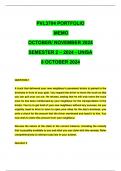
PVL3704 PORTFOLIO
MEMO
OCTOBER/ NOVEMBER 2024
SEMESTER 2 – 2024 - UNISA
8 OCTOBER 2024
QUESTION 1
A truck that delivered your new neighbour's pavement bricks is parked in the
driveway in front of your gate. You request the driver to move the truck so that
you can pull your car out. He refuses, stating that he will only move the truck
once he has been reimbursed by your neighbour for the transportation of the
bricks. You try to get hold of your new neighbour without any success. As you
urgently need to drive to town to open your shop for the day's business, you
write a check for the amount that the driver mentioned and hand it to him. You
now wish to claim this amount from your neighbour.
Discuss the nature of the claim in the current instance, including the remedy
that is possibly available to you and what you can claim with this remedy. Refer
comprehensively to relevant case law in your answer.
Question 2
, Briefly discuss the field of application and the requirements of the condictio
sine causa specialis. (10)
QUESTION 3
A has died, apparently leaving an estate worth R2 million net after all the debts
had been lodged and settled. In his will he has left all his assets to B and C in
equal shares. After the winding up of the estate by attorneys KLM, B and C each
received their legacy of R1 million. It later comes to light that X, a creditor of A,
had failed to submit a claim against the deceased estate for an amount of R3
million.
Creditors D (who was owed R800.000), E (who was owed R200.000) and F (who
was owed R500.000) were paid in full. Advise X whether it can claim the money
from KLM, or from B and C, or from D, E and
F. Discuss the nature of the claim and discuss when such a claim would become
prescribed.
(20)
Question 4
A has concluded a contract with B in terms of which B must paint the exterior
of A's house for R20.000 while A is on holiday. However, due to a mix up in
addresses (not caused by A) B painted C's house instead, who was also on
holiday during this period. C's house also seemed to need a fresh coat of paint.
Can b claim anything from a or c? if so explain in detail which action b can use,
how the claim should be quantified and any defence that a or c may raise against
the claim by b?
Question 1
MEMO
OCTOBER/ NOVEMBER 2024
SEMESTER 2 – 2024 - UNISA
8 OCTOBER 2024
QUESTION 1
A truck that delivered your new neighbour's pavement bricks is parked in the
driveway in front of your gate. You request the driver to move the truck so that
you can pull your car out. He refuses, stating that he will only move the truck
once he has been reimbursed by your neighbour for the transportation of the
bricks. You try to get hold of your new neighbour without any success. As you
urgently need to drive to town to open your shop for the day's business, you
write a check for the amount that the driver mentioned and hand it to him. You
now wish to claim this amount from your neighbour.
Discuss the nature of the claim in the current instance, including the remedy
that is possibly available to you and what you can claim with this remedy. Refer
comprehensively to relevant case law in your answer.
Question 2
, Briefly discuss the field of application and the requirements of the condictio
sine causa specialis. (10)
QUESTION 3
A has died, apparently leaving an estate worth R2 million net after all the debts
had been lodged and settled. In his will he has left all his assets to B and C in
equal shares. After the winding up of the estate by attorneys KLM, B and C each
received their legacy of R1 million. It later comes to light that X, a creditor of A,
had failed to submit a claim against the deceased estate for an amount of R3
million.
Creditors D (who was owed R800.000), E (who was owed R200.000) and F (who
was owed R500.000) were paid in full. Advise X whether it can claim the money
from KLM, or from B and C, or from D, E and
F. Discuss the nature of the claim and discuss when such a claim would become
prescribed.
(20)
Question 4
A has concluded a contract with B in terms of which B must paint the exterior
of A's house for R20.000 while A is on holiday. However, due to a mix up in
addresses (not caused by A) B painted C's house instead, who was also on
holiday during this period. C's house also seemed to need a fresh coat of paint.
Can b claim anything from a or c? if so explain in detail which action b can use,
how the claim should be quantified and any defence that a or c may raise against
the claim by b?
Question 1


