100% satisfaction guarantee Immediately available after payment Both online and in PDF No strings attached 4.2 TrustPilot
logo-home
Exam (elaborations)

ISTQB 1: Fundamentals of Testing Latest(2024/2025) Questions and Answers 100% Correct.

Rating
-
Sold
-
Pages
3
Grade
A+
Uploaded on
02-10-2024
Written in
2024/2025

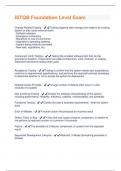
Test Plan - ️️A document describing the scope, approach, resources & schedule of intended test activities. It identifies, amongst others, test items, the features to be tested, the testing talks, who will do each task, degree of tester independence, the test environment, the test design techniques, and entry and exit criteria to be used and the rationale for their choice, and any risks requiring contingency planning. Testing - ️️The process consisting of all life cycle activities, both static and dynamic, concerned with planning, preparation, and evaluation of software products and related work products to determine that they satisfy specified requirements, to demonstrate that they are fit for purpose and to detect defects. Risk - ️️A factor that could result in future negative consequences, usually expressed as impact or likelihood. Error (mistake) - ️️A human action that produces an incorrect result. Defect (bug, fault) - ️️A flaw in a component or system that can cause the component or system to fail to perform its required function. E.g. an incorrect statement or data definition. A defect if encountered during execution, may cause a failure of the component or system. Failure - ️️Deviation of the component or system from its expected delivery, service or result. Quality - ️️The degree to which a component, system, or process meets specified requirements and/or user/customer needs and expectations. Requirement - ️️A condition or capability needed by a user to solve a problem or achieve an objective that must be met or possessed by a system or system component to satisfy a contract, standard, specification, or other formally imposed document. Review - ️️An evaluation of a product or project status to ascertain discrepancies from planned results and to recommend improvements. E.g. management review, informal review, inspection, and walk through. Exhaustive Testing (complete testing) - ️️A test approach in which the test suite comprises all combination of input values and preconditions.Confirmation Testing (re-testing) - ️️Testing that runs test cases that failed the last time that they were run, in order to verify the success of corrective actions. Regression Testing - ️️Testing of a previously tested program following modification to ensure that defects haven't been introduced or uncovered in unchanged areas of the software as a result of the made. Test Case - ️️A set of input values, execution preconditions, expected results and execution post-conditions, developed for a particular objective or test condition, such as to exercise a particular program path or to verify compliance with a specific requirement. Test Objective - ️️A reason or purpose for designing and executing a test. Debugging - ️️The process of finding, analyzing, and removing the cause of failures in software. Test Policy - ️️A high-level document describing the principles, approach, and major objectives of the organization regarding testing. Test Strategy - ️️A high-level description of the test levels to be performed and the testing within those levels for an organization or program (one or more projects) Coverage (test coverage) - ️️The degree, expressed as a percentage, to which a specified coverage item has been exercised by a test suite. Exit Criteria - ️️The set of generic and specific conditions, agreed upon with the stakeholders, for permitting a process to be officially completed. Test Control - ️️A test management task that deals with developing & applying a set of corrective actions to get a test project on track when monitoring shows a deviation from what was planned. Test Monitoring - ️️A test management task that deals with the activities related to periodically checking the status of a test project. Reports are prepared that compare the actual status to that which was planned. Test Basis - ️️All documents from which the requirements of a component or system can be inferred. The documentation on which the cases are based. If a document can be amended only by way of formal amendment procedure, then the test basis is called a 'frozen' test basis.Test Design Specification - ️️A document specifying the test conditions (coverage items) for a test item, the detailed test approach and the associated high-level test cases. Test Script Manual Test Specification - ️️A document specifying a sequence of actions for the execution of a test. Test Data - ️️Data that exists (e.g. in a database) before a test in executed, and that affects or is affected by the component or system under test. Test Suite - ️️A set of several test cases for a component or system under test, where the post-condition of one test is often used as the precondition for the next one. Test Execution - ️️The process of running a test by the component or system under test, producing actual results. Test Log - ️️A chronological record of relevant details about the execution of tests. Incident - ️️An event occurring that requires investigation. Test Summary Report - ️️A document summarizing testing activities & results. It also contains an evaluation of the corresponding test items against exit criteria. Testware - ️️Artifact produced during the test process required to plan, design, & execute tests, such as documentation, scripts, inputs, expected results, set-up, clear-up procedures, files, databases, environment, and any additional software or utilities used in testing. Independence - ️️Separation of responsibilities, which encourages the accomplishment of objective testing. Test Condition - ️️An item or event of a component or system that could be verified by one or more test cases. E.g. a function, a transaction, quality attributes, feature, or structural element. Test Approach - ️️The implementation of the test strategy for a specific project. It typically includes the decisions made based on the (test) project's goal and the risk assessment carried out, starting points regarding the test design techniques to be applied, exit criteria and test types to be performed.

Show more Read less
Institution
ISTQB 1: Fundamentals Of Testing
Course
ISTQB 1: Fundamentals of Testing


Whoops! We can’t load your doc right now. Try again or contact support.

Written for

Institution
ISTQB 1: Fundamentals of Testing
Course
ISTQB 1: Fundamentals of Testing

Document information

Uploaded on
October 2, 2024
Number of pages
3
Written in
2024/2025
Type
Exam (elaborations)
Contains
Questions & answers

Subjects

Content preview

ISTQB 1: Fundamentals of Testing
Test Plan - ✔️✔️A document describing the scope, approach, resources & schedule of
intended test activities. It identifies, amongst others, test items, the features to be
tested, the testing talks, who will do each task, degree of tester independence, the test
environment, the test design techniques, and entry and exit criteria to be used and the
rationale for their choice, and any risks requiring contingency planning.

Testing - ✔️✔️The process consisting of all life cycle activities, both static and
dynamic, concerned with planning, preparation, and evaluation of software products and
related work products to determine that they satisfy specified requirements, to
demonstrate that they are fit for purpose and to detect defects.


Risk - ✔️✔️A factor that could result in future negative consequences, usually
expressed as impact or likelihood.

Error (mistake) - ✔️✔️A human action that produces an incorrect result.

Defect (bug, fault) - ✔️✔️A flaw in a component or system that can cause the
component or system to fail to perform its required function.
E.g. an incorrect statement or data definition. A defect if encountered during execution,
may cause a failure of the component or system.

Failure - ✔️✔️Deviation of the component or system from its expected delivery, service
or result.

Quality - ✔️✔️The degree to which a component, system, or process meets specified
requirements and/or user/customer needs and expectations.


Requirement - ✔️✔️A condition or capability needed by a user to solve a problem or
achieve an objective that must be met or possessed by a system or system component
to satisfy a contract, standard, specification, or other formally imposed document.

Review - ✔️✔️An evaluation of a product or project status to ascertain discrepancies
from planned results and to recommend improvements.
E.g. management review, informal review, inspection, and walk through.

Exhaustive Testing (complete testing) - ✔️✔️A test approach in which the test suite
comprises all combination of input values and preconditions.

Get to know the seller

Seller avatar
Reputation scores are based on the amount of documents a seller has sold for a fee and the reviews they have received for those documents. There are three levels: Bronze, Silver and Gold. The better the reputation, the more your can rely on the quality of the sellers work.
ACADEMICMATERIALS City University New York
View profile
Follow You need to be logged in order to follow users or courses
Sold
560
Member since
2 year
Number of followers
186
Documents
10590
Last sold
2 days ago

4.1

94 reviews

5
53
4
11
3
21
2
3
1
6

Recently viewed by you

Why students choose Stuvia

Created by fellow students, verified by reviews

Quality you can trust: written by students who passed their tests and reviewed by others who've used these notes.

Didn't get what you expected? Choose another document

No worries! You can instantly pick a different document that better fits what you're looking for.

Pay as you like, start learning right away

No subscription, no commitments. Pay the way you're used to via credit card and download your PDF document instantly.

Student with book image

“Bought, downloaded, and aced it. It really can be that simple.”

Alisha Student

Frequently asked questions