

Written by students who passed Immediately available after payment Read online or as PDF Wrong document? Swap it for free 4.6 TrustPilot
logo-home
Document preview thumbnail
Preview 1 out of 4 pages
Exam (elaborations)

CCHP FINAL STUDY GUIDE SOLVED CORRECTLY!!

Document preview thumbnail
Preview 1 out of 4 pages

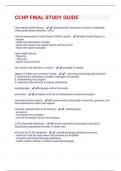
intermediate health literacy - ️️indicates skills necessary to perform moderately challenging literacy activities (~53%) national assessment of adult literacy (NAAL) results - ️️higher health literacy in: - women - white and asian/pacific islander - adults who spoke only english before starting school - those with higher education lower health literacy: - hispanics - 65 years - adults at poverty level key words in the definition of culture - ️️accepted or familiar stages of health communication model - ️️1. planning and strategy development 2. developing & pretesting concepts, messages, & materials 3. implementing the program 4. assessing effectiveness & making refinements paralanguage - ️️language without the words proxemics - ️️perception and use of interpersonal and personal space nonverbal communication - ️️communication using body movements, gestures, and facial expressions rather than speech concepts representative of all cultures - ️️- paralanguage - proxemics - nonverbal communication - cultural knowledge comes from dialogue CLAS standards (definition) - ️️national standards for providing culturally & linguistically appropriate services in health care what are the CLAS standards - ️️- provide language assistance services - individual must be made aware that services are available - competent providing language assistance - health related material in patient's preferred languagehistorical perspectives - ️️- misunderstanding & mistrust lead to conflict - people label those of another nation as one thing - individuals within cultures need to be viewed as wholes and made of their own diverse parts below basic health literacy - ️️indicates no more than the most simple & concrete literacy skills (~14%) basic health literacy - ️️indicates skills necessary to perform simple & everyday literacy activities (~22%) proficient health literacy - ️️indicates skills necessary to perform more complex and challenging literacy activities (~12%) majority of population has what health literacy level? - ️️intermediate (53%) health outcomes from low health literacy - ️️- increased use of emergency care & hospitalizations - lower instance of preventative services - poorer skills in taking medications - poorer interpretation of labels - more likely to suffer from depression - poorer health status among elderly - higher all-cause mortality in elderly ageism - ️️negative stereotype and discrimination based on age ethnogeriatrics - ️️healthcare for older adults from diverse ethnic backgrounds intersections of the studies of aging, ethnicity, and health LGBT youths health issues - ️️depression, family rejection, suicide, substance abuse, homelessness, prostitution, truancy lesbian & bisexual women health issues - ️️reproductive cancer, less likely to receive regular care, inadequate by providers, obesity and heart disease gay & bisexual men health issues - ️️HIV/AIDS, STIs, substance use & abuse, stress, eating disorders transgender health issues - ️️lack of access to healthcare, attempted suicide, high unemployment, risks from injection silicone uses (ISU), risks from illegally acquired sex hormonesracially & ethnically diverse communities health issues - ️️subjected to racism & stigma, limited access to healthcare, low SES, cultural factors, legislation LGBT survey (Massachusetts) results - ️️- LGBT health less than heterosexuals - worse outcomes for trans - lesbians less likely to have routine pap - legally married same sex couples were more likely to obtain health insurance through their spouse's employer than non-legally same sex couples laws on public health problems - ️️- school entry vaccination laws - smoking bands or restrictions - child safety belt laws - fluoridation of community water supplies legislative branch - ️️enacts laws - congress executive - ️️enforces laws - president, agencies judicial - ️️interprets laws in resolving disputes - court system utilitarianism - ️️to act as to produce the best for the largest number of people reasons why policies & practices may further disadvantage marginalized populations - ️️the persons charged with creating the policy and executing practice may not necessarily understand the experiences & beliefs of marginalized populations "why more hospitals should prioritize cultural competency" article - ️️practice 1 - be creative about addressing language barriers practice 2 - be responsive to mental health challenges practice 3 - be more mindful of stereotypes "the Hearthstone" strategies for different cultures - ️️- staff shared about cultures once a month to residents (cultural food, customs, dress, & life) - celebrate holidays of different cultures ways "Thrive" serves seniors and their communities - ️️provides critical thinking questions to address and see where your institution is lacking and then they provide tools to address and improve those areas you are lacking in cultural competency wise

Content preview

CCHP FINAL STUDY GUIDE
intermediate health literacy - ✔️✔️indicates skills necessary to perform moderately
challenging literacy activities (~53%)

national assessment of adult literacy (NAAL) results - ✔️✔️higher health literacy in:
- women
- white and asian/pacific islander
- adults who spoke only english before starting school
- those with higher education

lower health literacy:
- hispanics
- >65 years
- adults at poverty level

key words in the definition of culture - ✔️✔️accepted or familiar

stages of health communication model - ✔️✔️1. planning and strategy development
2. developing & pretesting concepts, messages, & materials
3. implementing the program
4. assessing effectiveness & making refinements

paralanguage - ✔️✔️language without the words

proxemics - ✔️✔️perception and use of interpersonal and personal space

nonverbal communication - ✔️✔️communication using body movements, gestures, and
facial expressions rather than speech

concepts representative of all cultures - ✔️✔️- paralanguage
- proxemics
- nonverbal communication
- cultural knowledge comes from dialogue

CLAS standards (definition) - ✔️✔️national standards for providing culturally &
linguistically appropriate services in health care

what are the CLAS standards - ✔️✔️- provide language assistance services
- individual must be made aware that services are available
- competent providing language assistance
- health related material in patient's preferred language


Document information

Uploaded on
October 1, 2024
Number of pages
4
Written in
2024/2025
Type
Exam (elaborations)
Contains
Questions & answers
$8.49

Wrong document? Swap it for free Within 14 days of purchase and before downloading, you can choose a different document. You can simply spend the amount again.
Written by students who passed
Immediately available after payment
Read online or as PDF

Seller avatar
Reputation scores are based on the amount of documents a seller has sold for a fee and the reviews they have received for those documents. There are three levels: Bronze, Silver and Gold. The better the reputation, the more your can rely on the quality of the sellers work.
Sold
621
Followers
185
Items
10512
Last sold
6 hours ago


Why students choose Stuvia

Created by fellow students, verified by reviews

Quality you can trust: written by students who passed their tests and reviewed by others who've used these notes.

Didn't get what you expected? Choose another document

No worries! You can instantly pick a different document that better fits what you're looking for.

Pay as you like, start learning right away

No subscription, no commitments. Pay the way you're used to via credit card and download your PDF document instantly.

Student with book image

“Bought, downloaded, and aced it. It really can be that simple.”

Alisha Student

Working on your references?

Create accurate citations in APA, MLA and Harvard with our free citation generator.

Working on your references?

Frequently asked questions
