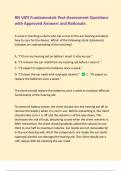
RN VATI Fundamentals Post-Assessment Questions
with Approved Answers and Rationale.
A nurse is teaching a client who has a new in-the-ear hearing aid about
how to care for the device. Which of the following client statements
indicates an understanding of the teaching?
A. "I'll turn my hearing aid on before I insert it into my ear."
B. "I'll remove the ear mold from my hearing aid before I clean it."
C. "I'll expect to replace the batteries once a week."
D. "I'll clean the ear mold with isopropyl alcohol." C. "I'll expect to
replace the batteries once a week."
The client should replace the batteries once a week to maintain efficient
functionality of the hearing aid.
To conserve battery power, the client should turn the hearing aid off or
remove the battery when it is not in use. Before reinserting it, the client
should make sure it is off and the volume is all the way down. This
decreases the risk of loud, disturbing sound when the client reinserts it.
After reinsertion, the client should gradually adjust the volume to one
third to one half its maximum volume. Ear molds are not removable for
in-the-ear-hearing aids. All of the components are inside the ear mold.
Isopropyl alcohol can damage the hearing aid. The client should use a
soft, damp cloth for cleaning the ear mold.
,A nurse at a health fair is performing screening assessments for older
adult clients. Which of the following is the priority mental health
assessment that the nurse should include?
A. Delirium
B. Dementia
C. Alcohol use disorder
D. Depression D. Depression
The greatest mental health risk for older adult clients is depression.
Therefore, this is the priority assessment to include.
A nurse is performing a health screening for a client. Which of the
following findings should indicate to the nurse that the client is at risk
for coronary artery disease?
A. Total cholesterol 196 mg/dL
B. Triglyceride 180 mg/dL
C. High-density lipoprotein (HDL) 56 mg/dL
D. Low-density lipoprotein (LDL) 120 mg/dL B. Triglyceride 180
mg/dL
, A triglyceride level of 180 mg/dL is outside the expected reference
range of 40 to 160 mg/dL for a male client and 35 to 135 mg/dL for a
female client, which places the client at risk for coronary artery disease.
A total cholesterol level of 196 mg/dL is within the expected reference
range of less than 200 mg/dL. Therefore, this finding does not place the
client at risk for coronary artery disease. An HDL level of 56 mg/dL is
within the expected reference range of greater than 45 mg/dL for a
male client and greater than 55 mg/dL for a female client. Therefore,
this finding does not place the client at risk for coronary artery disease.
An LDL level of 120 mg/dL is within the expected reference range of less
than 130 mg/dL. Therefore, this finding does not place the client at risk
for coronary artery disease.
A nurse is reviewing guidelines for documentation in an electronic
medical record with a newly licensed nurse. Which of the following
information should the nurse include?
A. It is important to include personal opinions when documenting
assessments.
B. Wait until the end of the shift to document an error.
C. It is acceptable to document for another nurse in urgent situations.
D. Log out of the computer terminal after completing documentation.
D. Log out of the computer terminal after completing
documentation.
with Approved Answers and Rationale.
A nurse is teaching a client who has a new in-the-ear hearing aid about
how to care for the device. Which of the following client statements
indicates an understanding of the teaching?
A. "I'll turn my hearing aid on before I insert it into my ear."
B. "I'll remove the ear mold from my hearing aid before I clean it."
C. "I'll expect to replace the batteries once a week."
D. "I'll clean the ear mold with isopropyl alcohol." C. "I'll expect to
replace the batteries once a week."
The client should replace the batteries once a week to maintain efficient
functionality of the hearing aid.
To conserve battery power, the client should turn the hearing aid off or
remove the battery when it is not in use. Before reinserting it, the client
should make sure it is off and the volume is all the way down. This
decreases the risk of loud, disturbing sound when the client reinserts it.
After reinsertion, the client should gradually adjust the volume to one
third to one half its maximum volume. Ear molds are not removable for
in-the-ear-hearing aids. All of the components are inside the ear mold.
Isopropyl alcohol can damage the hearing aid. The client should use a
soft, damp cloth for cleaning the ear mold.
,A nurse at a health fair is performing screening assessments for older
adult clients. Which of the following is the priority mental health
assessment that the nurse should include?
A. Delirium
B. Dementia
C. Alcohol use disorder
D. Depression D. Depression
The greatest mental health risk for older adult clients is depression.
Therefore, this is the priority assessment to include.
A nurse is performing a health screening for a client. Which of the
following findings should indicate to the nurse that the client is at risk
for coronary artery disease?
A. Total cholesterol 196 mg/dL
B. Triglyceride 180 mg/dL
C. High-density lipoprotein (HDL) 56 mg/dL
D. Low-density lipoprotein (LDL) 120 mg/dL B. Triglyceride 180
mg/dL
, A triglyceride level of 180 mg/dL is outside the expected reference
range of 40 to 160 mg/dL for a male client and 35 to 135 mg/dL for a
female client, which places the client at risk for coronary artery disease.
A total cholesterol level of 196 mg/dL is within the expected reference
range of less than 200 mg/dL. Therefore, this finding does not place the
client at risk for coronary artery disease. An HDL level of 56 mg/dL is
within the expected reference range of greater than 45 mg/dL for a
male client and greater than 55 mg/dL for a female client. Therefore,
this finding does not place the client at risk for coronary artery disease.
An LDL level of 120 mg/dL is within the expected reference range of less
than 130 mg/dL. Therefore, this finding does not place the client at risk
for coronary artery disease.
A nurse is reviewing guidelines for documentation in an electronic
medical record with a newly licensed nurse. Which of the following
information should the nurse include?
A. It is important to include personal opinions when documenting
assessments.
B. Wait until the end of the shift to document an error.
C. It is acceptable to document for another nurse in urgent situations.
D. Log out of the computer terminal after completing documentation.
D. Log out of the computer terminal after completing
documentation.