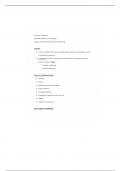
University of Maryland
PSYC100: Introduction to Psychology
Chapter 4 Pt 2: Behaviorism & Operant Conditioning
Learning:
● A process that produces a relatively enduring change in behavior or knowledge as a result
of an individual’s experience
● Conditioning: the process of learning associations between environmental events and
behavioral response. 2 types:
○ Classical Conditioning
○ Operant Conditioning
Operant Conditioning Includes:
● Thorndike
● Skinner
● Reinforcement: positive and negative
● Primary reinforcer
● Conditioned reinforcer
● Punishment (by application and by removal)
● Shaping
● Schedule of reinforcement
What is Operant Conditioning?
, ● Associating Behaviors and Consequences
● It is the learning of active, voluntary behaviors that are shaped and maintained by their
consequence
○ Thorndike: investigated animal behavior and how voluntary behavior are
influenced by their consequences
■ Placed hungry cats in “puzzle boxes” that allowed an escape through some
simple act
■ Through trial and error the cats learned to unlatch the puzzle box door and
escape
Law of Effect:
● Through Thorndike’s experiments, he formulated the Law of Effect
○ Responses followed by a “satisfying state of affairs” are strengthened and are
more likely to occur again in the same situation, whereas responses followed by
an unpleasant or “annoying state of affairs” are weakened a less likely to occur
■ Satisfying=strengthened=more likely to occur
■ Unsatisfying=weakened=less likely to occur
Operant Conditioning: Reinforcement:
● Operant — active behavior that operates upon the environment to generate consequences
○ Plain English: explains how we acquire the wide range of voluntary behaviors that
we perform in daily life
PSYC100: Introduction to Psychology
Chapter 4 Pt 2: Behaviorism & Operant Conditioning
Learning:
● A process that produces a relatively enduring change in behavior or knowledge as a result
of an individual’s experience
● Conditioning: the process of learning associations between environmental events and
behavioral response. 2 types:
○ Classical Conditioning
○ Operant Conditioning
Operant Conditioning Includes:
● Thorndike
● Skinner
● Reinforcement: positive and negative
● Primary reinforcer
● Conditioned reinforcer
● Punishment (by application and by removal)
● Shaping
● Schedule of reinforcement
What is Operant Conditioning?
, ● Associating Behaviors and Consequences
● It is the learning of active, voluntary behaviors that are shaped and maintained by their
consequence
○ Thorndike: investigated animal behavior and how voluntary behavior are
influenced by their consequences
■ Placed hungry cats in “puzzle boxes” that allowed an escape through some
simple act
■ Through trial and error the cats learned to unlatch the puzzle box door and
escape
Law of Effect:
● Through Thorndike’s experiments, he formulated the Law of Effect
○ Responses followed by a “satisfying state of affairs” are strengthened and are
more likely to occur again in the same situation, whereas responses followed by
an unpleasant or “annoying state of affairs” are weakened a less likely to occur
■ Satisfying=strengthened=more likely to occur
■ Unsatisfying=weakened=less likely to occur
Operant Conditioning: Reinforcement:
● Operant — active behavior that operates upon the environment to generate consequences
○ Plain English: explains how we acquire the wide range of voluntary behaviors that
we perform in daily life