

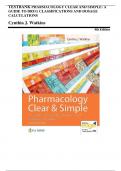
TESTBANK PHARMACOLOGY CLEAR AND SIMPLE: A
GUIDE TO DRUG CLASSIFICATIONS AND DOSAGE
CALCULATIONS
Cynthia J. Watkins
4th Edition
,Table of Contents
3 3
Chapter 1. History of Pharmacology
3 3 3 3 1
Chapter 2. Basics of Pharmacology
3 3 3 3 10
Chapter 3. Patient Safety in Medication Administration
3 3 3 3 3 3 19
Chapter 4. Regulations
3 3 30
Chapter 5. Prescriptions and Labels
3 3 3 3 42
Chapter 6. Review of Mathematics
3 3 3 3 49
Chapter 7. Measurement Systems
3 3 3 63
Chapter 8. Dosage Calculations
3 3 3 72
Chapter 9. Enteral Medications and Administration
3 3 3 3 3 80
Chapter 10. Parental Medications and Administration
3 3 3 3 3 87
Chapter 11. Integumentary System Medications
3 3 3 3 100
Chapter 12. Musculoskeletal System Medications
3 3 3 3 109
Chapter 13. Nervous System Medications
3 3 3 3 117
Chapter 14. Eye and Ear Medications
3 3 3 3 3 127
Chapter 15. Endocrine System Medications
3 3 3 3 133
Chapter 16. Cardiovascular System Medications
3 3 3 3 144
Chapter 17. Immunologic System Medications
3 3 3 3 156
Chapter 18. Pulmonary System Medications
3 3 3 3 167
Chapter 19. Gastrointestinal System Medications
3 3 3 3 175
Chapter 20. Reproductive and Urinary System Medications
3 3 3 3 3 3 184
Chapter 21. Vitamins, Minerals, Herbs, and Complementary and Alternative Medicine
3 3 3 3 3 3 3 3 3 194
,Chapter 1. History of Pharmacology
3 3 3 3
MULTIPLE CHOICE 3
1. The Greek word pharmakon means which of the following?
3 3 3 3 3 3 3 3
a. Medicine
b. Poison
c. Remedy
d. Medicine, poison, and remedy 3 3 3
ANS: D 3
Rationale: The word pharmakon refers to the curing of illness, thus meaning medicine andre
3 3 3 3 3 3 3 3 3 3 3 3 3 3
medy, as well as poison because early medicines were toxic enough to kill a patient or enemy.
3 3 3 3 3 3 3 3 3 3 3 3 3 3 3 3
PTS: 1 DIF: Easy TOP:
Unit 1: Introduction to PharmacologyKEY: History
3 3 3 3 3 3
2. The Dutch word droog means which of the following?
3 3 3 3 3 3 3 3
a. Drop
b. Drug
c. Dry
d. Dirge
ANS: C 3
Rationale: Droog, which meanWsW―W y,T‖BisStM
dr. 3 he.oWriSgin of the word drug, such as in the use of dry h
3 3 3 3 3 3 3 3 3 3 3 3 3 3
erbs as medications.
3 3
PTS: 1 DIF: Intermediate TOP:
Unit 1: Introduction to PharmacologyKEY: History
3 3 3 3 3 3
3. Most ancient societies treated illness based on which of the following?
3 3 3 3 3 3 3 3 3 3
a. Visions received by medicine men 3 3 3 3
b. Trial and error 3 3
c. Religion
d. Animal sacrifice 3
ANS: B 3
Rationale: Ancient societies had little knowledge of how the human body worked;th
3 3 3 3 3 3 3 3 3 3 3 3
erefore, treating illness was often based on trial and error.
3 3 3 3 3 3 3 3 3
PTS: 1 DIF: Intermediate TOP:
Unit 1: Introduction to PharmacologyKEY: History
3 3 3 3 3 3
4. Early records show that pharmacological treatments consisted of which of the following?
3 3 3 3 3 3 3 3 3 3 3
a. Plants
b. Minerals
c. Animal products 3
d. Plants, minerals, and animal products
3 3 3 3
1|Page
3 3 3 3 3
,
GUIDE TO DRUG CLASSIFICATIONS AND DOSAGE
CALCULATIONS
Cynthia J. Watkins
4th Edition
,Table of Contents
3 3
Chapter 1. History of Pharmacology
3 3 3 3 1
Chapter 2. Basics of Pharmacology
3 3 3 3 10
Chapter 3. Patient Safety in Medication Administration
3 3 3 3 3 3 19
Chapter 4. Regulations
3 3 30
Chapter 5. Prescriptions and Labels
3 3 3 3 42
Chapter 6. Review of Mathematics
3 3 3 3 49
Chapter 7. Measurement Systems
3 3 3 63
Chapter 8. Dosage Calculations
3 3 3 72
Chapter 9. Enteral Medications and Administration
3 3 3 3 3 80
Chapter 10. Parental Medications and Administration
3 3 3 3 3 87
Chapter 11. Integumentary System Medications
3 3 3 3 100
Chapter 12. Musculoskeletal System Medications
3 3 3 3 109
Chapter 13. Nervous System Medications
3 3 3 3 117
Chapter 14. Eye and Ear Medications
3 3 3 3 3 127
Chapter 15. Endocrine System Medications
3 3 3 3 133
Chapter 16. Cardiovascular System Medications
3 3 3 3 144
Chapter 17. Immunologic System Medications
3 3 3 3 156
Chapter 18. Pulmonary System Medications
3 3 3 3 167
Chapter 19. Gastrointestinal System Medications
3 3 3 3 175
Chapter 20. Reproductive and Urinary System Medications
3 3 3 3 3 3 184
Chapter 21. Vitamins, Minerals, Herbs, and Complementary and Alternative Medicine
3 3 3 3 3 3 3 3 3 194
,Chapter 1. History of Pharmacology
3 3 3 3
MULTIPLE CHOICE 3
1. The Greek word pharmakon means which of the following?
3 3 3 3 3 3 3 3
a. Medicine
b. Poison
c. Remedy
d. Medicine, poison, and remedy 3 3 3
ANS: D 3
Rationale: The word pharmakon refers to the curing of illness, thus meaning medicine andre
3 3 3 3 3 3 3 3 3 3 3 3 3 3
medy, as well as poison because early medicines were toxic enough to kill a patient or enemy.
3 3 3 3 3 3 3 3 3 3 3 3 3 3 3 3
PTS: 1 DIF: Easy TOP:
Unit 1: Introduction to PharmacologyKEY: History
3 3 3 3 3 3
2. The Dutch word droog means which of the following?
3 3 3 3 3 3 3 3
a. Drop
b. Drug
c. Dry
d. Dirge
ANS: C 3
Rationale: Droog, which meanWsW―W y,T‖BisStM
dr. 3 he.oWriSgin of the word drug, such as in the use of dry h
3 3 3 3 3 3 3 3 3 3 3 3 3 3
erbs as medications.
3 3
PTS: 1 DIF: Intermediate TOP:
Unit 1: Introduction to PharmacologyKEY: History
3 3 3 3 3 3
3. Most ancient societies treated illness based on which of the following?
3 3 3 3 3 3 3 3 3 3
a. Visions received by medicine men 3 3 3 3
b. Trial and error 3 3
c. Religion
d. Animal sacrifice 3
ANS: B 3
Rationale: Ancient societies had little knowledge of how the human body worked;th
3 3 3 3 3 3 3 3 3 3 3 3
erefore, treating illness was often based on trial and error.
3 3 3 3 3 3 3 3 3
PTS: 1 DIF: Intermediate TOP:
Unit 1: Introduction to PharmacologyKEY: History
3 3 3 3 3 3
4. Early records show that pharmacological treatments consisted of which of the following?
3 3 3 3 3 3 3 3 3 3 3
a. Plants
b. Minerals
c. Animal products 3
d. Plants, minerals, and animal products
3 3 3 3
1|Page
3 3 3 3 3
,


