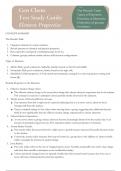
Gen Chem -The Perodic Table
-Types of Elements
Test Study Guide: -Priorities of Elements
-Chemistry of groups
Element Properties -And More
CONCEPT SUMMARY
The Periodic Table
1. Organizes elements by atomic numbers.
2. Reveals patterns in chemical and physical properties.
3. Rows (periods) correspond to principal energy levels (n).
4. Columns (groups) indicate similar valence shell electron configurations.
Types of Elements
1. Metals: Shiny, good conductors, malleable, ductile; located on the left and middle.
2. Nonmetals: Dull, poor conductors, brittle; found on the right side.
3. Metalloids: Exhibit properties of both metals and nonmetals; arranged in a stair-step pattern starting with
boron (B).
Periodic Properties of the Elements
1. Effective Nuclear Charge (Zen):
The effective nuclear charge is the net positive charge that valence electrons experience due to the nucleus.
This concept is crucial as it underpins various periodic trends observed in the elements.
2. Trends Across a Period and Down a Group:
Zen increases from left to right across a period, indicating that as you move across, electrons feel a
stronger pull from the nucleus.
There is minimal change in Zen values when moving down a group, suggesting that additional electron
shells do not significantly alter the effective nuclear charge experienced by valence electrons.
3. Valence Electron Separation:
As one moves down a group, valence electrons become increasingly distant from the nucleus due to an
increase in principal energy levels (n). This separation affects various properties of elements.
4. Atomic Radius Trends:
The atomic radius decreases from left to right across a period because increased Zen pulls electrons closer
to the nucleus.
Conversely, atomic radius increases from top to bottom in a group due to the addition of electron shells
which outweighs the increase in nuclear charge.
5. Ionic Radius:
The ionic radius refers to the size of charged species (ions). Notably, nonmetallic ions tend to have larger
radii than their metallic counterparts at the metalloid boundary.
Cations (positively charged ions) are typically smaller than their neutral atoms because they lose one or
more electrons, reducing electron-electron repulsion.
-Types of Elements
Test Study Guide: -Priorities of Elements
-Chemistry of groups
Element Properties -And More
CONCEPT SUMMARY
The Periodic Table
1. Organizes elements by atomic numbers.
2. Reveals patterns in chemical and physical properties.
3. Rows (periods) correspond to principal energy levels (n).
4. Columns (groups) indicate similar valence shell electron configurations.
Types of Elements
1. Metals: Shiny, good conductors, malleable, ductile; located on the left and middle.
2. Nonmetals: Dull, poor conductors, brittle; found on the right side.
3. Metalloids: Exhibit properties of both metals and nonmetals; arranged in a stair-step pattern starting with
boron (B).
Periodic Properties of the Elements
1. Effective Nuclear Charge (Zen):
The effective nuclear charge is the net positive charge that valence electrons experience due to the nucleus.
This concept is crucial as it underpins various periodic trends observed in the elements.
2. Trends Across a Period and Down a Group:
Zen increases from left to right across a period, indicating that as you move across, electrons feel a
stronger pull from the nucleus.
There is minimal change in Zen values when moving down a group, suggesting that additional electron
shells do not significantly alter the effective nuclear charge experienced by valence electrons.
3. Valence Electron Separation:
As one moves down a group, valence electrons become increasingly distant from the nucleus due to an
increase in principal energy levels (n). This separation affects various properties of elements.
4. Atomic Radius Trends:
The atomic radius decreases from left to right across a period because increased Zen pulls electrons closer
to the nucleus.
Conversely, atomic radius increases from top to bottom in a group due to the addition of electron shells
which outweighs the increase in nuclear charge.
5. Ionic Radius:
The ionic radius refers to the size of charged species (ions). Notably, nonmetallic ions tend to have larger
radii than their metallic counterparts at the metalloid boundary.
Cations (positively charged ions) are typically smaller than their neutral atoms because they lose one or
more electrons, reducing electron-electron repulsion.