O14: Unique Properties of Carbon
Structural and bonding properties
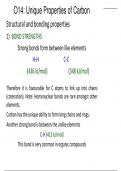
1) BOND STRENGTHS
Strong bonds form between like elements
H-H C-C
(436 kJ/mol) (348 kJ/mol)
Therefore it is favourable for C atoms to link up into chains
(catenation). Note: Homonuclear bonds are rare amongst other
elements.
Carbon has the unique ability to form long chains and rings.
Another strong bond is between the unlike elements
C-H (413 kJ/mol)
This bond is very common in organic compounds
, O14: Unique Properties of Carbon
2) NATURE OF BONDS
There are a variety of possible bonds involving carbon
e.g. C-C C=C C≡C C-X C=O C≡N
(X= halogen or OH)
The electron configuration of C:
1s2 2s2 2px1 2py1 2pz0
Core valence electrons
Therefore there are 4 valence electrons and 4 valence
orbitals. This means carbon must always form 4 bonds.
No unused electrons
No unused orbitals
No “reactive spots”
,O14: Unique Properties of Carbon
The carbon atom is small,
and it is screened by the
other atoms attached to it
and therefore it is difficult
to attack at the carbon
centre (in order to react
with the carbon).
, O14: Unique Properties of Carbon
Reactivity
• For all these reasons
ALKANES ARE VERY UNREACTIVE
• At room temperature alkanes do not react with
acids, bases, or strong oxidizing agents
• Therefore alkanes make good non-polar solvents.
Structural and bonding properties
1) BOND STRENGTHS
Strong bonds form between like elements
H-H C-C
(436 kJ/mol) (348 kJ/mol)
Therefore it is favourable for C atoms to link up into chains
(catenation). Note: Homonuclear bonds are rare amongst other
elements.
Carbon has the unique ability to form long chains and rings.
Another strong bond is between the unlike elements
C-H (413 kJ/mol)
This bond is very common in organic compounds
, O14: Unique Properties of Carbon
2) NATURE OF BONDS
There are a variety of possible bonds involving carbon
e.g. C-C C=C C≡C C-X C=O C≡N
(X= halogen or OH)
The electron configuration of C:
1s2 2s2 2px1 2py1 2pz0
Core valence electrons
Therefore there are 4 valence electrons and 4 valence
orbitals. This means carbon must always form 4 bonds.
No unused electrons
No unused orbitals
No “reactive spots”
,O14: Unique Properties of Carbon
The carbon atom is small,
and it is screened by the
other atoms attached to it
and therefore it is difficult
to attack at the carbon
centre (in order to react
with the carbon).
, O14: Unique Properties of Carbon
Reactivity
• For all these reasons
ALKANES ARE VERY UNREACTIVE
• At room temperature alkanes do not react with
acids, bases, or strong oxidizing agents
• Therefore alkanes make good non-polar solvents.