
COMPUTER NETWORKING
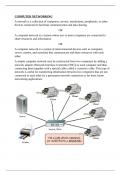
A network is a collection of computers, servers, mainframes, peripherals, or other
devices connected to facilitate communication and data sharing.
OR
A computer network is a system where two or more computers are connected to
share resources and information.
OR
A computer network is a system of interconnected devices such as (computer,
severs, routers, and switches) that communicate and share resources with each
other.
A simple computer network may be constructed from two computers by adding a
network adapter (Network Interface Controller [NIC]) to each computer and then
connecting them together with a special cable called a crossover cable. This type of
network is useful for transferring information between two computers that are not
connected to each other by a permanent network connection or for basic home
networking applications.
, TYPES OF NETWORK
Below is a list of the most common types of computer networks.
PERSONAL AREA NETWORK (PAN)
Is the connection of device within a small area network, usually within an
individual reach, allowing file sharing and communication. Examples include
Bluetooth and Wi-Fi Direct
LOCAL AREA NETWORK (LAN)
A network that is limited to a relatively small spatial area such as a room, a single
building, is called a local area network. Local area networks are sometimes called a
single location network.
For administrative purposes, large LANs are generally divided into smaller logical
segments called workgroups. A work group is a group of computers that share a
common set of resources within a LAN.
METROPOLITAN AREA NETWORK(MAN)
A network that connects two or more Local Area Networks together but does not
extended beyond the boundaries of the immediate town city, metropolitan area
network multiply routers switch and hubs are connected to create a MAN.
WIDE AREA NETWORK (WAN)
A WAN is a data communications network that covers a relatively broad
geographic area and that often uses transmission facilities provided by common
carriers, such as telephone companies.
ADVANTAGES OF NETWORK
1. Speed: sharing and transferring files with networks are very rapid. Thus,
saving time, while maintaining the integrity of the file.
2. Security: sensitive files and programs on a network are password protected
(established for specific directories to restrict access to authorized users) or
designated as “copy inhibit” so that you do not have to worry about illegal
copying programs.
3. Centralized Software Management: software can be loaded on one
computer (the file server) eliminating that need to spend time and energy
installing update and tracking files on independent computers without the
building.
A network is a collection of computers, servers, mainframes, peripherals, or other
devices connected to facilitate communication and data sharing.
OR
A computer network is a system where two or more computers are connected to
share resources and information.
OR
A computer network is a system of interconnected devices such as (computer,
severs, routers, and switches) that communicate and share resources with each
other.
A simple computer network may be constructed from two computers by adding a
network adapter (Network Interface Controller [NIC]) to each computer and then
connecting them together with a special cable called a crossover cable. This type of
network is useful for transferring information between two computers that are not
connected to each other by a permanent network connection or for basic home
networking applications.
, TYPES OF NETWORK
Below is a list of the most common types of computer networks.
PERSONAL AREA NETWORK (PAN)
Is the connection of device within a small area network, usually within an
individual reach, allowing file sharing and communication. Examples include
Bluetooth and Wi-Fi Direct
LOCAL AREA NETWORK (LAN)
A network that is limited to a relatively small spatial area such as a room, a single
building, is called a local area network. Local area networks are sometimes called a
single location network.
For administrative purposes, large LANs are generally divided into smaller logical
segments called workgroups. A work group is a group of computers that share a
common set of resources within a LAN.
METROPOLITAN AREA NETWORK(MAN)
A network that connects two or more Local Area Networks together but does not
extended beyond the boundaries of the immediate town city, metropolitan area
network multiply routers switch and hubs are connected to create a MAN.
WIDE AREA NETWORK (WAN)
A WAN is a data communications network that covers a relatively broad
geographic area and that often uses transmission facilities provided by common
carriers, such as telephone companies.
ADVANTAGES OF NETWORK
1. Speed: sharing and transferring files with networks are very rapid. Thus,
saving time, while maintaining the integrity of the file.
2. Security: sensitive files and programs on a network are password protected
(established for specific directories to restrict access to authorized users) or
designated as “copy inhibit” so that you do not have to worry about illegal
copying programs.
3. Centralized Software Management: software can be loaded on one
computer (the file server) eliminating that need to spend time and energy
installing update and tracking files on independent computers without the
building.


