

2
QUICK
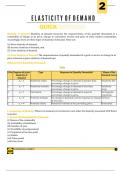
Elasticity of Demand: Elasticity of demand measures the responsiveness of the quantity demanded of a
commodity of change in its price, change in consumers' income and price of other related commodities.
Accordingly, there are three types of elasticity of demand. These are:
(A) Price elasticity of demand,
(B) Income elasticity of demand, and
(C) Cross elasticity of demand.
(A) Price Elasticity of Demand: The responsiveness of quantity demanded of a good or service to change in its
price is known as price elasticity of demand (ep).
Different Price Elasticities of Demand:
Table
S.No. Degrees of price Type Response in Quantity Demanded Shape of the
elasticity of Demand Curve
demand
1. ep > 1 Relatively elastic Percentage change in demand is greater than Relatively flat
percentage change in price.
2. ep < 1 Relatively inelastic Percentage change in demand is less than Relatively
percentage change in price. steep
3. ep = 1 Unit elastic Percentage change in demand is equal to Rectangular
percentage change in price. hyperbola
4. ep = 0 Perfectly inelastic No change in demand at all in response to change Vertical
in the price.
5. ep = ∞ Perfectly elastic Demand is infinite at the prevailing price. Horizontal
l. Comparison of Elasticity: When two demand curves intersect each other the elasticity associated with flatter
is greater.
2. Factors Affecting Elasticity of Demand:
(i) Nature of the commodity
(ii) Availability of substitutes
(iii) Number of uses
(iv) Possibility of postponement
(v) Proportion of income spent
(vi) Habits
(vii) Time period
(viii) Price level
,3. Importance of Elasticity of Demand:
(i) Useful to a producer
(ii) Importance in factor pricing
(iii) Useful to a finance minister
(iv) Importance in international trade
(v) It explains paradox of poverty
4. Methods of Measurement:
Percentage change in demand
(i) Percentage Method: ep =
Percentage change in price
(ii) Total Outlay Method: According to this method:
When price and total outlay are inversely related, ep will be greater than one.
When price and total outlay are positively related, ep will be less than one.
When total outlay remains unchanged when price of the commodity changes, ep will be equal to one.
Lower Line Segment from the point
(iii) Geometrical Method: ep =
Upper line segment from the point
(a) At mid-point of demand curve, ep = 1
(b) At any point above the mid-point ep > 1
(c) At any point below the mid-point ep < 1
(d) At a point where demand curve touches the Y-axis, ep = ∞
(e) At a point where demand curve touches X-axis, ep < 1
NOTE
Note
Percentage method gives exact measurement of price elasticity of demand while total outlay method gives us
only rough estimates of price elasticity.
(B) Income Elasticity: Degree of responsiveness of quantity demanded of a commodity to the change in income
of the consumer. In other words, income elasticity of demand measures how responsive the quantity demanded
of a commodity is to a change in income, price of the goods remaining unchanged. In case of normal goods,
the algebraic sign of this elasticity is positive and is negative in case of inferior goods.
Table
S.No. Numerical measure Description
1. Negative Quantity demanded decreases as income increases (e.g.,
inferior goods).
2. Zero Quantity demanded remains unchanged as income increases
(e.g., inexpensive goods).
3. Greater than zero but less than one Quantity demanded rises less than in proportion to income
increase.
4. Unity Quantity demanded rises in the same proportion as rise in
income.
5. Greater than one Quantity demanded rise more than in proportion to income
increase.
, (C) Cross Elasticity : Degree of responsiveness of quantity demanded of commodity X to the change in the price
of commodity Y. Cross elasticity measures how responsive demand of one good is to a change in the price of
another goods.
1 MARK QUESTIONS
A. FILL IN THE BLANKS
1.__________sign shows the inverse relationship between price and quantity demanded.
2. 6% change in price leads to an 18% change in quantity demanded. Price elasticity of demand is ___________
3. Using geometric method, elasticity of demand = ___________.
4. As we go down on a straight line demand curve, elasticity goes on ___________.
5. Unitary elastic demand curve is __________ curve.
6. When change in price leave no impact on quantity demanded of a commodity, elasticity of demand is
___________.
7. When the percentage change in price is less than percentage change in quantity demanded, the demand is
___________.
8. When the percentage change in price is more than percentage change in quantity demanded, the demand
is ___________
9. A commodity having more substitutes ___________ will be elastic.
10. Necessities are ___________ elastic.
11. When price falls from ₹20 to ₹ 10 leading to 50% change in quantity demanded, elasticity of demand is
____________.
12. Milk is ___________ elastic due to ___________ of milk.
13. Demand for salt is __________.
14. If elasticity of demand is, 10% fall in price will lead to ___________ rise in quantity demanded.
15. If ed = 2 and percentage change in price is 10 percentage. Percentage change in quantity demanded will be
___________ .
16. When demand curve is parallel to Y axis, ED would be ___________.
17. With a fall in price, total expenditure remains constant, ED would be ___________.
18. When price and total expenditure move in the same direction then ED will be ___________.
19. To calculate ED by point method on a non-linear demand curve, a ___________ has to be drawn.
20. When Ed = 2 and price falls by 5% what will be change in demand ___________.
ANSWERS
1. Minus 2. 3 3. Lower line segment/ 4. Decreasing
upper line segment
5. Rectangular hyperbola 6. Zero 7. greater than one 8. Less than one
9. Highly 10. Inelastic or less 11. One 12. highly elastic,
elastic several uses
13. Inelastic 14. 10 % 15. 20 % 16. Zero
17. One 18. Inelastic 19. Tangent 20. 10%
QUICK
Elasticity of Demand: Elasticity of demand measures the responsiveness of the quantity demanded of a
commodity of change in its price, change in consumers' income and price of other related commodities.
Accordingly, there are three types of elasticity of demand. These are:
(A) Price elasticity of demand,
(B) Income elasticity of demand, and
(C) Cross elasticity of demand.
(A) Price Elasticity of Demand: The responsiveness of quantity demanded of a good or service to change in its
price is known as price elasticity of demand (ep).
Different Price Elasticities of Demand:
Table
S.No. Degrees of price Type Response in Quantity Demanded Shape of the
elasticity of Demand Curve
demand
1. ep > 1 Relatively elastic Percentage change in demand is greater than Relatively flat
percentage change in price.
2. ep < 1 Relatively inelastic Percentage change in demand is less than Relatively
percentage change in price. steep
3. ep = 1 Unit elastic Percentage change in demand is equal to Rectangular
percentage change in price. hyperbola
4. ep = 0 Perfectly inelastic No change in demand at all in response to change Vertical
in the price.
5. ep = ∞ Perfectly elastic Demand is infinite at the prevailing price. Horizontal
l. Comparison of Elasticity: When two demand curves intersect each other the elasticity associated with flatter
is greater.
2. Factors Affecting Elasticity of Demand:
(i) Nature of the commodity
(ii) Availability of substitutes
(iii) Number of uses
(iv) Possibility of postponement
(v) Proportion of income spent
(vi) Habits
(vii) Time period
(viii) Price level
,3. Importance of Elasticity of Demand:
(i) Useful to a producer
(ii) Importance in factor pricing
(iii) Useful to a finance minister
(iv) Importance in international trade
(v) It explains paradox of poverty
4. Methods of Measurement:
Percentage change in demand
(i) Percentage Method: ep =
Percentage change in price
(ii) Total Outlay Method: According to this method:
When price and total outlay are inversely related, ep will be greater than one.
When price and total outlay are positively related, ep will be less than one.
When total outlay remains unchanged when price of the commodity changes, ep will be equal to one.
Lower Line Segment from the point
(iii) Geometrical Method: ep =
Upper line segment from the point
(a) At mid-point of demand curve, ep = 1
(b) At any point above the mid-point ep > 1
(c) At any point below the mid-point ep < 1
(d) At a point where demand curve touches the Y-axis, ep = ∞
(e) At a point where demand curve touches X-axis, ep < 1
NOTE
Note
Percentage method gives exact measurement of price elasticity of demand while total outlay method gives us
only rough estimates of price elasticity.
(B) Income Elasticity: Degree of responsiveness of quantity demanded of a commodity to the change in income
of the consumer. In other words, income elasticity of demand measures how responsive the quantity demanded
of a commodity is to a change in income, price of the goods remaining unchanged. In case of normal goods,
the algebraic sign of this elasticity is positive and is negative in case of inferior goods.
Table
S.No. Numerical measure Description
1. Negative Quantity demanded decreases as income increases (e.g.,
inferior goods).
2. Zero Quantity demanded remains unchanged as income increases
(e.g., inexpensive goods).
3. Greater than zero but less than one Quantity demanded rises less than in proportion to income
increase.
4. Unity Quantity demanded rises in the same proportion as rise in
income.
5. Greater than one Quantity demanded rise more than in proportion to income
increase.
, (C) Cross Elasticity : Degree of responsiveness of quantity demanded of commodity X to the change in the price
of commodity Y. Cross elasticity measures how responsive demand of one good is to a change in the price of
another goods.
1 MARK QUESTIONS
A. FILL IN THE BLANKS
1.__________sign shows the inverse relationship between price and quantity demanded.
2. 6% change in price leads to an 18% change in quantity demanded. Price elasticity of demand is ___________
3. Using geometric method, elasticity of demand = ___________.
4. As we go down on a straight line demand curve, elasticity goes on ___________.
5. Unitary elastic demand curve is __________ curve.
6. When change in price leave no impact on quantity demanded of a commodity, elasticity of demand is
___________.
7. When the percentage change in price is less than percentage change in quantity demanded, the demand is
___________.
8. When the percentage change in price is more than percentage change in quantity demanded, the demand
is ___________
9. A commodity having more substitutes ___________ will be elastic.
10. Necessities are ___________ elastic.
11. When price falls from ₹20 to ₹ 10 leading to 50% change in quantity demanded, elasticity of demand is
____________.
12. Milk is ___________ elastic due to ___________ of milk.
13. Demand for salt is __________.
14. If elasticity of demand is, 10% fall in price will lead to ___________ rise in quantity demanded.
15. If ed = 2 and percentage change in price is 10 percentage. Percentage change in quantity demanded will be
___________ .
16. When demand curve is parallel to Y axis, ED would be ___________.
17. With a fall in price, total expenditure remains constant, ED would be ___________.
18. When price and total expenditure move in the same direction then ED will be ___________.
19. To calculate ED by point method on a non-linear demand curve, a ___________ has to be drawn.
20. When Ed = 2 and price falls by 5% what will be change in demand ___________.
ANSWERS
1. Minus 2. 3 3. Lower line segment/ 4. Decreasing
upper line segment
5. Rectangular hyperbola 6. Zero 7. greater than one 8. Less than one
9. Highly 10. Inelastic or less 11. One 12. highly elastic,
elastic several uses
13. Inelastic 14. 10 % 15. 20 % 16. Zero
17. One 18. Inelastic 19. Tangent 20. 10%


