Institutions and Decision-Making
Unit 1. Introduction: Governance, National and
Global Institutions
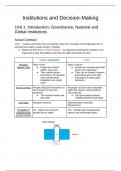
Social Contract
State – “human community that successfully claims the monopoly of the legitimate use of
physical force within a given territory” (Weber)
● States are born from a “social contract” – an agreement among the members of an
organized society that defines and limits the rights and duties of each
Hobbes (Leviathan) Locke
Humans’ State of war State of nature
Natural State ● People are wicked, ● People are naturally good and
selfish, and cruel. learn from experience.
● They cannot govern ● They can be trusted to govern
themselves. An absolute themselves given the right
ruler that demands information to make good
obedience can create decisions.
order.
Social Contract People relinquish themselves to All people are born with inalienable
the monarch in return for rights (life, liberty, and the right to
protection. own property).
● The monarch keeps law ● The government protects
and order. individual liberties and rights.
Civil State Absolute monarch Representative assembly
(Democracy)
Possibility of No – Before the monarch, Yes – People have fundamental,
Breaching the people had no rights. natural, and inalienable rights.
Social Contract
,Democracy
● “Dimokratía” = “rule by people”
○ Citizens exercise their power by voting
● Different types of democracy
○ “Direct democracy” v. “Representative democracy”
○ “Parliamentary democracy” v. “Presidential democracy”
○ “Constitutional democracy” or “Liberal democracy” v. “Illiberal democracy”
● Formal requirements
○ HHRR
○ Rule of Law
○ Separation of Powers
● Material requirements
○ Bill of Rights
● Other considerations (non-exhaustive)
○ Rule by the majority
○ Protection of the minority
○ Freedom of speech and political plurality
○ Periodical universal elections
Example: Democracy’s decline in Spain
● In 2017, Spain’s democracy ‘score’ declined by 0.22. At 8.08, Spain’s score
remained just above the threshold for full democracies.
● The national government’s attempt to stop by force Catalonia’s illegal referendum on
independence on October 1st and its repressive treatment of pro-independence
politicians have put it at risk of becoming a “flawed democracy”.
● After a unilateral declaration of independence by the regional parliament, the national
government temporarily suspended Catalan home rule. Several pro-independence
leaders have been jailed on remand and face serious criminal charges if found guilty.
○ [2024] Spain's congress has approved the controversial and divisive Catalan
amnesty bill that regional separatists demanded in return for helping the
country's Socialist-led coalition government (led by Pedro Sánchez) back into
office after last year's inconclusive general election.
Example: Democracy’s decline worldwide
● Less than half (45.7%) of the world’s population now live in a democracy of some
sort, a significant decline from 2020 (49.4%). Even fewer (6.4%) reside in a“full
democracy”; this level is down from 8.4% in 2020 after two countries (Chile and
Spain) were downgraded to “flawed democracies”.
,Samuel P. Huntington, "Democratizing Waves"
1. "Jacksonian Democracy" (white males’ suffrage) in the early 19th century
→ Benito Mussolini’s Italy in 1922
● "Jacksonian Democracy" – expansion of suffrage rights to white males,
particularly those without property qualifications
● Mussolini's Italy in 1922 – a contrast or a shift away from democratic
principles towards authoritarianism
2. End of World War II in 1945 → 1960:
● End of World War II – notable spread of democracy or democratization;
defeat of fascist regimes in Europe and the beginning of efforts to establish
democratic governments in many countries
3. Carnation Revolution in Portugal in 1974 → 2008:
● The Carnation Revolution in Portugal in 1974 – a peaceful military coup that
overthrew the authoritarian Estado Novo regime, leading to the establishment
of a democratic government in Portugal
● A period of democratic stability or expansion, encompassing other democratic
movements or transitions in different parts of the world
State
Theories of Statehood
● Declarative theory of statehood – "The political existence of the state is independent
of recognition by the other states.” (Art. 3)
● Constitutive theory of statehood – A state exists only insofar as it is recognized by
other states.
Montevideo Convention 1933
Article 1 of the Montevideo Convention
Requirements of Statehood
1. Permanent population
2. Defined territory (counter-example: Israel, Albania)
3. Government (counter-example: Somalia)
● Internal sovereignty – supreme power and authority within a state
4. Capacity to conduct international relations (counter-example: Kosovo, Palestine)
● External sovereignty – the state's independence and recognition in the
international arena
Globalization
Concept
1. Social/Cultural – “Heightened speed, volume, and facility of interactions among
people across borders, irrespective of distance or geographical barriers” (Jin)
2. Economic
● “The increasing interdependence of world economies as a result of the
growing scale of cross-border trade of commodities and services, the flow of
, international capital, and the wide and rapid spread of technologies” (Gao)
[“The continuing expansion and mutual integration of market frontiers”]
● Geographic dispersal of firms' factories, offices, service outlets, and markets
(global assembly line, export-processing zone, offshoring of work…) (Sassen)
[“Offshoring creates a space for an economy that goes beyond the regulatory
umbrella of the state. And in this regard, the significance of the state is in
decline.”]
3. Legal: TBD
● Forms of legal innovation (deregulation, regulatory regimes, and institutions
for the governance of international economic relations…)
International Organizations (IOs)
Why do states delegate power to IOs?
1. Gains from specialization
● Having an IO do certain tasks may be more efficient or effective than states
doing it on their own.
2. Neutrality
● States may not trust each other and therefore they may have trouble agreeing
on a solution. A neutral party can facilitate an agreement.
3. Shield the policymaking process
● States can use IOs as scapegoats for unpopular policies (e.g. incarceration
without trials for terrorists) as IOs’ decisions are usually non-reviewable by
domestic jurisdictions and opaque to public opinion.
In all cases, states benefit by granting an agent (IO) independence.
Unit 1. Introduction: Governance, National and
Global Institutions
Social Contract
State – “human community that successfully claims the monopoly of the legitimate use of
physical force within a given territory” (Weber)
● States are born from a “social contract” – an agreement among the members of an
organized society that defines and limits the rights and duties of each
Hobbes (Leviathan) Locke
Humans’ State of war State of nature
Natural State ● People are wicked, ● People are naturally good and
selfish, and cruel. learn from experience.
● They cannot govern ● They can be trusted to govern
themselves. An absolute themselves given the right
ruler that demands information to make good
obedience can create decisions.
order.
Social Contract People relinquish themselves to All people are born with inalienable
the monarch in return for rights (life, liberty, and the right to
protection. own property).
● The monarch keeps law ● The government protects
and order. individual liberties and rights.
Civil State Absolute monarch Representative assembly
(Democracy)
Possibility of No – Before the monarch, Yes – People have fundamental,
Breaching the people had no rights. natural, and inalienable rights.
Social Contract
,Democracy
● “Dimokratía” = “rule by people”
○ Citizens exercise their power by voting
● Different types of democracy
○ “Direct democracy” v. “Representative democracy”
○ “Parliamentary democracy” v. “Presidential democracy”
○ “Constitutional democracy” or “Liberal democracy” v. “Illiberal democracy”
● Formal requirements
○ HHRR
○ Rule of Law
○ Separation of Powers
● Material requirements
○ Bill of Rights
● Other considerations (non-exhaustive)
○ Rule by the majority
○ Protection of the minority
○ Freedom of speech and political plurality
○ Periodical universal elections
Example: Democracy’s decline in Spain
● In 2017, Spain’s democracy ‘score’ declined by 0.22. At 8.08, Spain’s score
remained just above the threshold for full democracies.
● The national government’s attempt to stop by force Catalonia’s illegal referendum on
independence on October 1st and its repressive treatment of pro-independence
politicians have put it at risk of becoming a “flawed democracy”.
● After a unilateral declaration of independence by the regional parliament, the national
government temporarily suspended Catalan home rule. Several pro-independence
leaders have been jailed on remand and face serious criminal charges if found guilty.
○ [2024] Spain's congress has approved the controversial and divisive Catalan
amnesty bill that regional separatists demanded in return for helping the
country's Socialist-led coalition government (led by Pedro Sánchez) back into
office after last year's inconclusive general election.
Example: Democracy’s decline worldwide
● Less than half (45.7%) of the world’s population now live in a democracy of some
sort, a significant decline from 2020 (49.4%). Even fewer (6.4%) reside in a“full
democracy”; this level is down from 8.4% in 2020 after two countries (Chile and
Spain) were downgraded to “flawed democracies”.
,Samuel P. Huntington, "Democratizing Waves"
1. "Jacksonian Democracy" (white males’ suffrage) in the early 19th century
→ Benito Mussolini’s Italy in 1922
● "Jacksonian Democracy" – expansion of suffrage rights to white males,
particularly those without property qualifications
● Mussolini's Italy in 1922 – a contrast or a shift away from democratic
principles towards authoritarianism
2. End of World War II in 1945 → 1960:
● End of World War II – notable spread of democracy or democratization;
defeat of fascist regimes in Europe and the beginning of efforts to establish
democratic governments in many countries
3. Carnation Revolution in Portugal in 1974 → 2008:
● The Carnation Revolution in Portugal in 1974 – a peaceful military coup that
overthrew the authoritarian Estado Novo regime, leading to the establishment
of a democratic government in Portugal
● A period of democratic stability or expansion, encompassing other democratic
movements or transitions in different parts of the world
State
Theories of Statehood
● Declarative theory of statehood – "The political existence of the state is independent
of recognition by the other states.” (Art. 3)
● Constitutive theory of statehood – A state exists only insofar as it is recognized by
other states.
Montevideo Convention 1933
Article 1 of the Montevideo Convention
Requirements of Statehood
1. Permanent population
2. Defined territory (counter-example: Israel, Albania)
3. Government (counter-example: Somalia)
● Internal sovereignty – supreme power and authority within a state
4. Capacity to conduct international relations (counter-example: Kosovo, Palestine)
● External sovereignty – the state's independence and recognition in the
international arena
Globalization
Concept
1. Social/Cultural – “Heightened speed, volume, and facility of interactions among
people across borders, irrespective of distance or geographical barriers” (Jin)
2. Economic
● “The increasing interdependence of world economies as a result of the
growing scale of cross-border trade of commodities and services, the flow of
, international capital, and the wide and rapid spread of technologies” (Gao)
[“The continuing expansion and mutual integration of market frontiers”]
● Geographic dispersal of firms' factories, offices, service outlets, and markets
(global assembly line, export-processing zone, offshoring of work…) (Sassen)
[“Offshoring creates a space for an economy that goes beyond the regulatory
umbrella of the state. And in this regard, the significance of the state is in
decline.”]
3. Legal: TBD
● Forms of legal innovation (deregulation, regulatory regimes, and institutions
for the governance of international economic relations…)
International Organizations (IOs)
Why do states delegate power to IOs?
1. Gains from specialization
● Having an IO do certain tasks may be more efficient or effective than states
doing it on their own.
2. Neutrality
● States may not trust each other and therefore they may have trouble agreeing
on a solution. A neutral party can facilitate an agreement.
3. Shield the policymaking process
● States can use IOs as scapegoats for unpopular policies (e.g. incarceration
without trials for terrorists) as IOs’ decisions are usually non-reviewable by
domestic jurisdictions and opaque to public opinion.
In all cases, states benefit by granting an agent (IO) independence.