

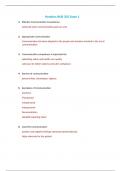
Hondros NUR 205 Exam 1
1. Effective Communication Competence
Achieved when communication goals are met
2. Appropriate Communication
Communication has been adapted to the people and situation involved in the act of
communication
3. Communication competence is important for:
optimizing safety and health care quality
advocacy for better systems and safer workplaces
4. Barriers of communication
personal bias, stereotypes, stigmas
5. Exemplars of Communication
Assertive
Therapeutic
Intrapersonal
Interpersonal
Documentation
Handoff/reporting (sbar)
6. Assertive Communication
positive and negative feelings expressed openly/directly.
Helps advocate for the patient
,7. Therapeutic Communication
interactive process, words/actions used by clinicians and patient.
Helps patient overcome stress, adjust to difficult situations, promotes understanding and
builds relationships that lead to positive outcomes
8. Intrapersonal Communication
self-talk
9. Interpersonal Communication
between people, talking among, verbal/nonverbal, begins at birth
10. Documentation
Legal documents
11. Handoff/reporting--SBAR
Situation, background, assessment, recommendations
12. Communication
Collaboration-->care coordination--> safety--> culture--> care quality
13. Collaboration
Development of partnerships, collab with other to meet needs of patients.
-Key component in reducing errors-
-begins on admission-
-discharge planning begins on admission-
, 14. Nurse-patient collaboration
health promotion/disease prevention behaviors, lifestyle changes, whole nursing
process, end of life decision making.
15. Nurse-nurse collaboration
intrapersonal/within profession
16. Nurse-physician collaboration
interprofessional/among other groups
17. Scope of practice is regulated by:
The State Board of Nursing
18. Why care coordination for the frail and elderly?
They are more vulnerable to negative outcomes
19. Delegation to LPN
Give the LPN your most stable patient
No blood transfusion, no initial teaching, and no admits
20. Most important thing for hospice care
Pain and comfort
21. Subjective pain
Patient complains of chest pain
1. Effective Communication Competence
Achieved when communication goals are met
2. Appropriate Communication
Communication has been adapted to the people and situation involved in the act of
communication
3. Communication competence is important for:
optimizing safety and health care quality
advocacy for better systems and safer workplaces
4. Barriers of communication
personal bias, stereotypes, stigmas
5. Exemplars of Communication
Assertive
Therapeutic
Intrapersonal
Interpersonal
Documentation
Handoff/reporting (sbar)
6. Assertive Communication
positive and negative feelings expressed openly/directly.
Helps advocate for the patient
,7. Therapeutic Communication
interactive process, words/actions used by clinicians and patient.
Helps patient overcome stress, adjust to difficult situations, promotes understanding and
builds relationships that lead to positive outcomes
8. Intrapersonal Communication
self-talk
9. Interpersonal Communication
between people, talking among, verbal/nonverbal, begins at birth
10. Documentation
Legal documents
11. Handoff/reporting--SBAR
Situation, background, assessment, recommendations
12. Communication
Collaboration-->care coordination--> safety--> culture--> care quality
13. Collaboration
Development of partnerships, collab with other to meet needs of patients.
-Key component in reducing errors-
-begins on admission-
-discharge planning begins on admission-
, 14. Nurse-patient collaboration
health promotion/disease prevention behaviors, lifestyle changes, whole nursing
process, end of life decision making.
15. Nurse-nurse collaboration
intrapersonal/within profession
16. Nurse-physician collaboration
interprofessional/among other groups
17. Scope of practice is regulated by:
The State Board of Nursing
18. Why care coordination for the frail and elderly?
They are more vulnerable to negative outcomes
19. Delegation to LPN
Give the LPN your most stable patient
No blood transfusion, no initial teaching, and no admits
20. Most important thing for hospice care
Pain and comfort
21. Subjective pain
Patient complains of chest pain


