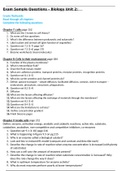
Exam Sample Questions – Biology Unit 2:
Create flashcards
Read through all chapters
Complete the following questions
Chapter 7: cells page 152
1. What are the 3 tenets to cell theory?
2. Do some cell size questions
3. What’s the difference between prokaryotic and eukaryotic?
4. Label a plant and animal cell (give function of organelles)
5. Question set 7.2 (1-7) page 167
6. Question set 7.3 (1-6) page 170
7. Biozone worksheets (macromolecules)
Chapter 8: Cells in their environment page 184
1. Function of the plasma membrane?
2. What is extracellular fluid?
3. Draw the fluid mosaic model
4. What are; adhesion proteins, transport proteins, receptor proteins, recognition proteins
5. Question set 8.1 (1-5)
6. What do carrier proteins and channel proteins do?
7. Define: passive transport – simple diffusion, facilitated diffusion, osmosis. Active transport –
endocytosis, pinocytosis, exocytosis, phagocytosis.
8. Question set 8.2 (1-4)
9. Diffusion
10. What are the factors affecting diffusion?
11. What are the factors affecting the exchange of materials through the membrane?
12. Question set 8.3 (1-6)
13. Question set 8.4 (1-5)
14. What are the limitations to cell size?
15. Define concentration gradient
16. Finish biozone pages
Chapter 9: Inside cells page 212
Define: enzyme, activation energy, anabolic and catabolic reactions, active site, substrate,
catabolism, anabolism, non-competitive and competitive inhibitors, co-enzymes
1. Question set 9.1 (1-10) page 216
2. What is happening in figure 9.5 on pg 215
3. Why is an enzyme called a biological catalyst?
4. Lock and key vs induced fit model (compare and contrast and describe each)
5. Describe the change in rate of reaction when enzyme concentration is increased (with plenty
of substrates)
6. How can a cell vary the amount of enzymes present?
7. Describe the change in rate of reaction when substrate concentration is increased? Why
does the rate change the way it does?
8. What is optimum temperature for enzyme activity?
9. Why do most enzymes perform poorly at lower temperatures?
Create flashcards
Read through all chapters
Complete the following questions
Chapter 7: cells page 152
1. What are the 3 tenets to cell theory?
2. Do some cell size questions
3. What’s the difference between prokaryotic and eukaryotic?
4. Label a plant and animal cell (give function of organelles)
5. Question set 7.2 (1-7) page 167
6. Question set 7.3 (1-6) page 170
7. Biozone worksheets (macromolecules)
Chapter 8: Cells in their environment page 184
1. Function of the plasma membrane?
2. What is extracellular fluid?
3. Draw the fluid mosaic model
4. What are; adhesion proteins, transport proteins, receptor proteins, recognition proteins
5. Question set 8.1 (1-5)
6. What do carrier proteins and channel proteins do?
7. Define: passive transport – simple diffusion, facilitated diffusion, osmosis. Active transport –
endocytosis, pinocytosis, exocytosis, phagocytosis.
8. Question set 8.2 (1-4)
9. Diffusion
10. What are the factors affecting diffusion?
11. What are the factors affecting the exchange of materials through the membrane?
12. Question set 8.3 (1-6)
13. Question set 8.4 (1-5)
14. What are the limitations to cell size?
15. Define concentration gradient
16. Finish biozone pages
Chapter 9: Inside cells page 212
Define: enzyme, activation energy, anabolic and catabolic reactions, active site, substrate,
catabolism, anabolism, non-competitive and competitive inhibitors, co-enzymes
1. Question set 9.1 (1-10) page 216
2. What is happening in figure 9.5 on pg 215
3. Why is an enzyme called a biological catalyst?
4. Lock and key vs induced fit model (compare and contrast and describe each)
5. Describe the change in rate of reaction when enzyme concentration is increased (with plenty
of substrates)
6. How can a cell vary the amount of enzymes present?
7. Describe the change in rate of reaction when substrate concentration is increased? Why
does the rate change the way it does?
8. What is optimum temperature for enzyme activity?
9. Why do most enzymes perform poorly at lower temperatures?