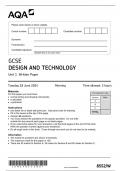
Please write clearly in block capitals.
Centre number Candidate number
Surname
Forename(s)
Candidate signature
I declare this is my own work.
GCSE
DESIGN AND TECHNOLOGY
Unit 1 Written Paper
Tuesday 18 June 2024 Morning Time allowed: 2 hours
Materials
For Examiner’s Use
For this paper you must have:
• normal writing and drawing instruments Section Mark
• a calculator
A
• a protractor.
B
Instructions C
• Use black ink or black ball-point pen. Use pencil only for drawing.
TOTAL
• Fill in the boxes at the top of this page.
• Answer all questions.
• You must answer the questions in the spaces provided. Do not write
outside the box around each page or on blank pages.
• If you need extra space for your answer(s), use the lined pages at the end of this book.
Write the question number against your answer(s).
• Do all rough work in this book. Cross through any work you do not want to be marked.
Information
• The marks for questions are shown in brackets.
• The maximum mark for this paper is 100.
• There are 20 marks for Section A, 30 marks for Section B and 50 marks for Section C.
*jun248552w01*
IB/G/Jun24/G4005/E9 8552/W
, 2
Do not write
outside the
Section A – Core technical principles box
Answer all questions in this section.
For the multiple-choice questions, completely fill in the lozenge alongside the appropriate answer.
CORRECT METHOD WRONG METHODS
If you want to change your answer you must cross out your original answer as shown.
If you wish to return to an answer previously crossed out, ring the answer you now wish to select
as shown.
0 1 Which one of the following metals is an alloy?
A Aluminium
B Brass
C Iron
D Tin
[1 mark]
0 2 Which one of the following has to be considered when organising the workplace?
A Fair trade
B Market pull
C Technology push
D Tools and equipment
[1 mark]
*02*
IB/G/Jun24/8552/W
, 3
Do not write
outside the
0 3 Which one of the following is the definition of a dense material? box
A It can be stretched out into a thin length.
B It has a compact molecular structure.
C It has the ability to float in water.
D It is able to conduct an electrical charge.
[1 mark]
0 4 Figure 1 shows a lever to be used as part of a mechanism.
The distance from point A to the fixed pivot is 80 mm.
The distance from point B to the fixed pivot is 20 mm.
Figure 1
If point A of the lever moves 40 mm clockwise, how far does point B move clockwise?
A 10 mm
B 20 mm
C 30 mm
D 40 mm
[1 mark]
Turn over ►
*03*
IB/G/Jun24/8552/W
Centre number Candidate number
Surname
Forename(s)
Candidate signature
I declare this is my own work.
GCSE
DESIGN AND TECHNOLOGY
Unit 1 Written Paper
Tuesday 18 June 2024 Morning Time allowed: 2 hours
Materials
For Examiner’s Use
For this paper you must have:
• normal writing and drawing instruments Section Mark
• a calculator
A
• a protractor.
B
Instructions C
• Use black ink or black ball-point pen. Use pencil only for drawing.
TOTAL
• Fill in the boxes at the top of this page.
• Answer all questions.
• You must answer the questions in the spaces provided. Do not write
outside the box around each page or on blank pages.
• If you need extra space for your answer(s), use the lined pages at the end of this book.
Write the question number against your answer(s).
• Do all rough work in this book. Cross through any work you do not want to be marked.
Information
• The marks for questions are shown in brackets.
• The maximum mark for this paper is 100.
• There are 20 marks for Section A, 30 marks for Section B and 50 marks for Section C.
*jun248552w01*
IB/G/Jun24/G4005/E9 8552/W
, 2
Do not write
outside the
Section A – Core technical principles box
Answer all questions in this section.
For the multiple-choice questions, completely fill in the lozenge alongside the appropriate answer.
CORRECT METHOD WRONG METHODS
If you want to change your answer you must cross out your original answer as shown.
If you wish to return to an answer previously crossed out, ring the answer you now wish to select
as shown.
0 1 Which one of the following metals is an alloy?
A Aluminium
B Brass
C Iron
D Tin
[1 mark]
0 2 Which one of the following has to be considered when organising the workplace?
A Fair trade
B Market pull
C Technology push
D Tools and equipment
[1 mark]
*02*
IB/G/Jun24/8552/W
, 3
Do not write
outside the
0 3 Which one of the following is the definition of a dense material? box
A It can be stretched out into a thin length.
B It has a compact molecular structure.
C It has the ability to float in water.
D It is able to conduct an electrical charge.
[1 mark]
0 4 Figure 1 shows a lever to be used as part of a mechanism.
The distance from point A to the fixed pivot is 80 mm.
The distance from point B to the fixed pivot is 20 mm.
Figure 1
If point A of the lever moves 40 mm clockwise, how far does point B move clockwise?
A 10 mm
B 20 mm
C 30 mm
D 40 mm
[1 mark]
Turn over ►
*03*
IB/G/Jun24/8552/W