AAPC - Chapter 14 Practical Applications
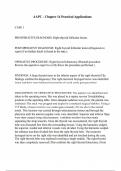
CASE 1 PREOPERATIVE DIAGNOSIS: Right thyroid follicular lesion. POSTOPERATIVE DIAGNOSIS: Right thyroid follicular lesion.(Diagnosis to report if no further detail is found in the note.) OPERATIVE PROCEDURE: Right thyroid lobectomy.(Planned procedure. Review the operative report to verify this is the procedure performed.) FINDINGS: A large thyroid mass in the inferior aspect of the right thyroid.(The findings confirm the diagnosis.) The right recurrent laryngeal nerve was identified intact and there were bilateral movements of vocal cords post procedure. DESCRIPTION OF OPERATIVE PROCEDURE: The patient was identified and taken to the operating room. She was placed in a supine reverse Trendelenburg position on the operating table. Once adequate sedation was given, the patient was intubated. The neck was prepped and draped in a standard surgical fashion. Using a #15 blade, a linear incision was made approximately 2.0 cm above the sternal notch. This incision was carried through subcutaneous tissues and through the platysma until the anterior jugular veins were identified. Superior and inferior flaps were then created using electrocautery. A midline incision was then made separating the strap muscles. Once the thyroid was encountered, the right thyroid lobe was dissected free from the surrounding tissues. Using the harmonic scalpel, the superior, medial and inferior vessels were divided. Using the harmonic scalpel, the isthmus was then divided free from the right thyroid lobe. The recurrent laryngeal nerve on the right side was identified and not touched during the case. The right thyroid lobe was explored revealing a single nodule. The right thyroid was then completely removed (This confirms the right thyroid lobectomy.) from the trachea and the surrounding tissues. It was marked and sent off the table as a specimen. The cavity was then irrigated with saline and hemostasis was achieved using electrocautery. The fascia and the strap muscles were then approximated using 3-0 Vicryl suture and a drain was placed into the cavity, exiting the left aspect of the incision. The platysma was then reapproximated using 3-0 Vicryl suture. The skin was then reapproximated using 4-0 Monocryl suture in running subcuticular closure and covered with Dermabond. By the end of the procedure, the sponge, needle, and instrument counts were correct. The patient was extubated observing bilateral movement of the vocal cords.
Written for
Document information
- Uploaded on
- September 6, 2024
- Number of pages
- 19
- Written in
- 2024/2025
- Type
- Exam (elaborations)
- Contains
- Questions & answers
Subjects
- aapc
- aapc chapter 14
-
aapc practical applications
-
aapc chapter 14 practical applications

Also available in package deal