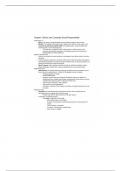
Chapter 3 Ethics and Corporate Social Responsibility
Introduction 3-1
- Ethics: The study of moral standards and their effect on behavior and conduct.
- Morality: The standards that people use to judge what is right or wrong, good or evil.
- Corporate Social Responsibility (CSR): Companies seek to pursue activities that
benefit society in some meaningful way.
- Can improve a company’s brand, enabling them to charge more for their
products, attract better employees, and ultimately improve their stock price.
- SUstainability and energy efficiency
Ethical Frameworks 3-2
- Laws do not provide the moral backbone to businesses, they reflect society’s minimum
standards.
- Investors expect businesses to maximize profits, while customers expect businesses to
demonstrate leadership in socially responsible initiatives such as reducing pollution and
waste and promoting civil and human rights.
- Moral Compass: Set of guiding principles that help an individual navigate complex
ethical challenges. Derived from a deep understanding of one’s personal values.
Utilitarianism 3-2a
- Utilitarianism: The ethical philosophy claiming that behaviors are considered moral if
they produce the greatest good, or utility, for the greatest number of people.
- Greatest happiness principle
- Cost-benefit analysis
- Managers should seek good outcomes for affected parties, be objective in
identifying others’ interests and the likely consequences of their actions, and be
impartial when balancing others’ interests with their own.
- “Good” things: Happiness, utility, pleasure
- “Bad” things: Pain and displeasure
- Can lead to a tyranny of the majority and a failure to respect individuals such as
minorities
Kantianism 3-2b
- Kantianism: An ethical philosophy claiming that motives and universal rules are
important aspects in judging what is right or wrong.
- People must take the right decisions for the right reasons
- Framework in evaluating leaders
- The intent or objectives of the leader
- What leader hoped to accomplish
- Purpose: Financial gain or personal advancement or advancement of
society
- Vision: Defined or emergent
- Innovation: Incremental or breakthrough
- Goal: Growth or stability
, - The means by which the leader sought to realize his or her intent to achieve his
or her objectives
- How leader went about achieving objectives
- Clear values or flexible pragmatism
- Empowering or exploiting people and processes
- Inclusive or exclusive
- The outcomes that were actually produced from this effort
- What results were produced; did they match intent
- Transforming society or financial success or personal wealth
accumulation
- Unlikely or inevitable
- Positive or negative unintended consequences
- Long-term or short-term horizon
- Tangible vs. intangible
- “I ought never to act except in such a way that my maxim should become a universal
law”
Virtues and Character 3-2c
- Character
- A person’s ability to recognize the moral elements of a situation
- How well a person makes moral judgments
- How consistent a person’s actions are with those judgments
- How well a person can teach others to exhibit character
- From Aristotle and Plato
- Virtue Ethics: An ethical philosophy claiming that morality’s primary function is to
develop virtuous character.
-
Introduction 3-1
- Ethics: The study of moral standards and their effect on behavior and conduct.
- Morality: The standards that people use to judge what is right or wrong, good or evil.
- Corporate Social Responsibility (CSR): Companies seek to pursue activities that
benefit society in some meaningful way.
- Can improve a company’s brand, enabling them to charge more for their
products, attract better employees, and ultimately improve their stock price.
- SUstainability and energy efficiency
Ethical Frameworks 3-2
- Laws do not provide the moral backbone to businesses, they reflect society’s minimum
standards.
- Investors expect businesses to maximize profits, while customers expect businesses to
demonstrate leadership in socially responsible initiatives such as reducing pollution and
waste and promoting civil and human rights.
- Moral Compass: Set of guiding principles that help an individual navigate complex
ethical challenges. Derived from a deep understanding of one’s personal values.
Utilitarianism 3-2a
- Utilitarianism: The ethical philosophy claiming that behaviors are considered moral if
they produce the greatest good, or utility, for the greatest number of people.
- Greatest happiness principle
- Cost-benefit analysis
- Managers should seek good outcomes for affected parties, be objective in
identifying others’ interests and the likely consequences of their actions, and be
impartial when balancing others’ interests with their own.
- “Good” things: Happiness, utility, pleasure
- “Bad” things: Pain and displeasure
- Can lead to a tyranny of the majority and a failure to respect individuals such as
minorities
Kantianism 3-2b
- Kantianism: An ethical philosophy claiming that motives and universal rules are
important aspects in judging what is right or wrong.
- People must take the right decisions for the right reasons
- Framework in evaluating leaders
- The intent or objectives of the leader
- What leader hoped to accomplish
- Purpose: Financial gain or personal advancement or advancement of
society
- Vision: Defined or emergent
- Innovation: Incremental or breakthrough
- Goal: Growth or stability
, - The means by which the leader sought to realize his or her intent to achieve his
or her objectives
- How leader went about achieving objectives
- Clear values or flexible pragmatism
- Empowering or exploiting people and processes
- Inclusive or exclusive
- The outcomes that were actually produced from this effort
- What results were produced; did they match intent
- Transforming society or financial success or personal wealth
accumulation
- Unlikely or inevitable
- Positive or negative unintended consequences
- Long-term or short-term horizon
- Tangible vs. intangible
- “I ought never to act except in such a way that my maxim should become a universal
law”
Virtues and Character 3-2c
- Character
- A person’s ability to recognize the moral elements of a situation
- How well a person makes moral judgments
- How consistent a person’s actions are with those judgments
- How well a person can teach others to exhibit character
- From Aristotle and Plato
- Virtue Ethics: An ethical philosophy claiming that morality’s primary function is to
develop virtuous character.
-