

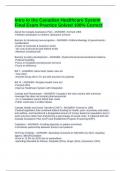
Intro to the Canadian Healthcare System
Final Exam Practice Solved 100% Correct
About the Canada Assistance Plan - ANSWER--Formed 1966
-Federal contribution to mothers' allowance scheme
Barriers to introducing new programs - ANSWER--Political ideology of governments -
neoliberalism
-Power of corporate & business sector
-Tax cuts at provincial and federal levels
-Absence of political will
Barriers to policy development - ANSWER--Dysfunctional provincial-federal relations
-Political feasibility
-Focus on hospitals and physician services
-Focus on efficiency
Bill 7 - ANSWER--More beds, better care act
-Year 2022
-Amends fixing 2021 LTC act with provision for patients
Bill 74 - ANSWER--Peoples Health Care Act
-Formed 2019
-Improve Healthcare System with Integration
Canada and Pharmacare - ANSWER--Canada is the only country with universal
coverage that does not include pharmaceuticals
-1 in 4 canadians cannot afford their meds
-Public could save 11 billion $/year
Canada Health and Social Transfer (CHST) - ANSWER--Formed in 1995
-Federal legislation that combined federal funding for health, post- secondary education,
and welfare, and transferred a designated amount of money based on population size to
each province rather than transferring a percentage of actual costs. It replaced both the
Canada Assistance Plan (CAP) and Established Program Financing (EPF).
Capitation - ANSWER--Funding depends on patient enrolment
-Formalizes partnership between doctors and patients
CIHI Key Findings - ANSWER--Spending increased to 308 billion by 2021, equaling
approx. $8019/Canadian
-Rose to 12.8% by 2020 due to expenditure
-Spending allocated as follows; hospitals (25%), drugs (14%), physicians (13%)
, Conservative Countries - ANSWER-Germany
France
Portugal
Italy
Decline of the Welfare State - ANSWER--Weakened national identities
-Deregulation of Market & trade
-Internationalization of investment
-Political Compromises
-Slowing of Economies
Define capitalism - ANSWER-an economic and political system in which a country's
trade and industry are controlled by private owners for profit, rather than by the needs of
producers
Define Liberalism - ANSWER--Personal Freedom; Absence of Coercion
-Limited Government
Define medically acceptable timeframe - ANSWER-Amount of time deemed appropriate
wait time for a procedure based on clinical evidence
Difference between Canadian and American Healthcare System - ANSWER-Canada=
Single Payer System
America= Private HCS
Dominant model of Primary Care in Canada - ANSWER-Fee-For-Service (FFS) for
physician services
Esping-Andersen's Welfare State Regimes - ANSWER--Political economy perspective
-Economic distribution & poverty impact
-Political impact
Established programs financing - ANSWER--Formed 1977
-Cost transfer conditional based on provinces compliance with federal conditions of
eligibility
-Unconditional transfer; tax points, revenue based on income tax yield
Forces in Development of Welfare State - ANSWER--Strong national identities at end of
WW2
-Rebuild western economies
-Strength of labor unions
-Political compromise
Ford Government Health Cuts - ANSWER--OHIP+
-Dementia strategy programs
-Planned new OD sites cancelled
Final Exam Practice Solved 100% Correct
About the Canada Assistance Plan - ANSWER--Formed 1966
-Federal contribution to mothers' allowance scheme
Barriers to introducing new programs - ANSWER--Political ideology of governments -
neoliberalism
-Power of corporate & business sector
-Tax cuts at provincial and federal levels
-Absence of political will
Barriers to policy development - ANSWER--Dysfunctional provincial-federal relations
-Political feasibility
-Focus on hospitals and physician services
-Focus on efficiency
Bill 7 - ANSWER--More beds, better care act
-Year 2022
-Amends fixing 2021 LTC act with provision for patients
Bill 74 - ANSWER--Peoples Health Care Act
-Formed 2019
-Improve Healthcare System with Integration
Canada and Pharmacare - ANSWER--Canada is the only country with universal
coverage that does not include pharmaceuticals
-1 in 4 canadians cannot afford their meds
-Public could save 11 billion $/year
Canada Health and Social Transfer (CHST) - ANSWER--Formed in 1995
-Federal legislation that combined federal funding for health, post- secondary education,
and welfare, and transferred a designated amount of money based on population size to
each province rather than transferring a percentage of actual costs. It replaced both the
Canada Assistance Plan (CAP) and Established Program Financing (EPF).
Capitation - ANSWER--Funding depends on patient enrolment
-Formalizes partnership between doctors and patients
CIHI Key Findings - ANSWER--Spending increased to 308 billion by 2021, equaling
approx. $8019/Canadian
-Rose to 12.8% by 2020 due to expenditure
-Spending allocated as follows; hospitals (25%), drugs (14%), physicians (13%)
, Conservative Countries - ANSWER-Germany
France
Portugal
Italy
Decline of the Welfare State - ANSWER--Weakened national identities
-Deregulation of Market & trade
-Internationalization of investment
-Political Compromises
-Slowing of Economies
Define capitalism - ANSWER-an economic and political system in which a country's
trade and industry are controlled by private owners for profit, rather than by the needs of
producers
Define Liberalism - ANSWER--Personal Freedom; Absence of Coercion
-Limited Government
Define medically acceptable timeframe - ANSWER-Amount of time deemed appropriate
wait time for a procedure based on clinical evidence
Difference between Canadian and American Healthcare System - ANSWER-Canada=
Single Payer System
America= Private HCS
Dominant model of Primary Care in Canada - ANSWER-Fee-For-Service (FFS) for
physician services
Esping-Andersen's Welfare State Regimes - ANSWER--Political economy perspective
-Economic distribution & poverty impact
-Political impact
Established programs financing - ANSWER--Formed 1977
-Cost transfer conditional based on provinces compliance with federal conditions of
eligibility
-Unconditional transfer; tax points, revenue based on income tax yield
Forces in Development of Welfare State - ANSWER--Strong national identities at end of
WW2
-Rebuild western economies
-Strength of labor unions
-Political compromise
Ford Government Health Cuts - ANSWER--OHIP+
-Dementia strategy programs
-Planned new OD sites cancelled


