🌿
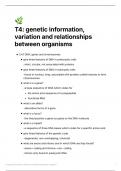
T4: genetic information,
variation and relationships
between organisms
3.4.1 DNA, genes and chromosomes
give three features of DNA in prokaryotic cells
-short, circular, not associated with proteins
give three features of DNA in eukaryotic cells
-found in nucleus, long, associated with proteins called histones to form
chromosomes
what is a a gene?
-a base sequence of DNA which codes for
the amino acid sequence of a polypeptide
functional RNA
what is an allele?
-alternative forms of a gene
what is a locus?
-the fixed position a gene occupies on the DNA molecule
what is a triplet?
-a sequence of three DNA bases which codes for a specific amino acid
give three features of the genetic code
-degenerate, non-overlapping, universal
what are exons and introns and in which DNA are they found?
-exons= coding and introns= non- coding
-introns only found in eukaryotic DNA
T4: genetic information, variation and relationships between organisms 1
, what is meant by a pair of homologous chromosomes?
-a pair where one is maternal and one is paternal
-they have the same genes but not necessarily the same alleles
3.4.2 DNA and proteinsynthesis
what is the genome?
-complete set of genes in a cell
what is the proteome?
-full range of proteins a cell is able to produce
compare and contrast the structures of mRNA and tRNA
-mRNA is larger than tRNA
-mRNA is linear whereas tRNA id clover shaped
-they both have codons
-both use base U instead of T
explain how transcription is carried out
1- DNA helicase breaks H bonds between base pairs causing DNA
strands to separate
2- one DNA strand acts as a template
3- free RNA nucleotides line up opposite complementary base pairs and
H bonds form between them
4- RNA polymerase catalyses formation of phosphodiester bonds to
join adjacent RNA nucleotides together
5- pre-mRNA spliced to remove introns and form mRNA
what is the difference in the last step of transcription in eukaryotes and
prokaryotes?
-in eukaryotes introns are present in DNA so splicing occurs but in
prokaryotic DNA there are no introns
-pre mRNA only produced in eukaryotes
where does translation occur?
-in the ribosome
explain the process of translation
T4: genetic information, variation and relationships between organisms 2
T4: genetic information,
variation and relationships
between organisms
3.4.1 DNA, genes and chromosomes
give three features of DNA in prokaryotic cells
-short, circular, not associated with proteins
give three features of DNA in eukaryotic cells
-found in nucleus, long, associated with proteins called histones to form
chromosomes
what is a a gene?
-a base sequence of DNA which codes for
the amino acid sequence of a polypeptide
functional RNA
what is an allele?
-alternative forms of a gene
what is a locus?
-the fixed position a gene occupies on the DNA molecule
what is a triplet?
-a sequence of three DNA bases which codes for a specific amino acid
give three features of the genetic code
-degenerate, non-overlapping, universal
what are exons and introns and in which DNA are they found?
-exons= coding and introns= non- coding
-introns only found in eukaryotic DNA
T4: genetic information, variation and relationships between organisms 1
, what is meant by a pair of homologous chromosomes?
-a pair where one is maternal and one is paternal
-they have the same genes but not necessarily the same alleles
3.4.2 DNA and proteinsynthesis
what is the genome?
-complete set of genes in a cell
what is the proteome?
-full range of proteins a cell is able to produce
compare and contrast the structures of mRNA and tRNA
-mRNA is larger than tRNA
-mRNA is linear whereas tRNA id clover shaped
-they both have codons
-both use base U instead of T
explain how transcription is carried out
1- DNA helicase breaks H bonds between base pairs causing DNA
strands to separate
2- one DNA strand acts as a template
3- free RNA nucleotides line up opposite complementary base pairs and
H bonds form between them
4- RNA polymerase catalyses formation of phosphodiester bonds to
join adjacent RNA nucleotides together
5- pre-mRNA spliced to remove introns and form mRNA
what is the difference in the last step of transcription in eukaryotes and
prokaryotes?
-in eukaryotes introns are present in DNA so splicing occurs but in
prokaryotic DNA there are no introns
-pre mRNA only produced in eukaryotes
where does translation occur?
-in the ribosome
explain the process of translation
T4: genetic information, variation and relationships between organisms 2