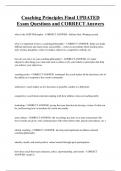
Coaching Principles Final UPDATED
Exam Questions and CORRECT Answers
what is the ASEP Philosophy - CORRECT ANSWER- Athletes first, Winning second
why is it important to have a coaching philosophy? - CORRECT ANSWER- helps you make
difficult decisions and coach more successfully -- removes uncertainty about training rules,
style of play, discipline, codes of conduct, objectives, competitive outlook, etc.
how do you arrive at your coaching philosophy? - CORRECT ANSWER- (1) major
objectives (the things you value and want to achieve) (2) your beliefs or principles that help
you achieve your objectives
coaching styles - CORRECT ANSWER- command: the coach makes all the decisions; role of
the athlete is to respond to the coach's commands
submissive: coach makes as few decisions as possible, similar to a babysitter
cooperative: coach shares decision making with their athletes, focus on teaching skills
leadership - CORRECT ANSWER- giving the team direction by having a vision of what can
be, and knowing how to translate the vision into reality
team culture - CORRECT ANSWER- the way things are done on a team (concerned with
how rewards are given, who communicates with whom about what, practice procedures, etc.)
ethical coaching - CORRECT ANSWER- develop and implement an athlete-centered
coaching philosophy
identify, model, and teach positive values learned through sport participation
how does coach best teach character, ethics, sportsmanship, and morals - CORRECT
ANSWER- model it
, (1)identify the principles
(2)teach the principles: create amoral environment, set rules for good behavior, explain and
discuss moral behavior, use and teach ethical decision making, motivate your athletes to
develop good character
(3)provide opportunities to practice moral behavior
name and describe the communication skills that coaches need - CORRECT ANSWER-
(1)developing credibility when you communicate
(2)communicating with a positive approach
(3)avoid sending messages high in information (4)communicating with consistency
(5)learning how to listen (6)improving your nonverbal communication
(7)learn how to send and receive messages
(8)remember it's not what you say but how you say
principles of motivation - CORRECT ANSWER- intrinsic motivation: those feelings that are
internally satisfying when athletes participate in sport
extrinsic motivation: rewards, recognition, trophies, etc.
what are the needs of athletes? - CORRECT ANSWER- to feel worthy and to have fun
how do you practice preventive discipline? - CORRECT ANSWER- (1)create the right team
culture
(2)hold team meetings
(3)develop team rules
(4)create team routines
(5)conduct exciting practices
(6)catch them going good
why do athletes misbehave - CORRECT ANSWER- athletes may be discourages
Exam Questions and CORRECT Answers
what is the ASEP Philosophy - CORRECT ANSWER- Athletes first, Winning second
why is it important to have a coaching philosophy? - CORRECT ANSWER- helps you make
difficult decisions and coach more successfully -- removes uncertainty about training rules,
style of play, discipline, codes of conduct, objectives, competitive outlook, etc.
how do you arrive at your coaching philosophy? - CORRECT ANSWER- (1) major
objectives (the things you value and want to achieve) (2) your beliefs or principles that help
you achieve your objectives
coaching styles - CORRECT ANSWER- command: the coach makes all the decisions; role of
the athlete is to respond to the coach's commands
submissive: coach makes as few decisions as possible, similar to a babysitter
cooperative: coach shares decision making with their athletes, focus on teaching skills
leadership - CORRECT ANSWER- giving the team direction by having a vision of what can
be, and knowing how to translate the vision into reality
team culture - CORRECT ANSWER- the way things are done on a team (concerned with
how rewards are given, who communicates with whom about what, practice procedures, etc.)
ethical coaching - CORRECT ANSWER- develop and implement an athlete-centered
coaching philosophy
identify, model, and teach positive values learned through sport participation
how does coach best teach character, ethics, sportsmanship, and morals - CORRECT
ANSWER- model it
, (1)identify the principles
(2)teach the principles: create amoral environment, set rules for good behavior, explain and
discuss moral behavior, use and teach ethical decision making, motivate your athletes to
develop good character
(3)provide opportunities to practice moral behavior
name and describe the communication skills that coaches need - CORRECT ANSWER-
(1)developing credibility when you communicate
(2)communicating with a positive approach
(3)avoid sending messages high in information (4)communicating with consistency
(5)learning how to listen (6)improving your nonverbal communication
(7)learn how to send and receive messages
(8)remember it's not what you say but how you say
principles of motivation - CORRECT ANSWER- intrinsic motivation: those feelings that are
internally satisfying when athletes participate in sport
extrinsic motivation: rewards, recognition, trophies, etc.
what are the needs of athletes? - CORRECT ANSWER- to feel worthy and to have fun
how do you practice preventive discipline? - CORRECT ANSWER- (1)create the right team
culture
(2)hold team meetings
(3)develop team rules
(4)create team routines
(5)conduct exciting practices
(6)catch them going good
why do athletes misbehave - CORRECT ANSWER- athletes may be discourages