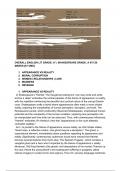
OVERALL ENGLISH LIT GRADE: A* | SHAKESPEARE GRADE: A 97/120
MARKS [87 UMS]
1. APPEARANCE VS REALITY
2. MORAL CORRUPTION
3. WOMEN | RELATIONSHIPS | LOVE
4. MADNESS
5. REVENGE
1. APPEARANCE VS REALITY
In Shakespeare’s "Hamlet," the thought-provoking line ‘one may smile and smile
and be a villain’ embodies the central paradox of the theme of appearance vs reality,
with the repetition reinforcing the deceitful and cyclical nature of the corrupt Danish
court. Shakespeare crafts a world where appearances often mask a more sinister
reality, exploring the complexities of human perception, deception, and truth. The
Renaissance period, which profoundly influenced Shakespeare, emphasised human
potential and the complexity of the human condition, exploring how perception can
be manipulated and how truth can be obscured. Thus, with contemporary influences,
"Hamlet" embodies Vin Hanley’s view that "appearances in the court blatantly
contradict realities."
Act 1 is pivotal to the theme of appearance versus reality, as critic Snider states,
"doubt rises, a reflection enters—the ghost may be a deception." The ghost, a
supernatural element, immediately raises questions regarding its appearance and
reality. Significantly, contemporary audiences would have noticed that Hamlet
borrows several features from Kyd’s play ‘The Spanish Tragedy’, which contains a
vengeful ghost and a hero who’s impacted by the theme of appearance v reality.
Moreover, Old King Hamlet’s (the ghost) vivid descriptions of his murder ("harrow up
thy soul, freeze thy young blood") and subsequent suffering in purgatory utilise
intense imagery to evoke horror and urgency. This rich, sensory language reinforces
, the ghost's suffering and the foul nature of his murder, creating a stark contrast
between the peaceful appearance of King Hamlet's death and the gruesome reality.
The ghost's account of his murder emphasises the motif of ears and hearing ("in the
porches of my ears"), symbolising how deceit and false appearances infiltrate and
corrupt the court. It suggests that words and appearances can be vehicles of
profound betrayal and evil, reinforcing Hamlet's need to scrutinise and question to
uncover the hidden reality. Additionally, Elizabethan beliefs about the night belonging
to the devil and supernatural creatures like ghosts, coupled with the Catholic doctrine
on purgatory, contrasts sharply with Protestant views that ghosts were demons in
disguise. Shakespeare effectively highlights the theme of appearance versus reality
by tapping into these conflicting religious beliefs, resonating with contemporary
audiences.
Within Act 1, Scene 2 of "Hamlet," Claudius speaks of his brother’s death with
apparent sorrow, masking the reality that he is the murderer. His crime is not only
fratricide but also regicide. Claudius’s use of inclusive language, such as "our dear
brother" and "our hearts in grief," and collective pronouns, creates the image of a
grieving, compassionate ruler who shares in the kingdom's sorrow. Additionally, his
formal, measured language and structured speech convey a sense of control and
authority, presenting the appearance of a composed and legitimate ruler. His
deceitful facade on the court is further emphasised in the 1996 production of Hamlet
as we see a wide shot of the audience applauding Claudius during his speech.
However, the modern audience is aware of the disparity between his appearance
and reality, knowing Claudius's rise to power is illegitimate. Notably, Shakespeare
could be illustrating a Biblical allusion to the story of Cain and Abel, by paralleling
Claudius and the Biblical figure Cain prompts a critical examination of political
leaders who present a façade of virtue while engaging in morally corrupt actions.
This allusion may encourage contemporary audiences to reflect on the nature of
power and the potential for leaders to use appearances to mask their true intentions
and actions, especially relevant in the context of the questioned succession of
Elizabeth I. As a result, Vin Hanley suggests that "the audience are disturbed by the
problematic nature of appearance versus reality." Moreover, Claudius's deceptive
nature is highlighted through irony, particularly in his reference to Gertrude as "our
sometime sister, now our queen." This ironic statement underscores his duplicity,
revealing the unnatural and morally corrupt transition from brother-in-law to husband.
It signifies Claudius’s manipulative ability to twist familial roles to suit his narrative,
masking the reality of his incestuous and politically motivated marriage. Ultimately,
as Vin Hanley notes, "Claudius can smile and smile and yet be a villain,"
encapsulating the play's central theme of appearance versus reality.
The metadrama scene within "Hamlet" serves as a striking illustration of dramatic
irony, where the audience possesses knowledge of Claudius’s guilt that eludes the
characters within the play. The Elizabethan and Jacobean periods saw a flourishing
of metatheatrical techniques. Playwrights like Shakespeare, Ben Jonson, and
Thomas Kyd often used plays-within-plays to draw attention to the artifice of theatre,
engaging the audience in a reflection on the nature of performance itself. As the
MARKS [87 UMS]
1. APPEARANCE VS REALITY
2. MORAL CORRUPTION
3. WOMEN | RELATIONSHIPS | LOVE
4. MADNESS
5. REVENGE
1. APPEARANCE VS REALITY
In Shakespeare’s "Hamlet," the thought-provoking line ‘one may smile and smile
and be a villain’ embodies the central paradox of the theme of appearance vs reality,
with the repetition reinforcing the deceitful and cyclical nature of the corrupt Danish
court. Shakespeare crafts a world where appearances often mask a more sinister
reality, exploring the complexities of human perception, deception, and truth. The
Renaissance period, which profoundly influenced Shakespeare, emphasised human
potential and the complexity of the human condition, exploring how perception can
be manipulated and how truth can be obscured. Thus, with contemporary influences,
"Hamlet" embodies Vin Hanley’s view that "appearances in the court blatantly
contradict realities."
Act 1 is pivotal to the theme of appearance versus reality, as critic Snider states,
"doubt rises, a reflection enters—the ghost may be a deception." The ghost, a
supernatural element, immediately raises questions regarding its appearance and
reality. Significantly, contemporary audiences would have noticed that Hamlet
borrows several features from Kyd’s play ‘The Spanish Tragedy’, which contains a
vengeful ghost and a hero who’s impacted by the theme of appearance v reality.
Moreover, Old King Hamlet’s (the ghost) vivid descriptions of his murder ("harrow up
thy soul, freeze thy young blood") and subsequent suffering in purgatory utilise
intense imagery to evoke horror and urgency. This rich, sensory language reinforces
, the ghost's suffering and the foul nature of his murder, creating a stark contrast
between the peaceful appearance of King Hamlet's death and the gruesome reality.
The ghost's account of his murder emphasises the motif of ears and hearing ("in the
porches of my ears"), symbolising how deceit and false appearances infiltrate and
corrupt the court. It suggests that words and appearances can be vehicles of
profound betrayal and evil, reinforcing Hamlet's need to scrutinise and question to
uncover the hidden reality. Additionally, Elizabethan beliefs about the night belonging
to the devil and supernatural creatures like ghosts, coupled with the Catholic doctrine
on purgatory, contrasts sharply with Protestant views that ghosts were demons in
disguise. Shakespeare effectively highlights the theme of appearance versus reality
by tapping into these conflicting religious beliefs, resonating with contemporary
audiences.
Within Act 1, Scene 2 of "Hamlet," Claudius speaks of his brother’s death with
apparent sorrow, masking the reality that he is the murderer. His crime is not only
fratricide but also regicide. Claudius’s use of inclusive language, such as "our dear
brother" and "our hearts in grief," and collective pronouns, creates the image of a
grieving, compassionate ruler who shares in the kingdom's sorrow. Additionally, his
formal, measured language and structured speech convey a sense of control and
authority, presenting the appearance of a composed and legitimate ruler. His
deceitful facade on the court is further emphasised in the 1996 production of Hamlet
as we see a wide shot of the audience applauding Claudius during his speech.
However, the modern audience is aware of the disparity between his appearance
and reality, knowing Claudius's rise to power is illegitimate. Notably, Shakespeare
could be illustrating a Biblical allusion to the story of Cain and Abel, by paralleling
Claudius and the Biblical figure Cain prompts a critical examination of political
leaders who present a façade of virtue while engaging in morally corrupt actions.
This allusion may encourage contemporary audiences to reflect on the nature of
power and the potential for leaders to use appearances to mask their true intentions
and actions, especially relevant in the context of the questioned succession of
Elizabeth I. As a result, Vin Hanley suggests that "the audience are disturbed by the
problematic nature of appearance versus reality." Moreover, Claudius's deceptive
nature is highlighted through irony, particularly in his reference to Gertrude as "our
sometime sister, now our queen." This ironic statement underscores his duplicity,
revealing the unnatural and morally corrupt transition from brother-in-law to husband.
It signifies Claudius’s manipulative ability to twist familial roles to suit his narrative,
masking the reality of his incestuous and politically motivated marriage. Ultimately,
as Vin Hanley notes, "Claudius can smile and smile and yet be a villain,"
encapsulating the play's central theme of appearance versus reality.
The metadrama scene within "Hamlet" serves as a striking illustration of dramatic
irony, where the audience possesses knowledge of Claudius’s guilt that eludes the
characters within the play. The Elizabethan and Jacobean periods saw a flourishing
of metatheatrical techniques. Playwrights like Shakespeare, Ben Jonson, and
Thomas Kyd often used plays-within-plays to draw attention to the artifice of theatre,
engaging the audience in a reflection on the nature of performance itself. As the