

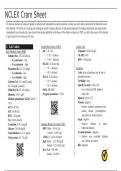
NCLEX Cram Sheet
We exist to educate and empower people to achieve their maximum God-given potential, so they can serve others and provide for themselves and
their families. We do this by creating and curating the world’s largest collection of educational materials for helping individuals pass high-stakes
standardized tests. Founded as a new kind of educational publisher at the dawn of the online revolution in 2002, we utilize the power of the Internet
to give much of our work away for free.
1. Lab Values Arterial Blood Gases (ABGs) Cardiac Labs
Basil Metabolic Panel (BMP) pH: 7.35-7.45 Troponin: <0.012 mcg/L
Sodium (Na): 135-145 mEq/L • <7.35 = acidosis CK-MP: 0-6%
• Hyponatremia – low • >7.45 = alkalosis BNP: <100 pg/mL
• Hypernatremia – high PaCO2: 35-45 mm Hg
Potassium (K): 3.5-5.3 mEq/L • <35 = alkalosis Urinalysis
• Hypokalemia – low • >45 = acidosis Color: straw (cloudiness may be due to
• Hyperkalemia – high HCO3: 22-26 mEq/L phosphates/urates)
Calcium (Ca): 9-11 mg/dL (total), • <22 = acidosis Turbidity: clear
4.5-5.6 mg/dL (ionized) • >26 = alkalosis Specific Gravity: 1.001-1.02
Chloride (Cl): 95-105 mEq/L PaO2: 80-100% • Low: sickle cell, DM, diabetes
Albumin: 3.9-5.0 g/dL Oxygen saturation: > 95% insipi- dus
Alkaline phosphatase (ALP): 44-147 Dipstick: pH 4.5-7.5
IU/L Protein: negative
ALT: 8-37 IU/L • Positive: nephritic syndrome, renal
AST: 10-34 IU/L tubular disease, pyelonephritis,
BUN: 7-20 mg/dL and polycystic kidney disease
CO2: 20-29 mmol/L Sugar: negative
Creatinine: 0.8-1.4 mg/dL Complete Blood Cell Count (CBC) • Positive: diabetes or other
Glucose: 70-100 mg/dL RBC: Male = 4.5-6.0 µL; endocrine diseases
Total bilirubin: 0.2-1.9 mg/dL Female = 4.0-5.0 µL Acetone/ketones: negative
Total protein: 6.3-7.9 g/dL WBCs: 3.5-10 x 103/mm3 • Positive: non controlled diabetes,
Hgb: Male = 13.5-18.0 g/dL alco- holism, starvation
Female = 12.0-16.0 g/dL Bile: negative
Hct: Male = 40-54%
Female = 36-46%
, Hemoglobin: negative 2. Assessments
• Positive: bleeding, Burns – Depth of Injury Wong-Baker FACES
kidney/bladder irritation 1st degree—superficial: reddened skin, • Graphic depictions of pain through
Nitrite: negative but intact different facial expressions
• Positive: indicates 2nd degree—partial thickness; loss of • Appropriate for children, non-English
bacteria Leukocyte esterase: skin, into dermis (most painful) speakers, and some illiterate patients
negative Urobilinogen: 3rd degree—full thickness; all skin is lost, or patients with cognitive impairment
positive can see fat/muscle • Pediatric version and an adult version
Urine output: 800-2000 mL/day (with 4th degree—full thickness + underlying Brief Pain Inventory
intake of 2000 mL) tissue; can see to bone • Assesses the effect pain has on
• 3rd and 4th degree are not painful activi- ties.
Lipid Profile since nerves are lost CPOT
Total cholesterol: <200 mg/dL • Used in critical care settings
• Moderate Risk: 200-240 mg/dL Rules of Nines (ventilat- ed patients)
• High Risk: >240 mg/dL Head and neck – 9% Pain Assessment in Advanced De-
High-density lipoprotein (HDL): 29 - • children = mentia Scale (PAINAD)
77 mg/dL 18% Anterior torso - • Appropriate for adults with
Low-density lipoprotein (LDL): 60 - 18% Posterior torso cognitive impairment
160 mg/dL - 18% Each leg - CRIES
Triglyceride level: 10-190 mg/dL 18% • Crying
• children = • Requires O2
BMI 13.5% Each arm - 9% • Increased vital sign
Scores for adults 20+ Genitalia/perineum - • Expression
• Underweight: <18.5 1% • Sleepiness
• Normal weight: 18.5-24.9 • Assesses pain in neonates
• Overweight: 25.0-29.9 FLACC
• Obese: 30+ • Face
Scores for <20 • Legs
• Underweight: <5th percentile • Activity
• At risk for overweight: 85th- • Cry
<95th percentile Pain Assessment/Pain Scales • Consolability
• Overweight: > 95th percentile Visual Analog Scale (VAS) (non-nu- • Appropriate for children to 3 years
meric) of age and older children
• Used to determine baseline pain. with cognitive impairment.
Patient Comfort Assessment Guide:
• To assess pain status and pain
relief, response to medications.
We exist to educate and empower people to achieve their maximum God-given potential, so they can serve others and provide for themselves and
their families. We do this by creating and curating the world’s largest collection of educational materials for helping individuals pass high-stakes
standardized tests. Founded as a new kind of educational publisher at the dawn of the online revolution in 2002, we utilize the power of the Internet
to give much of our work away for free.
1. Lab Values Arterial Blood Gases (ABGs) Cardiac Labs
Basil Metabolic Panel (BMP) pH: 7.35-7.45 Troponin: <0.012 mcg/L
Sodium (Na): 135-145 mEq/L • <7.35 = acidosis CK-MP: 0-6%
• Hyponatremia – low • >7.45 = alkalosis BNP: <100 pg/mL
• Hypernatremia – high PaCO2: 35-45 mm Hg
Potassium (K): 3.5-5.3 mEq/L • <35 = alkalosis Urinalysis
• Hypokalemia – low • >45 = acidosis Color: straw (cloudiness may be due to
• Hyperkalemia – high HCO3: 22-26 mEq/L phosphates/urates)
Calcium (Ca): 9-11 mg/dL (total), • <22 = acidosis Turbidity: clear
4.5-5.6 mg/dL (ionized) • >26 = alkalosis Specific Gravity: 1.001-1.02
Chloride (Cl): 95-105 mEq/L PaO2: 80-100% • Low: sickle cell, DM, diabetes
Albumin: 3.9-5.0 g/dL Oxygen saturation: > 95% insipi- dus
Alkaline phosphatase (ALP): 44-147 Dipstick: pH 4.5-7.5
IU/L Protein: negative
ALT: 8-37 IU/L • Positive: nephritic syndrome, renal
AST: 10-34 IU/L tubular disease, pyelonephritis,
BUN: 7-20 mg/dL and polycystic kidney disease
CO2: 20-29 mmol/L Sugar: negative
Creatinine: 0.8-1.4 mg/dL Complete Blood Cell Count (CBC) • Positive: diabetes or other
Glucose: 70-100 mg/dL RBC: Male = 4.5-6.0 µL; endocrine diseases
Total bilirubin: 0.2-1.9 mg/dL Female = 4.0-5.0 µL Acetone/ketones: negative
Total protein: 6.3-7.9 g/dL WBCs: 3.5-10 x 103/mm3 • Positive: non controlled diabetes,
Hgb: Male = 13.5-18.0 g/dL alco- holism, starvation
Female = 12.0-16.0 g/dL Bile: negative
Hct: Male = 40-54%
Female = 36-46%
, Hemoglobin: negative 2. Assessments
• Positive: bleeding, Burns – Depth of Injury Wong-Baker FACES
kidney/bladder irritation 1st degree—superficial: reddened skin, • Graphic depictions of pain through
Nitrite: negative but intact different facial expressions
• Positive: indicates 2nd degree—partial thickness; loss of • Appropriate for children, non-English
bacteria Leukocyte esterase: skin, into dermis (most painful) speakers, and some illiterate patients
negative Urobilinogen: 3rd degree—full thickness; all skin is lost, or patients with cognitive impairment
positive can see fat/muscle • Pediatric version and an adult version
Urine output: 800-2000 mL/day (with 4th degree—full thickness + underlying Brief Pain Inventory
intake of 2000 mL) tissue; can see to bone • Assesses the effect pain has on
• 3rd and 4th degree are not painful activi- ties.
Lipid Profile since nerves are lost CPOT
Total cholesterol: <200 mg/dL • Used in critical care settings
• Moderate Risk: 200-240 mg/dL Rules of Nines (ventilat- ed patients)
• High Risk: >240 mg/dL Head and neck – 9% Pain Assessment in Advanced De-
High-density lipoprotein (HDL): 29 - • children = mentia Scale (PAINAD)
77 mg/dL 18% Anterior torso - • Appropriate for adults with
Low-density lipoprotein (LDL): 60 - 18% Posterior torso cognitive impairment
160 mg/dL - 18% Each leg - CRIES
Triglyceride level: 10-190 mg/dL 18% • Crying
• children = • Requires O2
BMI 13.5% Each arm - 9% • Increased vital sign
Scores for adults 20+ Genitalia/perineum - • Expression
• Underweight: <18.5 1% • Sleepiness
• Normal weight: 18.5-24.9 • Assesses pain in neonates
• Overweight: 25.0-29.9 FLACC
• Obese: 30+ • Face
Scores for <20 • Legs
• Underweight: <5th percentile • Activity
• At risk for overweight: 85th- • Cry
<95th percentile Pain Assessment/Pain Scales • Consolability
• Overweight: > 95th percentile Visual Analog Scale (VAS) (non-nu- • Appropriate for children to 3 years
meric) of age and older children
• Used to determine baseline pain. with cognitive impairment.
Patient Comfort Assessment Guide:
• To assess pain status and pain
relief, response to medications.


