Naming Ionic, Covalent
Compounds, Acids, Bases, and
Hydrates
Compound: A substance formed when two or more elements chemically
bond together.
Covalent Compounds
The oxygen (O2) we inhale is an example of a diatomic molecule. Covalent
compounds consist of neutral atoms, typically nonmetals like H2O, CO2, and
C12H22O11. These compounds have low melting and boiling points, often
appearing as gases or liquids at room temperature. They feature covalent
bonds where electrons are shared and exist as distinct molecules.
Remember the exception as BRINClHOF: Br2, I2, N2, Cl2, H2, O2, F2.
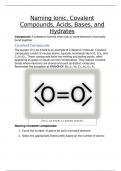
The O2 you breathe is a diatomic molecule.
Naming Covalent Compounds:
1. Count the number of atoms for each nonmetal element.
2. Select the appropriate Greek prefix based on the number of atoms:
, Examples:
N2O5: Dinitrogen Pentoxide
CO: Carbon Monoxide
Formulas for Covalent Compounds:
1. Refer to the Greek prefix.
2. Assign the appropriate number of atoms to the elements involved.
Examples:
Dinitrogen Tetraoxide: N2O4
Carbon Monoxide: CO
Ionic Compounds
When you think of ionic compounds, think of salts like NaCl, CaCO3, and KF.
These compounds generally consist of a metal paired with one or more
nonmetals. They feature cations and anions, which balance out to maintain a
neutral charge. Ionic compounds have high melting and boiling points and
form ionic bonds through electron transfer. These compounds exist as crystal
lattices, with the unit cell being the smallest repeating structure.
Compounds, Acids, Bases, and
Hydrates
Compound: A substance formed when two or more elements chemically
bond together.
Covalent Compounds
The oxygen (O2) we inhale is an example of a diatomic molecule. Covalent
compounds consist of neutral atoms, typically nonmetals like H2O, CO2, and
C12H22O11. These compounds have low melting and boiling points, often
appearing as gases or liquids at room temperature. They feature covalent
bonds where electrons are shared and exist as distinct molecules.
Remember the exception as BRINClHOF: Br2, I2, N2, Cl2, H2, O2, F2.
The O2 you breathe is a diatomic molecule.
Naming Covalent Compounds:
1. Count the number of atoms for each nonmetal element.
2. Select the appropriate Greek prefix based on the number of atoms:
, Examples:
N2O5: Dinitrogen Pentoxide
CO: Carbon Monoxide
Formulas for Covalent Compounds:
1. Refer to the Greek prefix.
2. Assign the appropriate number of atoms to the elements involved.
Examples:
Dinitrogen Tetraoxide: N2O4
Carbon Monoxide: CO
Ionic Compounds
When you think of ionic compounds, think of salts like NaCl, CaCO3, and KF.
These compounds generally consist of a metal paired with one or more
nonmetals. They feature cations and anions, which balance out to maintain a
neutral charge. Ionic compounds have high melting and boiling points and
form ionic bonds through electron transfer. These compounds exist as crystal
lattices, with the unit cell being the smallest repeating structure.