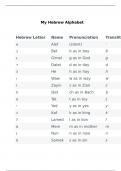
My Hebrew Alphabet
Hebrew Letter Name Pronunciation Translit
א Alef (silent) ʾ
ב Bet b as in boy b
ג Gimel g as in God g
ד Dalet d as in day d
ה He h as in hay h
ו Waw w as in way w
ז Zayin z as in Zion z
ח Ḥet ch as in Bach ḥ
ט Tet t as in toy ṭ
י Yod y as in yes y
כ Kaf k as in king k
ל Lamed l as in lion l
מ Mem m as in mother m
נ Nun n as in now n
ס Samek s as in sin s
,ע Ayin (silent) ʿ
פ Pe p as in pastor p
צ Tsade ts as in boots ṣ
ק Qof k as in king q
ר Resh r as in run r
ׂש Sin s as in sin s
ׁש Shin sh as in ship š
ת Taw t as in toy t
Numerical Values
Hebrew does not have a separate set of characters to represent numbers
(like the English 1, 2, 3, etc.). Rather, each letter of the Hebrew alphabet
represents a numerical value. The consonants אthrough טrepresent the
numbers 1-9. Consonants יthrough צrepresent numbers 10-90 in
multiples of 10 (10, 20, 30, etc.). And קthrough תrepresent the numbers
100, 200, 300 and 400 (ׂ שand ׁ שboth represent 300). For a full
presentation of the Hebrew numerical system, see ‘Hebrew Numbers’.
Chapter 1
, Summary
Before you move on to vowels, be sure that you are comfortable with the
following summary. When possible, treat the exercises like a quiz, not
using your book to answer the questions. Then go back and make
corrections with your book. This will give you an idea of the material
you have mastered and the material you need to study further.
Memorize the twenty-three consonants of the Hebrew alphabet in order.
Be able to write out the alphabet completely from right to left. You
should also know the name, pronunciation, and transliteration value of
each letter.
Five letters of the Hebrew alphabet ( כ, מ, נ,פ, and )צhave final forms (
ך, ם, ן,ף, and )ץ. These must be memorized. Note that a final ( ךKaf)
will frequently appear with two dots (ְ)ך.
Six Hebrew consonants are known as begadkephat letters ()בגדכפת.
They are capable of two different pronunciations, hard and soft. These
pronunciations are distinguished by the presence or absence of a
Daghesh Lene. The distinction in pronunciation and transliteration must
be memorized.
Four Hebrew consonants are called gutturals: א,ע ,ה, and ח.
Remember that רmay also behave like a guttural.
, Chapter 1
The Hebrew Acrostic
Knowledge of the Hebrew alphabet opens the door of understanding to
the Hebrew acrostic or alphabetical psalms. These are biblical poems in
which consecutive units (either lines, verses, or groups of verses) begin
with sequential letters of the Hebrew alphabet. No doubt such a
linguistic device provides a simple memory aid to the listener while still
communicating the intensity and passion of the poet. For instance, the
individual verses of Ps 9-10, 25, 34, and 145 begin with words whose
first letters are, consecutively, the letters of the Hebrew alphabet. In Ps
37, the opening letters of alternate verses are arranged according to the
sequence of the alphabet. Another variation occurs in Ps 111 and 112,
where each line (rather than each verse) begins with successive letters of
the Hebrew alphabet. The most elaborate acrostic biblical poem is Ps
119. This artistically shaped poem consists of twenty- two sections, each
comprised of eight verses. These units feature twenty- two letters of the
Hebrew alphabet, with all eight verses of a given unit beginning with the
same letter of the alphabet.
As an artistic device, the acrostic uses both structure and content to
express totality and completeness. Thus, everything from A to Z (or אto
)תis praised regarding the qualities of God (Ps 111 and 145), the just
man (Ps 112), the virtuous woman (Prov 31:10-31), or the beauty of the
law (Ps 119). Conversely, the writer of the book of Lamentations uses
the acrostic to communicate the complete sense of grief over Jerusalem's
fall. What is notable about the acrostic is that such an artificial scheme
did not stand in the way of producing literature of a high order full of
passion and thoughtfulness.
Hebrew Letter Name Pronunciation Translit
א Alef (silent) ʾ
ב Bet b as in boy b
ג Gimel g as in God g
ד Dalet d as in day d
ה He h as in hay h
ו Waw w as in way w
ז Zayin z as in Zion z
ח Ḥet ch as in Bach ḥ
ט Tet t as in toy ṭ
י Yod y as in yes y
כ Kaf k as in king k
ל Lamed l as in lion l
מ Mem m as in mother m
נ Nun n as in now n
ס Samek s as in sin s
,ע Ayin (silent) ʿ
פ Pe p as in pastor p
צ Tsade ts as in boots ṣ
ק Qof k as in king q
ר Resh r as in run r
ׂש Sin s as in sin s
ׁש Shin sh as in ship š
ת Taw t as in toy t
Numerical Values
Hebrew does not have a separate set of characters to represent numbers
(like the English 1, 2, 3, etc.). Rather, each letter of the Hebrew alphabet
represents a numerical value. The consonants אthrough טrepresent the
numbers 1-9. Consonants יthrough צrepresent numbers 10-90 in
multiples of 10 (10, 20, 30, etc.). And קthrough תrepresent the numbers
100, 200, 300 and 400 (ׂ שand ׁ שboth represent 300). For a full
presentation of the Hebrew numerical system, see ‘Hebrew Numbers’.
Chapter 1
, Summary
Before you move on to vowels, be sure that you are comfortable with the
following summary. When possible, treat the exercises like a quiz, not
using your book to answer the questions. Then go back and make
corrections with your book. This will give you an idea of the material
you have mastered and the material you need to study further.
Memorize the twenty-three consonants of the Hebrew alphabet in order.
Be able to write out the alphabet completely from right to left. You
should also know the name, pronunciation, and transliteration value of
each letter.
Five letters of the Hebrew alphabet ( כ, מ, נ,פ, and )צhave final forms (
ך, ם, ן,ף, and )ץ. These must be memorized. Note that a final ( ךKaf)
will frequently appear with two dots (ְ)ך.
Six Hebrew consonants are known as begadkephat letters ()בגדכפת.
They are capable of two different pronunciations, hard and soft. These
pronunciations are distinguished by the presence or absence of a
Daghesh Lene. The distinction in pronunciation and transliteration must
be memorized.
Four Hebrew consonants are called gutturals: א,ע ,ה, and ח.
Remember that רmay also behave like a guttural.
, Chapter 1
The Hebrew Acrostic
Knowledge of the Hebrew alphabet opens the door of understanding to
the Hebrew acrostic or alphabetical psalms. These are biblical poems in
which consecutive units (either lines, verses, or groups of verses) begin
with sequential letters of the Hebrew alphabet. No doubt such a
linguistic device provides a simple memory aid to the listener while still
communicating the intensity and passion of the poet. For instance, the
individual verses of Ps 9-10, 25, 34, and 145 begin with words whose
first letters are, consecutively, the letters of the Hebrew alphabet. In Ps
37, the opening letters of alternate verses are arranged according to the
sequence of the alphabet. Another variation occurs in Ps 111 and 112,
where each line (rather than each verse) begins with successive letters of
the Hebrew alphabet. The most elaborate acrostic biblical poem is Ps
119. This artistically shaped poem consists of twenty- two sections, each
comprised of eight verses. These units feature twenty- two letters of the
Hebrew alphabet, with all eight verses of a given unit beginning with the
same letter of the alphabet.
As an artistic device, the acrostic uses both structure and content to
express totality and completeness. Thus, everything from A to Z (or אto
)תis praised regarding the qualities of God (Ps 111 and 145), the just
man (Ps 112), the virtuous woman (Prov 31:10-31), or the beauty of the
law (Ps 119). Conversely, the writer of the book of Lamentations uses
the acrostic to communicate the complete sense of grief over Jerusalem's
fall. What is notable about the acrostic is that such an artificial scheme
did not stand in the way of producing literature of a high order full of
passion and thoughtfulness.