8/18/24, 3:36 AM
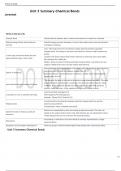
Unit 5 Summary-Chemical Bonds
Jeremiah
Terms in this set (16)
Chemical Bond Mutual attraction between atom's valance shell electrons to create new molecules
Potential energy effects when bonds are Potential energy per atom decreases in a bond. More stable atoms mean less potential
formed energy per molecule.
Ionic- This bond forms from the electrical charge attraction between oppositely
charged atoms. The charge on the atom is the result of a "electron swap" between two
atoms
3 main types of chemical bonds and how
Covalent- The atoms valance shells "share" electrons to make each atom more stable.
valence electrons play a role in each
Each behaves like a Noble gas.
Metallic- these are bonds involving electrically charged metals. one positive and one
negative. Metals tend to have very few valance shell electrons.
Polar molecules- Unequal distribution of electrons within the molecule. One end of the
pole positive and the other end negative. Ranges from 0.3-1.7
polarity of molecules
Nonpolar molecules- equal distribution of electrons. Usually havre electronegativity
ranging from 0 to 0.3
The charge on the atom is the result of an electron swap between two atoms. This swap
allows both atoms to behave like a noble gas. The atom that lost an electron, called
How electrical charges create ionic bonds
oxidation, is now positively charged and called a cation. The atom that gained an
electron, called reduction, is now negatively charged and is called an anion
Ionic-Fluorine(4)-Hydrogen(2.2)
3 examples on how to calculate bond type Polar-Oxygen(3.44)-Hydrogen(2.2)
Nonpolar- Carbon(2.54)-Carbon(2.54)
a bond formed by the attraction between positively charged metal ions and the
Metallic bonds electrons around them.
Characteristics- luster, malleable, and ductile
Electrons are represented by dots surrounding an elements symbol. The octet rule
Explain the steps in drawing a Lewis dot
applies to the valance electron shell. Inner shell electrons are not represented in these
structure
models because they are not involved in the chemical bonding
the bonding in molecules or ions that cannot be correctly represented by a single
Resonance
Lewis structure
Polyatomic ions and explain what types of These are groups of atoms bonded together that possess both molecular(covalent)
Unit 5 Summary-Chemical Bonds
bonds they are involved in quantities and ionic qualities.
1/2
Unit 5 Summary-Chemical Bonds
Jeremiah
Terms in this set (16)
Chemical Bond Mutual attraction between atom's valance shell electrons to create new molecules
Potential energy effects when bonds are Potential energy per atom decreases in a bond. More stable atoms mean less potential
formed energy per molecule.
Ionic- This bond forms from the electrical charge attraction between oppositely
charged atoms. The charge on the atom is the result of a "electron swap" between two
atoms
3 main types of chemical bonds and how
Covalent- The atoms valance shells "share" electrons to make each atom more stable.
valence electrons play a role in each
Each behaves like a Noble gas.
Metallic- these are bonds involving electrically charged metals. one positive and one
negative. Metals tend to have very few valance shell electrons.
Polar molecules- Unequal distribution of electrons within the molecule. One end of the
pole positive and the other end negative. Ranges from 0.3-1.7
polarity of molecules
Nonpolar molecules- equal distribution of electrons. Usually havre electronegativity
ranging from 0 to 0.3
The charge on the atom is the result of an electron swap between two atoms. This swap
allows both atoms to behave like a noble gas. The atom that lost an electron, called
How electrical charges create ionic bonds
oxidation, is now positively charged and called a cation. The atom that gained an
electron, called reduction, is now negatively charged and is called an anion
Ionic-Fluorine(4)-Hydrogen(2.2)
3 examples on how to calculate bond type Polar-Oxygen(3.44)-Hydrogen(2.2)
Nonpolar- Carbon(2.54)-Carbon(2.54)
a bond formed by the attraction between positively charged metal ions and the
Metallic bonds electrons around them.
Characteristics- luster, malleable, and ductile
Electrons are represented by dots surrounding an elements symbol. The octet rule
Explain the steps in drawing a Lewis dot
applies to the valance electron shell. Inner shell electrons are not represented in these
structure
models because they are not involved in the chemical bonding
the bonding in molecules or ions that cannot be correctly represented by a single
Resonance
Lewis structure
Polyatomic ions and explain what types of These are groups of atoms bonded together that possess both molecular(covalent)
Unit 5 Summary-Chemical Bonds
bonds they are involved in quantities and ionic qualities.
1/2