

Module 2 - Foundations in biology
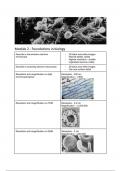
Describe a transmission electron - 2D black and white images
microscope - Internal details visible
- Highest resolution - smaller
organelles become visible
Describe a scanning electron microscope - 3D black and white images
- Can see surface detail
Resolution and magnification on light Resolution - 200 nm
microscope/optical Magnification - x1500
Resolution and magnification on TEM Resolution - 0.2 nm
Magnification - x1,000,000
Resolution and magnification on SEM Resolution - 2 nm
Magnification - x200,000
, Describe the functions of the cytoskeleton - Whole cell support by providing
in eukaryotic cells strength and stability
- Movement of cilia, chromosomes
and vesicles
- Determines and changes the shape
of the cell
- Forms spindle fibres
- Holds organelles in place
List 8 properties of water - Coolant
- Solvent
- Transport medium
- High specific heat capacity
- High latent heat of vaporisation
- Habitat
- Cohesion/adhesion
- High surface tension
Synthesis of sucrose, lactose and maltose Sucrose - α-glucose + fructose
Lactose - α-glucose + galactose
Maltose - α-glucose + α-glucose
Properties of triglycerides - Energy storage
- Thermal insulation
- Cushioning to protect vital organs
- Buoyancy for aquatic animals
Properties of phospholipid - Forms the phospholipid bilayer
acting as a barrier to water-soluble
substances
- Controls what enters and leaves a
cell
- Centre of bilayer is hydrophobic
Properties of cholesterol - Regulates fluidity of plasma
membrane
- Positioned between the
phospholipids
Secondary structure of proteins Hydrogen bonds form within the amino acid
chain, so it coils into an alpha helix or folds
into a beta pleated sheet
Tertiary structure of proteins The coiled or folded chain of amino acids is
coiled and folded further
- Ionic bonds
- Hydrophilic/hydrophobic interactions
- Hydrogen bonds
- Disulfide bridges
Quaternary structure of proteins Several polypeptide chains are joined
together
Describe a transmission electron - 2D black and white images
microscope - Internal details visible
- Highest resolution - smaller
organelles become visible
Describe a scanning electron microscope - 3D black and white images
- Can see surface detail
Resolution and magnification on light Resolution - 200 nm
microscope/optical Magnification - x1500
Resolution and magnification on TEM Resolution - 0.2 nm
Magnification - x1,000,000
Resolution and magnification on SEM Resolution - 2 nm
Magnification - x200,000
, Describe the functions of the cytoskeleton - Whole cell support by providing
in eukaryotic cells strength and stability
- Movement of cilia, chromosomes
and vesicles
- Determines and changes the shape
of the cell
- Forms spindle fibres
- Holds organelles in place
List 8 properties of water - Coolant
- Solvent
- Transport medium
- High specific heat capacity
- High latent heat of vaporisation
- Habitat
- Cohesion/adhesion
- High surface tension
Synthesis of sucrose, lactose and maltose Sucrose - α-glucose + fructose
Lactose - α-glucose + galactose
Maltose - α-glucose + α-glucose
Properties of triglycerides - Energy storage
- Thermal insulation
- Cushioning to protect vital organs
- Buoyancy for aquatic animals
Properties of phospholipid - Forms the phospholipid bilayer
acting as a barrier to water-soluble
substances
- Controls what enters and leaves a
cell
- Centre of bilayer is hydrophobic
Properties of cholesterol - Regulates fluidity of plasma
membrane
- Positioned between the
phospholipids
Secondary structure of proteins Hydrogen bonds form within the amino acid
chain, so it coils into an alpha helix or folds
into a beta pleated sheet
Tertiary structure of proteins The coiled or folded chain of amino acids is
coiled and folded further
- Ionic bonds
- Hydrophilic/hydrophobic interactions
- Hydrogen bonds
- Disulfide bridges
Quaternary structure of proteins Several polypeptide chains are joined
together


