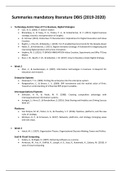
Summaries mandatory literature DBIS (2019-2020)
Technology-Centric View of IT in Business, Digital Strategies
Carr, N. G. (2003). IT doesn't matter.
Bharadwaj, A., El Sawy, O. A., Pavlou, P. A., & Venkatraman, N. V. (2013). Digital business
strategy: toward a next generation of insights.
R. Fichman (2012). Distinctive IT Characteristics: Implications for Digital Innovation and Value
Creation.
Bughin, J., Chui, M., & Manyika, J. (2013). Ten IT-enabled business trends for the decade ahead.
Nylén, D., & Holmström, J. (2015). Digital innovation strategy: A framework for diagnosing and
improving digital product and service innovation.
Hopkins, M. S. (2010). IT-DRIVEN INNOVATION-Value Creation, Experiments and Why IT Does
Matter.
Ross, J. W., Beath, C. M., & Sebastian, I. M. (2017). How to Develop a Great Digital Strategy.
Week 2
Dhar, V., & Sundararajan, A. (2007). Information technologies in business: A blueprint for
education and research.
Enterprise Systems
Davenport, T. H. (1998). Putting the enterprise into the enterprise system.
Ranganathan, C., & Brown, C. V. (2006). ERP investments and the market value of firms:
Toward an understanding of influential ERP project variables.
Interorganizational Systems
Johnston, H. R., & Vitale, M. R. (1988). Creating competitive advantage with
interorganizational information systems.
Jernigan, S., Kiron, D., & Ransbotham, S. (2016). Data Sharing and Analytics are Driving Success
With IoT.
Platforms
Van Alstyne, M. W., Parker, G. G., & Choudary, S. P. (2016). Pipelines, platforms, and the new
rules of strategy.
McIntyre, D. P., & Srinivasan, A. (2017). Networks, platforms, and strategy: Emerging views
and next steps.
Week 3
Hatch, M. J. (1997). Organization Theory: Organizational Decision Making, Power and Politics
SaaS & Cloud Computing
Dubey, A., & Wagle, D. (2007). Delivering software as a service.
Armbrust, M., Fox, A., Griffith, R., Joseph, A. D., Katz, R., Konwinski, A., Zaharia, M. (2010). A
view of cloud computing.
, Big Data
Provost, F., & Fawcett, T. (2013). Data Science and its Relationship to Big Data and Data-Driven
Decision Making.
McAfee, A., & Brynjolfsson, E. (2012). Big data: the management revolution.
Artificial Intelligence
Bornstein, A. M. (2016). Is Artificial Intelligence Permanently Inscrutable?
Luca, M., Kleinberg, J., & Mullainathan, S. (2016). Algorithms need managers, too.
Week 4
Khodyakov, D. (2007). Trust as a process: A three-dimensional approach.
Sharing vs. Gig Economy
Sundararajan, A. (2016). The Sharing Economy.
Mazzella, F., Sundararajan, A., Butt d’Espous, V., & Möhlmann, M. (2016). How Digital Trust
Powers the Sharing Economy: The Digitization of Trust.
Blockchain
The great chain of being sure about things.
Evans, P. (2016). Thinking Outside The Blocks: A Strategic Perspective on Blockchain and Digital
Tokens.
Trust in Machines
Waytz, A., Heafner, J., & Epley, N. (2014). The mind in the machine: Anthropomorphism
increases trust in an autonomous vehicle.
Schroeder, J., & Schroeder, M. (2018). Trusting in Machines: How Mode of Interaction Affects
Willingness to Share Personal Information with Machines.
Week 5
Günther, W. A., Mehrizi, M. H. R., Huysman, M., & Feldberg, F. (2017). Debating big data: A
literature review on realizing value from big data.
Mastering Data Projects
Wixom, B. H., & Watson, H. J. (2001). An empirical investigation of the factors affecting data
warehousing success.
Bell, P. C. (2015). Sustaining an analytics advantage.
Data-Driven Organizations
Kiron, D. (2017). Lessons from Becoming a Data-Driven Organization.
Constantiou, I. D., & Kallinikos, J. (2015). New games, new rules: big data and the changing
context of strategy.
Data-Driven Business Model Innovation
Woerner, S. L., & Wixom, B. H. (2015). Big data: extending the business strategy toolbox.
Hartmann, P. M., Zaki, M., Feldmann, N., & Neely, A. (2014). Big data for big business? A
taxonomy of data-driven business models used by start-up firms. A Taxonomy of Data-Driven
Business Models Used by Start-Up Firms.
TEDx talk Frans Feldberg about the Economics of AI/Prediction Machines.
, IT doesn’t matter
Carr (2003)
Chief executives now talk about the strategic value of information technology, how they can use IT to
gain a competitive advantage, and about the “digitization” of their business models. Technologies
opened opportunities for forward looking companies to gain real advantage. But as their availability
increased and their cost decreased, they became commodity (something you can buy) inputs. From a
strategic standpoint; they became invisible (they no longer mattered). This is also what is happening
to information technology nowadays.
A distinction needs to be made between proprietary technologies and what might be called
infrastructural technologies:
Proprietary technologies: these technologies can be owned by a single company (a patent).
As long as these technologies are protected, they can provide a sustainable advantage;
Infrastructural technologies: these technologies offer far more value when shared than when
used in isolation (railroads).
In its earliest phases, an infrastructural technology can take the form of a proprietary technology. As
long as access to the technology is restricted (through physical limitations, intellectual property rights
or high costs), a company can use it to gain advantage over rivals. In addition to enabling new, more
efficient operating methods, infrastructural technologies often lead to broader market changes. The
trap that executives often fall into is assuming that opportunities for advantage from infrastructural
technology will always be available. But the reality is that gaining advantage from IT is temporarily.
When the commercial potential is clear and broadly appreciated, investments will be made in it and
the technology develops with extreme speed. The only meaningful advantage most companies hope
to gain from an infrastructural technology after its buildout is a cost advantage. Even that is very hard
to sustain.
IT has all the hallmarks of an infrastructural technology:
IT is a transport mechanism (it carries digital information);
IT is far more valuable when shared than when used in isolation;
IT is highly replicable;
Even the most cutting-edge IT capabilities quickly become available to all.
The greatest IT risk facing most companies is simply overspending, IT has become a commodity. The
new rules for IT management become:
Spend less;
Follow, don’t lead;
Focus on vulnerabilities, not opportunities;
The key to success, for the vast majority of companies, is no longer to seek advantage aggressively, but
to manage costs and risks meticulously. Instead of seeking advantage through technology, companies
should manage IT defensively by watching costs and avoiding risks.
As information technology’s power and ubiquity have grown its strategic importance has diminished.
The way you approach IT investment needs to change dramatically. IT is the latest in a series of broadly
adapted technologies that have reshaped the industry over the past two centuries. But as their
availability increased and their costs decreased, they became commodity inputs. They became invisible
and they no longer mattered. When a resource becomes essential to competition but inconsequential
to strategy the risk it creates becomes more important than the advantage it provides.
Technology-Centric View of IT in Business, Digital Strategies
Carr, N. G. (2003). IT doesn't matter.
Bharadwaj, A., El Sawy, O. A., Pavlou, P. A., & Venkatraman, N. V. (2013). Digital business
strategy: toward a next generation of insights.
R. Fichman (2012). Distinctive IT Characteristics: Implications for Digital Innovation and Value
Creation.
Bughin, J., Chui, M., & Manyika, J. (2013). Ten IT-enabled business trends for the decade ahead.
Nylén, D., & Holmström, J. (2015). Digital innovation strategy: A framework for diagnosing and
improving digital product and service innovation.
Hopkins, M. S. (2010). IT-DRIVEN INNOVATION-Value Creation, Experiments and Why IT Does
Matter.
Ross, J. W., Beath, C. M., & Sebastian, I. M. (2017). How to Develop a Great Digital Strategy.
Week 2
Dhar, V., & Sundararajan, A. (2007). Information technologies in business: A blueprint for
education and research.
Enterprise Systems
Davenport, T. H. (1998). Putting the enterprise into the enterprise system.
Ranganathan, C., & Brown, C. V. (2006). ERP investments and the market value of firms:
Toward an understanding of influential ERP project variables.
Interorganizational Systems
Johnston, H. R., & Vitale, M. R. (1988). Creating competitive advantage with
interorganizational information systems.
Jernigan, S., Kiron, D., & Ransbotham, S. (2016). Data Sharing and Analytics are Driving Success
With IoT.
Platforms
Van Alstyne, M. W., Parker, G. G., & Choudary, S. P. (2016). Pipelines, platforms, and the new
rules of strategy.
McIntyre, D. P., & Srinivasan, A. (2017). Networks, platforms, and strategy: Emerging views
and next steps.
Week 3
Hatch, M. J. (1997). Organization Theory: Organizational Decision Making, Power and Politics
SaaS & Cloud Computing
Dubey, A., & Wagle, D. (2007). Delivering software as a service.
Armbrust, M., Fox, A., Griffith, R., Joseph, A. D., Katz, R., Konwinski, A., Zaharia, M. (2010). A
view of cloud computing.
, Big Data
Provost, F., & Fawcett, T. (2013). Data Science and its Relationship to Big Data and Data-Driven
Decision Making.
McAfee, A., & Brynjolfsson, E. (2012). Big data: the management revolution.
Artificial Intelligence
Bornstein, A. M. (2016). Is Artificial Intelligence Permanently Inscrutable?
Luca, M., Kleinberg, J., & Mullainathan, S. (2016). Algorithms need managers, too.
Week 4
Khodyakov, D. (2007). Trust as a process: A three-dimensional approach.
Sharing vs. Gig Economy
Sundararajan, A. (2016). The Sharing Economy.
Mazzella, F., Sundararajan, A., Butt d’Espous, V., & Möhlmann, M. (2016). How Digital Trust
Powers the Sharing Economy: The Digitization of Trust.
Blockchain
The great chain of being sure about things.
Evans, P. (2016). Thinking Outside The Blocks: A Strategic Perspective on Blockchain and Digital
Tokens.
Trust in Machines
Waytz, A., Heafner, J., & Epley, N. (2014). The mind in the machine: Anthropomorphism
increases trust in an autonomous vehicle.
Schroeder, J., & Schroeder, M. (2018). Trusting in Machines: How Mode of Interaction Affects
Willingness to Share Personal Information with Machines.
Week 5
Günther, W. A., Mehrizi, M. H. R., Huysman, M., & Feldberg, F. (2017). Debating big data: A
literature review on realizing value from big data.
Mastering Data Projects
Wixom, B. H., & Watson, H. J. (2001). An empirical investigation of the factors affecting data
warehousing success.
Bell, P. C. (2015). Sustaining an analytics advantage.
Data-Driven Organizations
Kiron, D. (2017). Lessons from Becoming a Data-Driven Organization.
Constantiou, I. D., & Kallinikos, J. (2015). New games, new rules: big data and the changing
context of strategy.
Data-Driven Business Model Innovation
Woerner, S. L., & Wixom, B. H. (2015). Big data: extending the business strategy toolbox.
Hartmann, P. M., Zaki, M., Feldmann, N., & Neely, A. (2014). Big data for big business? A
taxonomy of data-driven business models used by start-up firms. A Taxonomy of Data-Driven
Business Models Used by Start-Up Firms.
TEDx talk Frans Feldberg about the Economics of AI/Prediction Machines.
, IT doesn’t matter
Carr (2003)
Chief executives now talk about the strategic value of information technology, how they can use IT to
gain a competitive advantage, and about the “digitization” of their business models. Technologies
opened opportunities for forward looking companies to gain real advantage. But as their availability
increased and their cost decreased, they became commodity (something you can buy) inputs. From a
strategic standpoint; they became invisible (they no longer mattered). This is also what is happening
to information technology nowadays.
A distinction needs to be made between proprietary technologies and what might be called
infrastructural technologies:
Proprietary technologies: these technologies can be owned by a single company (a patent).
As long as these technologies are protected, they can provide a sustainable advantage;
Infrastructural technologies: these technologies offer far more value when shared than when
used in isolation (railroads).
In its earliest phases, an infrastructural technology can take the form of a proprietary technology. As
long as access to the technology is restricted (through physical limitations, intellectual property rights
or high costs), a company can use it to gain advantage over rivals. In addition to enabling new, more
efficient operating methods, infrastructural technologies often lead to broader market changes. The
trap that executives often fall into is assuming that opportunities for advantage from infrastructural
technology will always be available. But the reality is that gaining advantage from IT is temporarily.
When the commercial potential is clear and broadly appreciated, investments will be made in it and
the technology develops with extreme speed. The only meaningful advantage most companies hope
to gain from an infrastructural technology after its buildout is a cost advantage. Even that is very hard
to sustain.
IT has all the hallmarks of an infrastructural technology:
IT is a transport mechanism (it carries digital information);
IT is far more valuable when shared than when used in isolation;
IT is highly replicable;
Even the most cutting-edge IT capabilities quickly become available to all.
The greatest IT risk facing most companies is simply overspending, IT has become a commodity. The
new rules for IT management become:
Spend less;
Follow, don’t lead;
Focus on vulnerabilities, not opportunities;
The key to success, for the vast majority of companies, is no longer to seek advantage aggressively, but
to manage costs and risks meticulously. Instead of seeking advantage through technology, companies
should manage IT defensively by watching costs and avoiding risks.
As information technology’s power and ubiquity have grown its strategic importance has diminished.
The way you approach IT investment needs to change dramatically. IT is the latest in a series of broadly
adapted technologies that have reshaped the industry over the past two centuries. But as their
availability increased and their costs decreased, they became commodity inputs. They became invisible
and they no longer mattered. When a resource becomes essential to competition but inconsequential
to strategy the risk it creates becomes more important than the advantage it provides.