

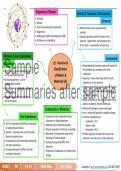
Properties of Matter: Names & Formulae of Substances:
• Strength.
• Density. Elements:
• Thermal and electrical conductivity. • Elements have names represented by
• Magnetism. symbols.
• Melting point (MP) and boiling point (BP). • Symbols typically include first letter of the
• Brittleness or malleability. element - capital letter, and sometimes the
first 2 letters - second letter is lower case.
Mixtures & Pure Substances: Compounds:
Sample
Mixtures:
• Consist of 2 or more substances that
can be separated physically.
• No fixed proportions - can be
U1: Revision &
Classification
of Matter &
Materials (A)
• Represented by formulae made up of symbols of
the elements that combine to form the
compound.
• Subscript – shows how many atoms of each
element are in the molecule.
concentrated or dilute.
Summaries after sample
• Homogeneous = substances can’t be • Element on the left and lower down on Periodic
seen separately. Table is given first when naming compounds –
• Heterogenous = different substances remains unchanged.
can be told apart. • Name of element on the right and higher up on
- table is changed to -ide and comes last.
Compounds vs Mixtures: • Metals and hydrogen remain unchanged.
• Ions = atoms with positive or negative charges.
Pure Substances: • Compounds have chemically bonded • Common compound ions:
substances in fixed proportions. - Carbonate = CO3-2.
• Can't be separated into different substances • Mixtures aren't chemically bonded. - Nitrate = NO3-.
by simple physical means. • Physical separation of mixtures is possible. - Phosphate = PO4-3.
• Element = substance that can't be broken • Separation of compounds requires the • Prefixes are given to show how many of the
down into simpler forms. breaking of chemical bonds. element or ion there are in that compound.
• Compounds can be broken down chemically • Compound properties differ from
into other substances. elements.
• Compound properties differ from their • Properties of substances in a mixture don't
constituent elements. change.
-
GR10 PS T1-T1 Mind Map Via Afrika Copyright © www.summariessa.co.za (DO NOT COPY)
,Sample
Summaries after sample
,Sample
Summaries after sample
, Properties of Matter: Names & Formulae of Substances:
• Strength.
• Density. Elements:
• Thermal and electrical conductivity. • Elements have names represented by
• Magnetism. symbols.
• Melting point (MP) and boiling point (BP). • Symbols typically include first letter of the
• Brittleness or malleability. element - capital letter, and sometimes the
first 2 letters - second letter is lower case.
Mixtures & Pure Substances: Compounds:
Mixtures: U1: Revision & • Represented by formulae made up of symbols of
• Consist of 2 or more substances that Classification the elements that combine to form the
can be separated physically. of Matter & compound.
• No fixed proportions - can be • Subscript – shows how many atoms of each
concentrated or dilute.
Materials (A) element are in the molecule.
• Homogeneous = substances can’t be • Element on the left and lower down on Periodic
seen separately. Table is given first when naming compounds –
• Heterogenous = different substances remains unchanged.
can be told apart. • Name of element on the right and higher up on
- table is changed to -ide and comes last.
Compounds vs Mixtures: • Metals and hydrogen remain unchanged.
• Ions = atoms with positive or negative charges.
Pure Substances: • Compounds have chemically bonded • Common compound ions:
substances in fixed proportions. - Carbonate = CO3-2.
• Can't be separated into different substances • Mixtures aren't chemically bonded. - Nitrate = NO3-.
by simple physical means. • Physical separation of mixtures is possible. - Phosphate = PO4-3.
• Element = substance that can't be broken • Separation of compounds requires the • Prefixes are given to show how many of the
down into simpler forms. breaking of chemical bonds. element or ion there are in that compound.
• Compounds can be broken down chemically • Compound properties differ from
into other substances. elements.
• Compound properties differ from their • Properties of substances in a mixture don't
constituent elements. change.
-
GR10 PS T1-T1 Mind Map Via Afrika Copyright © www.summariessa.co.za (DO NOT COPY)
• Strength.
• Density. Elements:
• Thermal and electrical conductivity. • Elements have names represented by
• Magnetism. symbols.
• Melting point (MP) and boiling point (BP). • Symbols typically include first letter of the
• Brittleness or malleability. element - capital letter, and sometimes the
first 2 letters - second letter is lower case.
Mixtures & Pure Substances: Compounds:
Sample
Mixtures:
• Consist of 2 or more substances that
can be separated physically.
• No fixed proportions - can be
U1: Revision &
Classification
of Matter &
Materials (A)
• Represented by formulae made up of symbols of
the elements that combine to form the
compound.
• Subscript – shows how many atoms of each
element are in the molecule.
concentrated or dilute.
Summaries after sample
• Homogeneous = substances can’t be • Element on the left and lower down on Periodic
seen separately. Table is given first when naming compounds –
• Heterogenous = different substances remains unchanged.
can be told apart. • Name of element on the right and higher up on
- table is changed to -ide and comes last.
Compounds vs Mixtures: • Metals and hydrogen remain unchanged.
• Ions = atoms with positive or negative charges.
Pure Substances: • Compounds have chemically bonded • Common compound ions:
substances in fixed proportions. - Carbonate = CO3-2.
• Can't be separated into different substances • Mixtures aren't chemically bonded. - Nitrate = NO3-.
by simple physical means. • Physical separation of mixtures is possible. - Phosphate = PO4-3.
• Element = substance that can't be broken • Separation of compounds requires the • Prefixes are given to show how many of the
down into simpler forms. breaking of chemical bonds. element or ion there are in that compound.
• Compounds can be broken down chemically • Compound properties differ from
into other substances. elements.
• Compound properties differ from their • Properties of substances in a mixture don't
constituent elements. change.
-
GR10 PS T1-T1 Mind Map Via Afrika Copyright © www.summariessa.co.za (DO NOT COPY)
,Sample
Summaries after sample
,Sample
Summaries after sample
, Properties of Matter: Names & Formulae of Substances:
• Strength.
• Density. Elements:
• Thermal and electrical conductivity. • Elements have names represented by
• Magnetism. symbols.
• Melting point (MP) and boiling point (BP). • Symbols typically include first letter of the
• Brittleness or malleability. element - capital letter, and sometimes the
first 2 letters - second letter is lower case.
Mixtures & Pure Substances: Compounds:
Mixtures: U1: Revision & • Represented by formulae made up of symbols of
• Consist of 2 or more substances that Classification the elements that combine to form the
can be separated physically. of Matter & compound.
• No fixed proportions - can be • Subscript – shows how many atoms of each
concentrated or dilute.
Materials (A) element are in the molecule.
• Homogeneous = substances can’t be • Element on the left and lower down on Periodic
seen separately. Table is given first when naming compounds –
• Heterogenous = different substances remains unchanged.
can be told apart. • Name of element on the right and higher up on
- table is changed to -ide and comes last.
Compounds vs Mixtures: • Metals and hydrogen remain unchanged.
• Ions = atoms with positive or negative charges.
Pure Substances: • Compounds have chemically bonded • Common compound ions:
substances in fixed proportions. - Carbonate = CO3-2.
• Can't be separated into different substances • Mixtures aren't chemically bonded. - Nitrate = NO3-.
by simple physical means. • Physical separation of mixtures is possible. - Phosphate = PO4-3.
• Element = substance that can't be broken • Separation of compounds requires the • Prefixes are given to show how many of the
down into simpler forms. breaking of chemical bonds. element or ion there are in that compound.
• Compounds can be broken down chemically • Compound properties differ from
into other substances. elements.
• Compound properties differ from their • Properties of substances in a mixture don't
constituent elements. change.
-
GR10 PS T1-T1 Mind Map Via Afrika Copyright © www.summariessa.co.za (DO NOT COPY)


