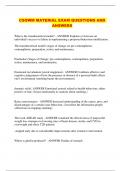
CSOWM MATERIAL EXAM QUESTIONS AND
ANSWERS
What is the transtheoretical model? - ANSWER Explains or forecasts an
individual's success or failure in implementing a proposed behaviour modification.
The transtheoretical model's stages of change are pre-contemplation,
contemplation, preparation, action, and maintenance.
Prochaska's Stages of Change: pre-contemplation, contemplation, preparation,
action, maintenance, and termination.
Emotional reevaluation [social reappraisal - ANSWER Combines affective and
cognitive judgements of how the presence or absence of a personal habit affects
one's environment (smoking harms the environment).
dramatic relief: ANSWER Emotional arousal related to health behaviour, either
positive or bad. (I react emotionally to cautions about smoking.)
Raise consciousness - ANSWER Increased understanding of the causes, pros, and
disadvantages of a certain issue behaviour. (I recollect the information people
offered me on stopping smoking)
The Look AHEAD study - ANSWER examined the effectiveness of purposeful
weight loss strategies in lowering rates of heart disease, stroke, and CVD in
overweight and obese T2D patients.
-stopped early due to considerable improvements after extensive intervention
Where is ghrelin produced? - ANSWER Fundus of stomach
, social emancipation (change process) - ANSWER enhances social alternatives and
opportunities (finding society evolves in ways that make it simpler for
nonsmokers).
Self-reevaluation (process of change) - ANSWER Recognising that behaviour
change is a crucial element of one's identity as a person, both positive and negative
(my addiction to smoking makes me feel horrible).
Stimulus control (stages of change - ANSWER Removes cues for unhealthy
behaviour and gives prompts for healthier options (removing things that remind
you of your behaviour).
Helping Relationship - ANSWER Combine care, trust, openness, and acceptance
with support for good behaviour (I have someone who listens when I want to
smoke).
Counterconditioning/systematic desensitisation - ANSWER Learning better
behaviours that can replace problem behaviours (keeping my hands busy when I
want to smoke)
Reinforcement management - ANSWER Rewarding positive behaviour while
lowering rewards for undesirable behaviour.
What RPE range is appropriate for training in zone 2? - ANSWER An RPE of 5-6
What RPE is the vigorous activity? - Answer 14-17 RP
What RPE is moderate? - Answer 12-13 RPE
Which growth chart is used to diagnose a child's obesity? - Answer BMI for age
and gender.
ANSWERS
What is the transtheoretical model? - ANSWER Explains or forecasts an
individual's success or failure in implementing a proposed behaviour modification.
The transtheoretical model's stages of change are pre-contemplation,
contemplation, preparation, action, and maintenance.
Prochaska's Stages of Change: pre-contemplation, contemplation, preparation,
action, maintenance, and termination.
Emotional reevaluation [social reappraisal - ANSWER Combines affective and
cognitive judgements of how the presence or absence of a personal habit affects
one's environment (smoking harms the environment).
dramatic relief: ANSWER Emotional arousal related to health behaviour, either
positive or bad. (I react emotionally to cautions about smoking.)
Raise consciousness - ANSWER Increased understanding of the causes, pros, and
disadvantages of a certain issue behaviour. (I recollect the information people
offered me on stopping smoking)
The Look AHEAD study - ANSWER examined the effectiveness of purposeful
weight loss strategies in lowering rates of heart disease, stroke, and CVD in
overweight and obese T2D patients.
-stopped early due to considerable improvements after extensive intervention
Where is ghrelin produced? - ANSWER Fundus of stomach
, social emancipation (change process) - ANSWER enhances social alternatives and
opportunities (finding society evolves in ways that make it simpler for
nonsmokers).
Self-reevaluation (process of change) - ANSWER Recognising that behaviour
change is a crucial element of one's identity as a person, both positive and negative
(my addiction to smoking makes me feel horrible).
Stimulus control (stages of change - ANSWER Removes cues for unhealthy
behaviour and gives prompts for healthier options (removing things that remind
you of your behaviour).
Helping Relationship - ANSWER Combine care, trust, openness, and acceptance
with support for good behaviour (I have someone who listens when I want to
smoke).
Counterconditioning/systematic desensitisation - ANSWER Learning better
behaviours that can replace problem behaviours (keeping my hands busy when I
want to smoke)
Reinforcement management - ANSWER Rewarding positive behaviour while
lowering rewards for undesirable behaviour.
What RPE range is appropriate for training in zone 2? - ANSWER An RPE of 5-6
What RPE is the vigorous activity? - Answer 14-17 RP
What RPE is moderate? - Answer 12-13 RPE
Which growth chart is used to diagnose a child's obesity? - Answer BMI for age
and gender.