Physics Lab 1 Test - Quizzes From The Year
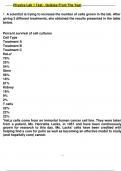
1. A scientist is trying to increase the number of cells grown in the lab. After
giving 3 different treatments, she obtained the results presented in the table
below.
Percent survival of cell cultures
Cell Type
Treatment A
Treatment B
Treatment C
HeLa*
79%
25%
54%
Stem
56%
18%
81%
Kidney
18%
9%
2%
T cells
22%
22%
22%
*HeLa cells come from an immortal human cancer cell line. They were taken
from a patient, Ms. Henrietta Lacks, in 1951 and have been continuously
grown for research to this day. Ms. Lacks' cells have been credited with
helping find a cure for polio as well as becoming an effective model to study
(and hopefully cure) cancer.
, Physics Lab 1 Test - Quizzes From The Year
What one of the following represents possible dependent and independent
variables for the investigation in this scenario?: c. DV = percent survival of cell
cultures; IV = treatment
2. Over a period of 10 days a student measures the average growth of
three similar plants grown in three different lighting conditions: A, B, C. a.
DV = lighting conditions; IV = number of days
b.
DV = plant growth; IV = lighting conditions
c.
DV = lighting conditions; IV = plant growth
d.
DV = number of days; IV = lighting conditions
e.
DV = number of days; IV = plant growth: b.
DV = plant growth; IV = lighting conditions
3. Consider this graph which shows carbon dioxide levels that were measured
each January over five decades at the Mauna Loa observatory in Hawaii. What
is a possible hypothesis for the investigation portrayed in this scenario? a.
The amount of atmospheric carbon dioxide is increasing each year.
b.
All investigations measuring the amount of atmospheric carbon dioxide
would yield similar results. c.
If the levels of atmospheric carbon dioxide were measured in another
observatory at the same latitude the same results would be found. d.
The amount of atmospheric carbon dioxide is related to the year it was
measured.
e.
The amount of atmospheric carbon dioxide is related to the location it was
measured.: d.
The amount of atmospheric carbon dioxide is related to the year it was measured.
4. The graph represents the amount of product created in a reaction aided by
one of two enzymes. [Enzyme A is represented by the line mostly on top and
Enzyme B is represented by the line with the sharper peak.]What is a possible
hypothesis for the investigation portrayed in this scenario? a.
, Physics Lab 1 Test - Quizzes From The Year
Enzyme B creates more product at a reaction temperature of 45 °C than
Enzyme A.
b.
The enzyme used is related to the temperature of the reaction.
c.
The temperature of the reaction is related to the amount of product created.
d.
Enzyme A creates more product than Enzyme B for most temperatures.
e.
The amount of product created is related to the temperature of the reaction.:
e.
The amount of product created is related to the temperature of the reaction.
5. One hundred samples of several different plant parts were placed in each
of six sealed containers of equal volume. The amount of CO2 present in the
containers at the beginning was 250 mL. After 2 days, it was at the level shown
in the table. Suppose the researcher hypothesizes that the amount of CO2
absorption is related to the type of plant. If she selects container 5 as one of
her containers, what conditions should she choose for a new container 6 to
test her hypothesis? a.
Myrtle leaf, orange light, 27°C
b.
Myrtle leaf, orange light, 21°C
c.
Myrtle root, red light, 21°C
d.
Oak leaf, orange light, 27°C
e.
Oak root, red light, 21°C: a.
Myrtle leaf, orange light, 27°C
6. Two students want to determine if the mass of water changes during
heating. Both start with about 40 g of water and heat their water samples the
same way for the same length of time. After heating they each measure the
mass of their own samples again using the same electronic balance as before
(note that each student uses an electronic balance with a different
uncertainty).
1. A scientist is trying to increase the number of cells grown in the lab. After
giving 3 different treatments, she obtained the results presented in the table
below.
Percent survival of cell cultures
Cell Type
Treatment A
Treatment B
Treatment C
HeLa*
79%
25%
54%
Stem
56%
18%
81%
Kidney
18%
9%
2%
T cells
22%
22%
22%
*HeLa cells come from an immortal human cancer cell line. They were taken
from a patient, Ms. Henrietta Lacks, in 1951 and have been continuously
grown for research to this day. Ms. Lacks' cells have been credited with
helping find a cure for polio as well as becoming an effective model to study
(and hopefully cure) cancer.
, Physics Lab 1 Test - Quizzes From The Year
What one of the following represents possible dependent and independent
variables for the investigation in this scenario?: c. DV = percent survival of cell
cultures; IV = treatment
2. Over a period of 10 days a student measures the average growth of
three similar plants grown in three different lighting conditions: A, B, C. a.
DV = lighting conditions; IV = number of days
b.
DV = plant growth; IV = lighting conditions
c.
DV = lighting conditions; IV = plant growth
d.
DV = number of days; IV = lighting conditions
e.
DV = number of days; IV = plant growth: b.
DV = plant growth; IV = lighting conditions
3. Consider this graph which shows carbon dioxide levels that were measured
each January over five decades at the Mauna Loa observatory in Hawaii. What
is a possible hypothesis for the investigation portrayed in this scenario? a.
The amount of atmospheric carbon dioxide is increasing each year.
b.
All investigations measuring the amount of atmospheric carbon dioxide
would yield similar results. c.
If the levels of atmospheric carbon dioxide were measured in another
observatory at the same latitude the same results would be found. d.
The amount of atmospheric carbon dioxide is related to the year it was
measured.
e.
The amount of atmospheric carbon dioxide is related to the location it was
measured.: d.
The amount of atmospheric carbon dioxide is related to the year it was measured.
4. The graph represents the amount of product created in a reaction aided by
one of two enzymes. [Enzyme A is represented by the line mostly on top and
Enzyme B is represented by the line with the sharper peak.]What is a possible
hypothesis for the investigation portrayed in this scenario? a.
, Physics Lab 1 Test - Quizzes From The Year
Enzyme B creates more product at a reaction temperature of 45 °C than
Enzyme A.
b.
The enzyme used is related to the temperature of the reaction.
c.
The temperature of the reaction is related to the amount of product created.
d.
Enzyme A creates more product than Enzyme B for most temperatures.
e.
The amount of product created is related to the temperature of the reaction.:
e.
The amount of product created is related to the temperature of the reaction.
5. One hundred samples of several different plant parts were placed in each
of six sealed containers of equal volume. The amount of CO2 present in the
containers at the beginning was 250 mL. After 2 days, it was at the level shown
in the table. Suppose the researcher hypothesizes that the amount of CO2
absorption is related to the type of plant. If she selects container 5 as one of
her containers, what conditions should she choose for a new container 6 to
test her hypothesis? a.
Myrtle leaf, orange light, 27°C
b.
Myrtle leaf, orange light, 21°C
c.
Myrtle root, red light, 21°C
d.
Oak leaf, orange light, 27°C
e.
Oak root, red light, 21°C: a.
Myrtle leaf, orange light, 27°C
6. Two students want to determine if the mass of water changes during
heating. Both start with about 40 g of water and heat their water samples the
same way for the same length of time. After heating they each measure the
mass of their own samples again using the same electronic balance as before
(note that each student uses an electronic balance with a different
uncertainty).