

Guidelines:
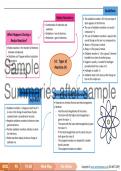
Redox Reactions: • The oxidation number is 0 if only one type of
atom appears in the formula.
• Combination of reduction and
oxidation. • The sum of oxidation numbers in a neutral
compound = 0.
What Happens During a • Oxidation = loss of electrons.
• The sum of oxidation numbers is equal to the
• Reduction = gain of electrons.
Redox Reaction? overall charge on the ion in a compound ion.
• Always +1 for group 1 metals.
• Redox reactions = the transfer of electrons • Always +2 for group 2 metals.
between compounds. • Oxidation number is -1 for a group 7 element
• Oxidation can’t happen without reduction bonded to an atom of another group.
U1: Types of
Sample
taking place. • Oxygen is usually -2, except for hydrogen
• OILRIG: peroxide which has a value of -1.
- Oxidation Is Loss (oil). Reaction (A)
• Hydrogen is usually +1.
- Reduction Is Gain (rig). • Oxidation state is the same as the charge on
the ion for simple ions.
Summaries after sample
Oxidation Numbers:
Definition:
Determining Oxidation Numbers:
• Depends on chemical formula and electronegativity.
• Method:
• Oxidation numbers = charge an atom has if it
is ionic or the charge it would have if polar - Find the electronegativities of the atoms.
covalent bond is considered to be ionic. - The atom with the higher electronegativity is
• Negative oxidation numbers indicate an atom given the value -1.
gained electrons. - The atom with the lower electronegativity is given
• Positive oxidation numbers indicate an atom the value +1.
lost electrons. - If the electronegativities are the same, they are
• Redox reactions always involve a change in both given the value 0.
oxidation no. - The assigned numbers are doubled if a double
bond is present.
- The assigned numbers are added.
GR11 PS T4-C8 Mind Map Via Afrika Copyright © www.summariessa.co.za (DO NOT COPY)
,Sample
Summaries after sample
, Sample
Summaries after sample
Redox Reactions: • The oxidation number is 0 if only one type of
atom appears in the formula.
• Combination of reduction and
oxidation. • The sum of oxidation numbers in a neutral
compound = 0.
What Happens During a • Oxidation = loss of electrons.
• The sum of oxidation numbers is equal to the
• Reduction = gain of electrons.
Redox Reaction? overall charge on the ion in a compound ion.
• Always +1 for group 1 metals.
• Redox reactions = the transfer of electrons • Always +2 for group 2 metals.
between compounds. • Oxidation number is -1 for a group 7 element
• Oxidation can’t happen without reduction bonded to an atom of another group.
U1: Types of
Sample
taking place. • Oxygen is usually -2, except for hydrogen
• OILRIG: peroxide which has a value of -1.
- Oxidation Is Loss (oil). Reaction (A)
• Hydrogen is usually +1.
- Reduction Is Gain (rig). • Oxidation state is the same as the charge on
the ion for simple ions.
Summaries after sample
Oxidation Numbers:
Definition:
Determining Oxidation Numbers:
• Depends on chemical formula and electronegativity.
• Method:
• Oxidation numbers = charge an atom has if it
is ionic or the charge it would have if polar - Find the electronegativities of the atoms.
covalent bond is considered to be ionic. - The atom with the higher electronegativity is
• Negative oxidation numbers indicate an atom given the value -1.
gained electrons. - The atom with the lower electronegativity is given
• Positive oxidation numbers indicate an atom the value +1.
lost electrons. - If the electronegativities are the same, they are
• Redox reactions always involve a change in both given the value 0.
oxidation no. - The assigned numbers are doubled if a double
bond is present.
- The assigned numbers are added.
GR11 PS T4-C8 Mind Map Via Afrika Copyright © www.summariessa.co.za (DO NOT COPY)
,Sample
Summaries after sample
, Sample
Summaries after sample


