

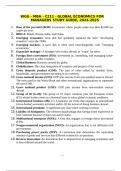
WGU - MBA - C211 - GLOBAL ECONOMICS FOR
MANAGERS STUDY GUIDE, 2024-2025
1. Base of the pyramid (BOP): Economies where people make less than $2,000 per
capita per year.
2. BRICA: Brazil, Russia, India, and China.
3. Emerging economies: term that has gradually replaced the term "developing
countries" since the 1990s.
4. Emerging markets: A term that is often used interchangeably with "emerging
economies."
5. Expatriate manager: A manager who works abroad, or "expat" for short.
6. Foreign direct investment (FDI): Investment in, controlling, and managing value-
added activities in other countries.
7. Global Business: Business around the globe.
8. Globalization: The close integration of countries and peoples of the world.
9. Gross domestic product (GDP): The sum of value added by resident firms,
households, and governments operating in an economy.
10. Gross national income (GNI): GDP plus income from non-resident sources abroad.
The term used by the World Bank and other international organizations to supersede
the term GNP.
11. Gross national product (GNP): GDP plus income from non-resident sources
abroad
12. Group of 20 (G-20): The group of 19 major countries plus the European Union
(EU) whose leaders meet on a biannual basis to solve global economic problems.
13. International business (IB): (1) A business (or firm) that engages in international
(cross-border) economic activities and/or (2) the action of doing business abroad.
14. International premium: A significant pay raise when working overseas.
15. Liability of foreignness: The inherent disadvantage that foreign firms experience in
host countries because of their non-native status.
16. Multinational enterprise (MNE): A firm that engages in foreign direct investment
(FDI).
17. Nongovernmental organization (NGO): An organization that is not affiliated with
governments.
18. Purchasing power parity (PPP): A conversion that determines the equivalent
amount of goods and services that different currencies can purchase.
19. Reverse innovation: An innovation that is adopted first in emerging economies and
is then diffused around the world.
, .
20. Risk management: The identification and assessment of risks and the preparation to
minimize the impact of high-risk, unfortunate events.
21. Scenario planning: A technique to prepare and plan for multiple scenarios (either
high or low risk).
22 Semiglobalization: A perspective that suggests that barriers to market integration at
borders are high, but not high enough to insulate countries from each other completely.
23. Triad: North America, Western Europe, and Japan.
24. Purchasing power parity (PPP): adjustment made to the GDP to reflect differences
in the cost of living
25. The bottom billion: Concentrated in Africa and Central Asia - 58 small countries,
stuck at the bottom in terms of growth, incomes and human development 26.
Enhance employability & advance career, better preparation to be expat,
competence in interacting with foreign
suppliers/partners/competitors/employees: Why study global business?
27. Institution-based view: A core perspective. Success and failure of firms are
constrained by institutions
28. Formal rules: requirements that treat domestic and foreign firms as equals enhance
the potential odds
for foreign firms' success or those that discriminate against foreign firms, would
undermine the chances for foreign entrants
29. Informal rules: cultures, ethics, and norms play an important part in shaping the
success and failure of firms around the globe
30. Resource-based view: A core perspective. Success and failure of firms is
determined by their environment
31. New force in recent times, a long-running historical evolution, a pendulum
swinging between extremes: What are the three views of globalization?
32. "Four Tigers": Hong Kong, Singapore, South Korea and Taiwan
33. Absolute advantage: The economic advantage one nation enjoys that is absolutely
superior to other nations.
34. Administrative policy: Bureaucratic rules that make it harder to import foreign
goods.
35. antidumping duty: Tariffs levied on imports that have been "dumped" (selling
below costs to "unfairly" drive domestic firms out of business).
36. Balance of Trade: The aggregation of importing and exporting that leads to the
country-level trade surplus or deficit.
37. Classical trade theories: The major theories of international trade that were
advanced before the 20th century, which consist of (1) mercantilism, (2) absolute
advantage, and (3) comparative advantage.
, .
38. Comparative advantage: Relative (not absolute) advantage in one economic
activity that one nation enjoys in comparison with other nations.
39. Deadweight cost: Net losses that occur in an economy as a result of tariffs.
40. Export: Selling abroad.
41 Factor endowment: The extent to which different countries possess various factors of
production such as labor, land, and technology.
42. Factor endowment theory: A theory that suggests that nations will develop
comparative advantages based on their locally abundant factors.
43. Heckscher-Ohlin theory: Another name for factor endowment theory
44. First-mover advantage: Advantage that first movers enjoy and do not share with
late entrants.
45. Free trade: The idea that free market forces should determine how much to trade
with little or no government intervention.
46. Import: Buying from abroad.
47. Import quota: Restriction on the quantity of imports.
48. Import tariff: A tax imposed on imports.
49. Infant industry argument: The argument that if domestic firms are as young as
"infants," in the absence of government intervention, they stand no chances of
surviving and will be crushed by mature foreign rivals.
50. Local content requirement: A requirement stipulating that a certain proportion of
the value of the goods made in one country must originate from that country.
51. Merchandise: Tangible products being traded.
52. Modern trade theories: The major theories of international trade that were
advanced in the 20th century, which consist of (1) product life cycle, (2) strategic
trade, and (3) national competitive advantage of industries.
53. Nontariff barrier (NTB): Trade barrier that relies on nontariff means to discourage
imports.
54. Opportunity cost: Cost of pursuing one activity at the expense of another activity,
given the alternatives (other opportunities).
55. Product life cycle theory: A theory that accounts for changes in the patterns of trade
over time by focusing on product life cycles.
56. Protectionism: The idea that governments should actively protect domestic
industries from imports and vigorously promote exports.
57. Resource mobility: Assumption that a resource used in producing a product for one
industry can be shifted and put to use in another industry.
58. Services: Intangible services being traded.
MANAGERS STUDY GUIDE, 2024-2025
1. Base of the pyramid (BOP): Economies where people make less than $2,000 per
capita per year.
2. BRICA: Brazil, Russia, India, and China.
3. Emerging economies: term that has gradually replaced the term "developing
countries" since the 1990s.
4. Emerging markets: A term that is often used interchangeably with "emerging
economies."
5. Expatriate manager: A manager who works abroad, or "expat" for short.
6. Foreign direct investment (FDI): Investment in, controlling, and managing value-
added activities in other countries.
7. Global Business: Business around the globe.
8. Globalization: The close integration of countries and peoples of the world.
9. Gross domestic product (GDP): The sum of value added by resident firms,
households, and governments operating in an economy.
10. Gross national income (GNI): GDP plus income from non-resident sources abroad.
The term used by the World Bank and other international organizations to supersede
the term GNP.
11. Gross national product (GNP): GDP plus income from non-resident sources
abroad
12. Group of 20 (G-20): The group of 19 major countries plus the European Union
(EU) whose leaders meet on a biannual basis to solve global economic problems.
13. International business (IB): (1) A business (or firm) that engages in international
(cross-border) economic activities and/or (2) the action of doing business abroad.
14. International premium: A significant pay raise when working overseas.
15. Liability of foreignness: The inherent disadvantage that foreign firms experience in
host countries because of their non-native status.
16. Multinational enterprise (MNE): A firm that engages in foreign direct investment
(FDI).
17. Nongovernmental organization (NGO): An organization that is not affiliated with
governments.
18. Purchasing power parity (PPP): A conversion that determines the equivalent
amount of goods and services that different currencies can purchase.
19. Reverse innovation: An innovation that is adopted first in emerging economies and
is then diffused around the world.
, .
20. Risk management: The identification and assessment of risks and the preparation to
minimize the impact of high-risk, unfortunate events.
21. Scenario planning: A technique to prepare and plan for multiple scenarios (either
high or low risk).
22 Semiglobalization: A perspective that suggests that barriers to market integration at
borders are high, but not high enough to insulate countries from each other completely.
23. Triad: North America, Western Europe, and Japan.
24. Purchasing power parity (PPP): adjustment made to the GDP to reflect differences
in the cost of living
25. The bottom billion: Concentrated in Africa and Central Asia - 58 small countries,
stuck at the bottom in terms of growth, incomes and human development 26.
Enhance employability & advance career, better preparation to be expat,
competence in interacting with foreign
suppliers/partners/competitors/employees: Why study global business?
27. Institution-based view: A core perspective. Success and failure of firms are
constrained by institutions
28. Formal rules: requirements that treat domestic and foreign firms as equals enhance
the potential odds
for foreign firms' success or those that discriminate against foreign firms, would
undermine the chances for foreign entrants
29. Informal rules: cultures, ethics, and norms play an important part in shaping the
success and failure of firms around the globe
30. Resource-based view: A core perspective. Success and failure of firms is
determined by their environment
31. New force in recent times, a long-running historical evolution, a pendulum
swinging between extremes: What are the three views of globalization?
32. "Four Tigers": Hong Kong, Singapore, South Korea and Taiwan
33. Absolute advantage: The economic advantage one nation enjoys that is absolutely
superior to other nations.
34. Administrative policy: Bureaucratic rules that make it harder to import foreign
goods.
35. antidumping duty: Tariffs levied on imports that have been "dumped" (selling
below costs to "unfairly" drive domestic firms out of business).
36. Balance of Trade: The aggregation of importing and exporting that leads to the
country-level trade surplus or deficit.
37. Classical trade theories: The major theories of international trade that were
advanced before the 20th century, which consist of (1) mercantilism, (2) absolute
advantage, and (3) comparative advantage.
, .
38. Comparative advantage: Relative (not absolute) advantage in one economic
activity that one nation enjoys in comparison with other nations.
39. Deadweight cost: Net losses that occur in an economy as a result of tariffs.
40. Export: Selling abroad.
41 Factor endowment: The extent to which different countries possess various factors of
production such as labor, land, and technology.
42. Factor endowment theory: A theory that suggests that nations will develop
comparative advantages based on their locally abundant factors.
43. Heckscher-Ohlin theory: Another name for factor endowment theory
44. First-mover advantage: Advantage that first movers enjoy and do not share with
late entrants.
45. Free trade: The idea that free market forces should determine how much to trade
with little or no government intervention.
46. Import: Buying from abroad.
47. Import quota: Restriction on the quantity of imports.
48. Import tariff: A tax imposed on imports.
49. Infant industry argument: The argument that if domestic firms are as young as
"infants," in the absence of government intervention, they stand no chances of
surviving and will be crushed by mature foreign rivals.
50. Local content requirement: A requirement stipulating that a certain proportion of
the value of the goods made in one country must originate from that country.
51. Merchandise: Tangible products being traded.
52. Modern trade theories: The major theories of international trade that were
advanced in the 20th century, which consist of (1) product life cycle, (2) strategic
trade, and (3) national competitive advantage of industries.
53. Nontariff barrier (NTB): Trade barrier that relies on nontariff means to discourage
imports.
54. Opportunity cost: Cost of pursuing one activity at the expense of another activity,
given the alternatives (other opportunities).
55. Product life cycle theory: A theory that accounts for changes in the patterns of trade
over time by focusing on product life cycles.
56. Protectionism: The idea that governments should actively protect domestic
industries from imports and vigorously promote exports.
57. Resource mobility: Assumption that a resource used in producing a product for one
industry can be shifted and put to use in another industry.
58. Services: Intangible services being traded.


